
Safe Outdoor LED Screen for Public Events

Before you rent or buy an outdoor LED screen for public events, understand one thing: the screen is only as reliable as the power, rigging, and signal chain behind it. The difference between indoor and outdoor LED is not just brightness; it is thermal load, wind pressure, ingress protection, and crowd safety.
Table of Contents
- 1. Match Pixel Pitch to Viewing Distance
- 2. Set Brightness for Direct Sunlight and Night Modes
- Daylight vs. Night Brightness Settings
- 3. Build Redundant Power and Weather Protection
- 4. Route Signal with a Media Server and Processor
- Build a Redundant Signal Path
- 5. Plan Permits, Rigging, and Safety Clearances
- 6.Crowed management and sightlines
- 7. Protect Outdoor LED Screens from Wind
- What IP rating does an outdoor LED screen for public events need?
- How much power does an outdoor LED screen for public events use?
- Can I use an indoor LED screen outdoors for a short event?
- How do I keep an outdoor LED screen for public events cool in hot weather?
- What is the difference between a mobile LED trailer and a ground-stacked outdoor LED screen for public events?
- Conclusion
Many event teams discover this the hard way when a bright midday panel washes out or a rain shower trips a breaker. This guide breaks down five practical decisions that determine whether your screen stays visible and safe from setup to strike.
You will learn how to match pixel pitch to viewing distance, set daylight and night brightness, protect the system outdoors, route reliable signal, and handle permits and rigging. Each section ends with one action you can take before your next site walk.
Outdoor led display for rental usage-TW VISION PQ series
1. Match Pixel Pitch to Viewing Distance
Pixel pitch is the distance in millimeters between the centers of two adjacent LED pixels, and it decides how close your crowd can stand before the image looks blocky. When you spec an outdoor LED screen for public events, start with the closest viewer, not the total square footage.
A screen that is 20 feet wide may look impressive, but if fans are only 10 feet away, a coarse 10mm pitch will read as visible dots rather than a smooth picture.
Consider a city food festival where the LED wall sits just behind the stage barrier. If the closest spectator is 12 feet away, a 4mm or 5mm pitch panel keeps text and sponsor logos sharp; a 10mm panel would force you to push the screen farther back or raise it above sightlines.
An outdoor LED screen for public events viewed from 50 feet or more can use a coarser pitch without losing perceived sharpness.
| Pixel pitch range | Typical minimum viewing distance | Best use | Action to take |
|---|---|---|---|
| 2.5–4mm | 8–15 ft | Close-stage screens, sponsor walls | Verify front access and pixel density |
| 5–8mm | 15–50 ft | Festival side screens | Ask for module-level calibration |
| 10–20mm | 50+ ft | Large stadium or distant bleachers | Prioritize brightness over resolution |
How to apply this: Measure the closest audience point, convert that distance to a millimeter pitch using the manufacturer’s minimum-viewing-distance chart, and choose the nearest available pitch one step finer than the minimum.
2. Set Brightness for Direct Sunlight and Night Modes
Brightness, measured in nits, is the first thing an audience notices when the sun comes out. An outdoor LED screen for public events needs several times more light output than an indoor display. Manufacturer spec sheets commonly list outdoor panels at 5,000 nits or higher, with high-brightness designs exceeding that threshold for full-sun use.
Compare that with indoor panels, which run far lower because they never face direct sunlight.
Consider a summer parade route where the screen faces west at 3 p.m. A panel that looked bright at dawn may be unreadable by mid-afternoon. Plan for the worst sun angle, and place the screen in shade or use a brighter panel orientation.
Daylight vs. Night Brightness Settings
For an outdoor LED screen for public events, brightness should be scheduled as a timeline, not left at one setting.
– Daytime preset: run near rated peak brightness, but keep headroom to avoid overdriving modules.
– Dusk preset: dim to a level readable without blinding nearby residents or drivers.
– Rain/overcast: use a mid preset to reduce power draw and heat.
A processor such as Brompton Technology lets you set global brightness and per-panel calibration from a laptop, so you are not climbing the structure to adjust modules.
How to apply this: Ask the vendor for a noon-sun brightness reading at the exact panel orientation, and program three brightness presets in the processor before load-in.
3. Build Redundant Power and Weather Protection
Temporary outdoor power is the most common cause of LED wall failure at public events. An outdoor LED screen for public events is a temporary electrical installation, not a plug-and-play monitor.
Generator power can drift in voltage and frequency as other loads switch on and off, and a single power cord shared with a food vendor or stage audio can trip at the worst time.
The National Fire Protection Association publishes NFPA 70, the National Electrical Code, which requires ground-fault circuit-interrupter protection for temporary outdoor wiring used at events. That protection exists to shield workers and the public from shock hazards. You can review the code requirements on the NFPA website.
In one case, a municipal market used a portable LED trailer without checking the generator’s neutral-ground bonding. The screen booted, then shut down repeatedly until an electrician corrected the ground path. Before an outdoor LED screen for public events goes live, have a licensed electrician verify generator grounding, load balance, and GFCI protection.
– Use IP65 front and IP54 rear cabinets as a minimum.
– Tilt the screen or add a rain cap to keep water from pooling on top.
– Elevate power connections above expected flood water.
How to apply this: Create a one-page power plan that lists total panel amperage, generator size, grounding method, and the location of every GFCI-protected circuit.
Outdoor rental usage LED screen-TW VISION PI series.
4. Route Signal with a Media Server and Processor
The signal chain is the hidden path that turns a laptop playlist into a synchronized wall of video.
When you run an outdoor LED screen for public events, use a two-part chain: a media server for playback and an LED processor for pixel mapping. Resolume is a real-time media server that many VJs and event crews use to mix clips, logos, and live camera feeds. Brompton Technology makes Tessera processors that handle per-panel calibration and diagnostics.
For large multi-screen shows, disguise adds timeline-based control and 3D preview.
A common scenario is a holiday light show where the same content must play across one main LED wall and two narrow side screens. A media server lets you map one composition to all three outputs, so the edit stays synchronized without creating separate files.
An outdoor LED screen for public events that relies on a single HDMI cable is one loose connector away from a black screen.
Build a Redundant Signal Path
– Run primary and backup signal lines on separate network switches.
– Keep the processor and media server behind a UPS.
– Test the chain with full-white and full-red patterns before gates open.
How to apply this: Ask the video vendor to label the signal flow from laptop to media server to processor to receiver card, then run a 30-minute loop test before the public arrives.
5. Plan Permits, Rigging, and Safety Clearances
Wind, crowd flow, and emergency access decide whether your screen is approved, not just whether the picture looks good. An outdoor LED screen for public events acts like a sail. Engineers calculate wind loads using standards such as ASCE 7, and a large wall can require ballast, ground anchors, or additional truss bracing.
The screen’s weight is only part of the load; wind pressure often controls the design.
A downtown festival application was delayed because the producer submitted only the screen manufacturer’s specs, not the engineer-stamped rigging drawing. The city required the drawing before issuing the temporary use permit. Most cities treat an outdoor LED screen for public events as a temporary structure, so permit triggers apply.
– Confirm the screen structure is rated for the event’s maximum expected wind.
– Keep emergency egress clear of power cables and rigging.
– Place barriers to prevent crowd contact with hot power supplies.
Every outdoor LED screen for public events should be installed by a crew that can produce a site-specific safety plan, not a generic template.
How to apply this: Contact the local building or fire marshal at least 30 days before the event and ask exactly which stamped drawings, permits, and inspections are required for a temporary LED wall.
6. Crowd Management and Sightlines
Audience Safety Around Screen Installations
A large screen may attract viewers who congregate nearby, creating pinch points. Plan for:
– Safe distances between screens and the audience based on screen size and potential collapse zones,
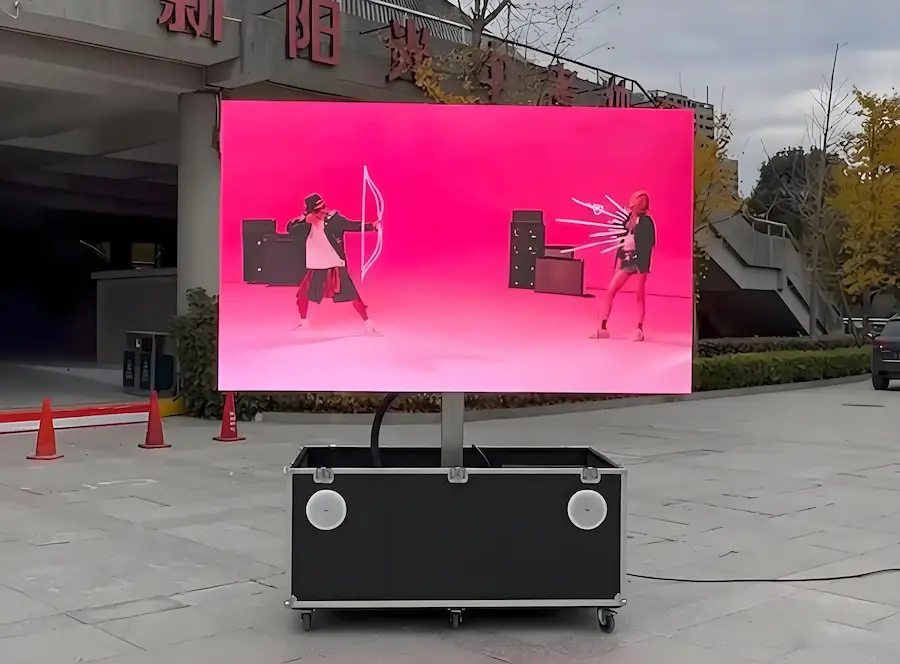
– Barriers to prevent unauthorized access to the screen’s base or trailer,
– Clear signage and lighting for night events,
– Adequate stewards and security personnel around the screen.
Optimizing Sightlines and Accessibility
Ensure the screen placement maximizes viewing while avoiding overcrowding:
– Use sightline analysis to determine screen height and tilt,
– Provide accessible viewing areas for people with disabilities,
– Consider multiple screens or delays to serve dispersed audiences.
Comfort and safety are intertwined: an over-congested viewing area increases risk.
7. Protect Outdoor LED Screens from Wind
How to protect outdoor LED screens from wind is a decision you should make before installation, not after a storm warning. Wind force does not scale in a straight line: when wind speed doubles, the pressure on a flat panel roughly quadruples because dynamic pressure rises with the square of velocity.
Waterproofing and temperature control get most of the attention, but wind load is often the first structural stress to crack a frame, loosen anchor bolts, or twist an LED cabinet. The challenge is that a screen can look stable while its mounting system is already flexing beyond the tested limit.
Match the Mounting Structure to the Wind Load
Even a well-rated LED cabinet will fail if the steel frame and anchor bolts are under-specified. This is where many installers forget how to protect outdoor LED screens from wind: they size the frame for the weight of the screen, not for the horizontal wind force that pushes against its face.
Wind applies a bending moment to the mounting pole or wall, so the structure needs both strength and stiffness.
Use SkyCiv Structural 3D or similar structural software to model the screen as a surface area, not a point weight. The software can compute reactions, bending moments, and bolt demands for your local gust speed. Structural bolts such as ASTM A325 are commonly specified for steel connections because they have a known minimum tensile strength.
On a large display, oversized washers and base plates help spread the load and reduce pull-through on the cabinet.
A stamped design is a real proof point when someone asks how to protect outdoor LED screens from wind in a high-gust zone. How to apply this: have a licensed structural engineer stamp the mounting design against the local basic wind speed, and schedule an annual check of anchor bolt torque.
Add Wind Deflection or Shielding Where Possible
Shielding strategies can reduce direct pressure, but they must be designed carefully. A solid wall in front of a screen can create turbulence behind the wall and may not reduce total load the way you expect. When you evaluate how to protect outdoor LED screens from wind, use computational fluid dynamics or wind testing rather than guesswork.
Dlubal RWIND Simulation and similar tools can model how wind flows around the panel and the proposed shield. Porous screens or louvered panels can break up gust impact, but they add their own load and may obstruct viewing. The right shield depends on the display’s orientation, height above ground, and local gust direction.
This design step is often skipped by teams trying how to protect outdoor LED screens from wind with a quick site fix. A common mistake is to bolt a solid sign board next to the LED wall and assume it will absorb the wind; more often it changes the airflow and creates new pressure zones.
| Approach | What it does | Action to take |
|---|---|---|
| Porous wind screen | Breaks gust impact without solid wall | Have an engineer model flow |
| Side fin or guide | Redirects wind around the panel | Check viewing angle first |
| Structural stiffener | Adds stiffness to the cabinet | Specify for front and rear pressure |
| Relocation or angle | Reduces exposed frontal area | Review mounting after code change |
| CFD simulation | Predicts pressure zones | Use before cutting steel |
Frequently Asked Questions About outdoor LED screen for public events
What IP rating does an outdoor LED screen for public events need?
When you specify an outdoor LED screen for public events, require IP65 on the front and at least IP54 on the rear. IP65 means dust-tight and protected against water jets, which matters for rain and wind-driven spray. If the screen sits near a fountain, coastline, or pressure washing, choose fully sealed cabinets with IP65 front and rear.
A temporary screen fully covered by a stage roof may use a lower rear rating, but the front must still handle weather.
How much power does an outdoor LED screen for public events use?
Power draw for an outdoor LED screen for public events varies by pixel pitch, brightness, and content. A fine-pitch wall at full white draws far more than a coarse-pitch wall showing dark video.
Ask the vendor for watts per square meter at the target brightness, then size the generator with headroom beyond the calculated load and separate circuits for processor, fans, and controls. In bright sunlight, peak draw may approach the panel’s maximum rating even if average content is not white.
Can I use an indoor LED screen outdoors for a short event?
It is not recommended even for a few hours. Indoor panels usually lack sealed cabinets, outdoor-rated power supplies, and sunlight-level brightness, so heat, dust, or a sudden shower can damage them quickly. A cool, fully shaded evening with no rain is the only low-risk exception, and only if the manufacturer confirms temporary outdoor use in writing.
For any real outdoor LED screen for public events, use an outdoor-rated product to protect the investment and the audience.
How do I keep an outdoor LED screen for public events cool in hot weather?
Thermal management starts with rear ventilation and shade. Keep the back of the cabinet open to airflow, use sunshields where possible, and avoid placing generators or fryers near the intake. Monitor cabinet temperature in the processor software, and lower brightness during peak heat if the vendor allows.
An outdoor LED screen for public events that runs thermally stable will last longer and avoid color shift. If the ambient temperature exceeds the panel’s rated operating range, shut down during the hottest hour.
What is the difference between a mobile LED trailer and a ground-stacked outdoor LED screen for public events?
A mobile LED trailer is self-contained, usually with the screen mounted on a truck or hydraulic trailer, so road closure and setup are faster. A ground-stacked outdoor LED screen for public events uses modular cabinets assembled on site and can be built wider or curved to fit a stage.
Trailers work well for one-day markets and parades; ground-stacked systems offer more flexibility for large festivals but require more labor, rigging, and space.
Conclusion
Every successful outdoor LED screen for public events comes down to five decisions: pitch, brightness, power, signal, and safety.
– Match pixel pitch to the closest viewer, not the screen width.
– Program daylight and night brightness presets before the event starts.
– Treat the screen as a temporary electrical and structural installation.
– Route redundant signal through a media server and LED processor.
– Submit engineer-stamped rigging and permit drawings early.
Your next step is to request the photometric and wind-load data sheets from the screen vendor, then schedule a site walk with your production lead and local fire marshal. Put these five secrets into your checklist, and your next public event screen will stay visible, safe, and on schedule.
Related Articles
- Outdoor LED Screen Atlanta: 15 : A Complete Buying Guide
- https://www.cstwvision.com/rental-led-display-supplier-in-the-usa/
- https://www.cstwvision.com/outdoor-led-screen-rental/
- https://www.cstwvision.com/outdoor-led-screen-for-concerts/