

Bendable LED display manufacturers: custom screens & installation support

Bendable LED display manufacturers: custom screens & installation support aren’t a single product line; they’re the full system you need to evaluate before buying curved LED modules.
According to TrendForce’s latest LED display supply chain research, flexible and bendable modules have moved from trade-show prototypes to standard catalog options. Yet, many buyers still treat them like rigid panels when planning installation.
Table of Contents
- What Makes Bendable LED Modules Different from Rigid Cabinets
- How to Evaluate a Bendable LED Display Manufacturer Beyond the Datasheet
- Custom Screen Engineering: Radius, Pixel Pitch, and Module Mapping
- Matching Pixel Pitch to Viewing Distance
- Mapping Curved Modules in the Processor
- Installation Support That Prevents On-Site Failures
- Comparing Custom Screen Quotes and Long-Term Support
- How do I know if a bendable LED module can handle my required curve radius?
- Can bendable LED screens be used outdoors?
- What control system works best for curved LED walls?
- How much spare module inventory should I keep?
- What is the most common mistake in bendable LED installation?
- Conclusion
That leads to cracked masks, dead pixel rows, and content that tears at the seam. The five checks below are the fast, practical ways to evaluate a supplier before you sign a purchase order.

What Makes Bendable LED Modules Different from Rigid Cabinets
– Bendable LED: A bendable panel has a limited adjustment range and is often built on a rigid circuit board with hinge or bend zones. You can adjust it during installation, but every material has a rated bend radius.
– Flexible LED: A flexible panel uses a plastic or thin-film substrate and can conform to columns, waves, or curved walls. It is usually thinner and lighter than a rigid cabinet.
– Curved LED: A curved panel is fixed at a set radius before it ships. It is not meant to be reshaped on site.
| Factor | Bendable LED | Flexible LED | Curved LED | What to check |
|---|---|---|---|---|
| Substrate | Rigid PCB with bend zones | Plastic or thin-film | Metal or rigid board | Bend radius spec |
| Shape change | User-adjustable | Conforms to surfaces | Fixed curvature | Installer adjustability |
| Typical use | Foldable, articulated | Columns, wearables | Fixed video walls | Project shape needs |
| Durability risk | Hinge fatigue | Crease damage | Cracking if forced | Flex-cycle rating |
Bendable LED modules use a flexible printed circuit board and a compressible mask, which allows them to follow concave or convex curves—but only within a rated radius. Rigid cabinets are built around a fixed frame, so they fit flat walls well but leave gaps or protrusions on curved substrates.
LED module manufacturers list minimum bend radius values for both concave and convex installation, and these limits vary by pixel pitch, mask thickness, and solder joint design. Exceeding the rated radius in the field is a common cause of dead pixel rows and mask warping.
Consider a lobby column with a 600 mm radius. A module rated only for 1000 mm will appear to mount correctly but may crack along the solder joints after thermal cycling or vibration.
When you evaluate a bendable LED display manufacturer: custom screens & installation support requirements should be requested at the same time as the bend radius. A supplier that cannot state both values clearly is not ready for a custom curved project.
How to apply this: ask for a signed radius diagram and physically flex one sample module on the actual substrate before you approve production.
How to Evaluate a Bendable LED Display Manufacturer Beyond the Datasheet
A manufacturer’s datasheet is not enough; you need to verify factory quality, support response, and control system compatibility before ordering custom screens. Check for UL or CE safety certifications, IP ratings that match the environment, and real case studies with contactable references.
According to Brompton Technology, processor-level geometry correction is required for LED panels mounted on curved surfaces. That means your chosen processor must support per-tile rotation, scaling, and masking—not just basic brightness controls.
In one case, a buyer chose a low-cost manufacturer and received modules that used a proprietary control protocol. The installation team could not map content across the curve without replacing receiving cards, which erased the initial savings.
A qualified bendable LED display manufacturer: custom screens & installation support team will provide a receiving card profile that works with your chosen processor. Use NovaStar NovaLCT or VMP software to confirm that each module responds to mapping commands.
You should also ask for a factory audit report or a video walkthrough of the production line. A supplier that refuses a sample module test is often hiding inconsistent solder joints or mask tolerances.
How to apply this: request one sample module and run it through your own control system before committing to a full custom screen order.
Custom Screen Engineering: Radius, Pixel Pitch, and Module Mapping
Custom curved screens fail most often when the pixel pitch, module size, and bend radius are treated as separate choices instead of one geometry problem. You need to match pixel pitch to the closest viewing distance, then confirm that the module size can follow the curve without visible faceting.
Matching Pixel Pitch to Viewing Distance
Tighter pixel pitch improves perceived sharpness on curved surfaces, but it also increases data load and can reduce brightness. A close-up retail window needs a finer pitch than a stage backdrop viewed from 30 meters.
Ask a bendable LED display manufacturer: custom screens & installation support engineer to run a viewing-distance simulation with your CAD file. If the simulation shows visible gaps at the seams, the module mask may need a softer edge.
Mapping Curved Modules in the Processor
A bent LED wall without processor geometry correction will stretch content at the edges and create uneven gaps. Mapping tools like MadMapper can help align pixel space, but the LED processor still needs a matching receiving card profile.
The table below summarizes what to check before you approve custom screen drawings.
| Evaluation factor | What to check | Action to take |
|---|---|---|
| Minimum bend radius | Concave and convex values in mm | Compare with CAD radius; request a test report |
| Pixel pitch | Available pitch for bendable modules | Match closest viewing distance |
| Module size | Width, height, and mounting depth | Confirm curve coverage without faceting |
| Control compatibility | Receiving card and processor profile | Test one module with NovaStar or Brompton |
| IP rating | Front and rear protection class | Match indoor, outdoor, or covered use |
| Installation documentation | Wiring, shims, and seam tolerances | Ask for a written checklist |
A bendable LED display manufacturer: custom screens & installation support specialist should map every module position in the CAD model before production. That step catches radius conflicts, power routing issues, and seam misalignment before they ship.
How to apply this: generate a radius map of your curved surface and send it to at least three manufacturers for a technical quote.
Installation Support That Prevents On-Site Failures
The best way to avoid dead modules and misaligned content is to require installation support as part of the purchase, not as a paid add-on after delivery. Support can include remote debugging, on-site supervision, pre-shipment assembly, and a written wall-substrate tolerance guide.
Many installation failures happen at seams and corner modules because the installer forces a radius tighter than the module rating. A bendable LED display manufacturer: custom screens & installation support provider should flag those areas in the shop drawings before delivery.
A common scenario is a concave reception wall that passes bench testing but fails on site because the wall substrate has a 20 mm variance. Flexible mounting rails and adjustable shims can absorb that variance if planned in advance.

Core Components of Professional Installation
A professional installation service for TW VISION bendable screens typically includes:
– Site survey and feasibility assessment
– Structural and mounting design
– Power and data planning
– Pre-installation module preparation
– On-site mounting and mechanical alignment
– Electrical and network integration
– Calibration, color tuning, and software commissioning
– Safety certification, testing, and client training
– Documentation and preventative maintenance planning
Each of these components requires experienced personnel, specific tools (such as precision alignment jigs and spectroradiometers), and a project management process that coordinates multiple trades.
Site Survey and Feasibility: The Foundation of Success
The installation begins with a comprehensive site survey. Professionals inspect the intended mounting surface, load-bearing capacity, access points, HVAC conditions, lighting environment, and adjacency to fire suppression systems. For bendable screens, additional attention is paid to radius constraints, curvature continuity, and any nearby structures that could limit the desired form.
Key outcomes from the survey include:
– Structural capacity report and recommendations for reinforcements
– Environmental constraints (temperature, humidity, direct sunlight)
– Access and staging logistics
– Required permits and code compliance items
A detailed survey prevents costly surprises during installation and informs the engineering design.
Engineering and Mounting Design
TW VISION bendable screens are mounted using custom-engineered frames, flexible mounting rails, or modular chassis that allow precise curvature while maintaining module alignment and cable management. Professional installers will produce shop drawings that specify attachment points, fastener types, tolerances for curvature, and seismic or wind-load considerations for exterior installations.
Important engineering factors:
– Minimum and maximum curvature radii as specified by TW VISION
– Distributed load calculations to ensure the wall or supporting structure can carry the weight
– Vibration isolation in environments subject to movement
– Consideration for thermal expansion and maintenance access
Professionals coordinate with architects and structural engineers when anchor points could affect the building envelope.
Electrical, Power, and Network Integration
Bendable screens demand disciplined electrical planning. A certified electrician in the professional team will design power distribution consistent with local codes. Considerations include dedicated circuits, UPS or surge protection, grounding and bonding, and layout for power supplies or driver modules.
Network integration includes providing redundant network paths for content distribution, provisioning for management and monitoring, and securing remote access for firmware updates and diagnostics. In high-availability environments, professionals design failover strategies and power monitoring.
Module Handling, Pre-Assembly, and Protection
Bendable screen modules are delicate and valuable. Professional installers use static-safe handling, custom crating, and pre-assembly rigs to partially assemble the screen before hoisting into place. This minimizes time spent working at height and reduces the possibility of damage.
Pre-assembly tasks typically include:
– Firmware updates at bench level
– Module-level diagnostics and burn-in
– Cable labeling and harnessing
– Protective film applications where required
Pre-assembly reduces on-site work and improves overall quality control.
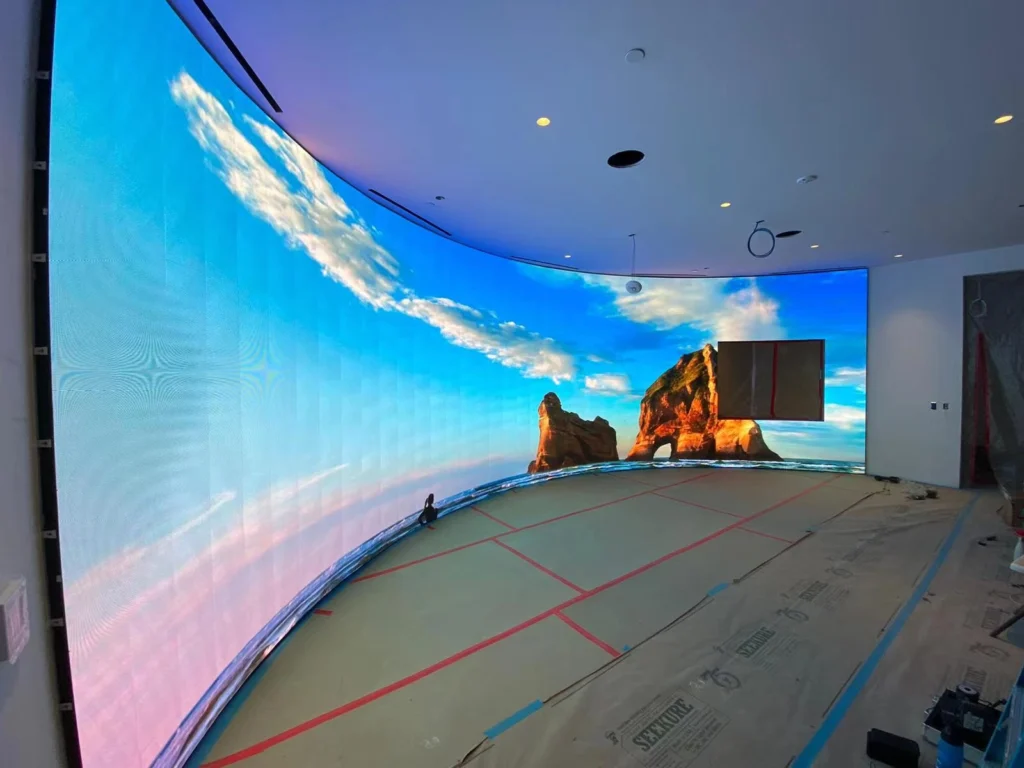
Precision Installation and Alignment
Alignment is where professional skill and tooling become critical. Unlike flat LED walls, bendable screens require meticulous module-to-module alignment across a three-dimensional curve. Installers use laser alignment tools, mechanical jigs, and adjustable mounting brackets to achieve seamless joints and correct pixel pitch continuity.
Crucial steps:
– Incremental curvature setting to avoid overstress
– Tight mechanical tolerance checks for gap and overlap
– Verification of cable strain relief and routing
– Continuous verification against the design curvature profile
Proper alignment eliminates visible seams, color inconsistencies, and potential mechanical strain over time.
Color Calibration and Software Commissioning
After physical installation, color uniformity and timing must be calibrated. Professionals use spectroradiometers and colorimeters to measure luminance, color temperature, gamma response, and chromaticity across the entire surface. TW VISION screens can be tuned at the module or sub-module level to achieve consistent color and brightness.
Commissioning tasks:
– Black-level and white-level calibration
– Gamma and color temperature tuning to client spec (e.g., D65, 6500K)
– Pixel mapping and scaling to native resolution
– Integration of content management and scheduling systems
Certification of calibration and a final acceptance test are standard deliverables.
Safety, Code Compliance, and Warranty Considerations
Professional installers ensure that the installation complies with all applicable building and electrical codes, fire safety regulations, and accessibility standards. They document anchor points, fire-rating interactions, and any penetrations in firewall-rated assemblies.
Factory warranties often require certified installation to remain valid. Professional installation ensures that the product is handled, mounted, and commissioned per TW VISION’s specifications, protecting the client’s investment and enabling prompt manufacturer support if issues arise.
Training, Handover, and Maintenance
A professional service includes client training on routine maintenance, emergency procedures, simple diagnostics, and the content management interface. Documentation—wiring diagrams, firmware versions, calibration files, and a maintenance schedule—is provided.
Planned maintenance might include:
– Periodic recalibration and pixel health checks
– Filter and ventilation maintenance (if enclosed)
– Firmware and software updates
– Routine mechanical inspections for fastener integrity and cable tensions
Ongoing maintenance contracts help preserve performance and value.
Cost Drivers and Timeline
Key cost drivers for a professional installation include:
– Complexity of curvature and custom frame fabrication
– Extent of structural reinforcement or modifications
– Access constraints and need for scaffolding or lifts
– Pre-installation testing and burn-in time
– Degree of calibration and content integration needed
– Travel and logistics for specialist technicians
A typical mid-sized project timeline—from initial survey to final commissioning—ranges from 4 to 12 weeks, depending on custom fabrication, permitting, and coordination with other trades.
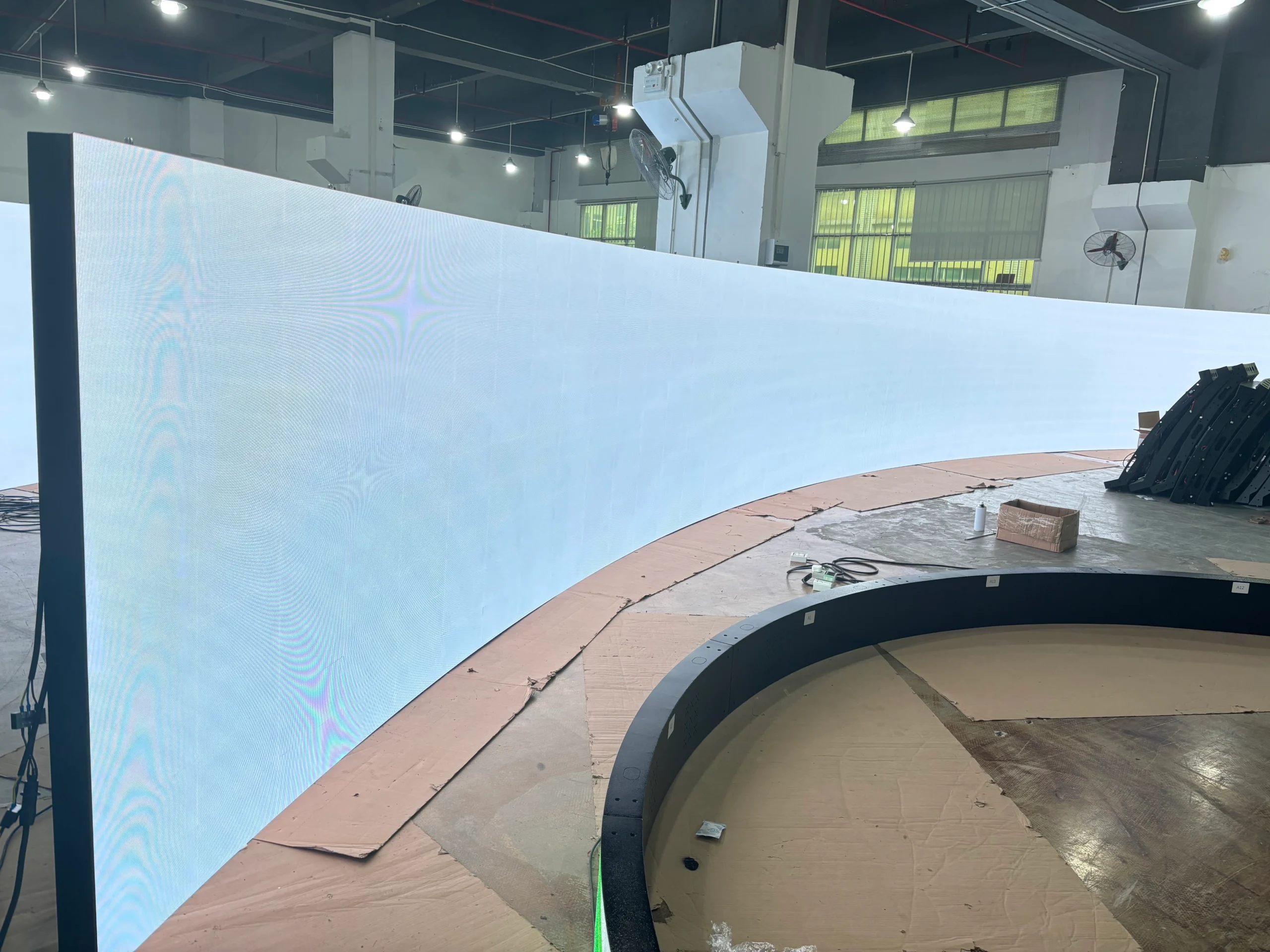
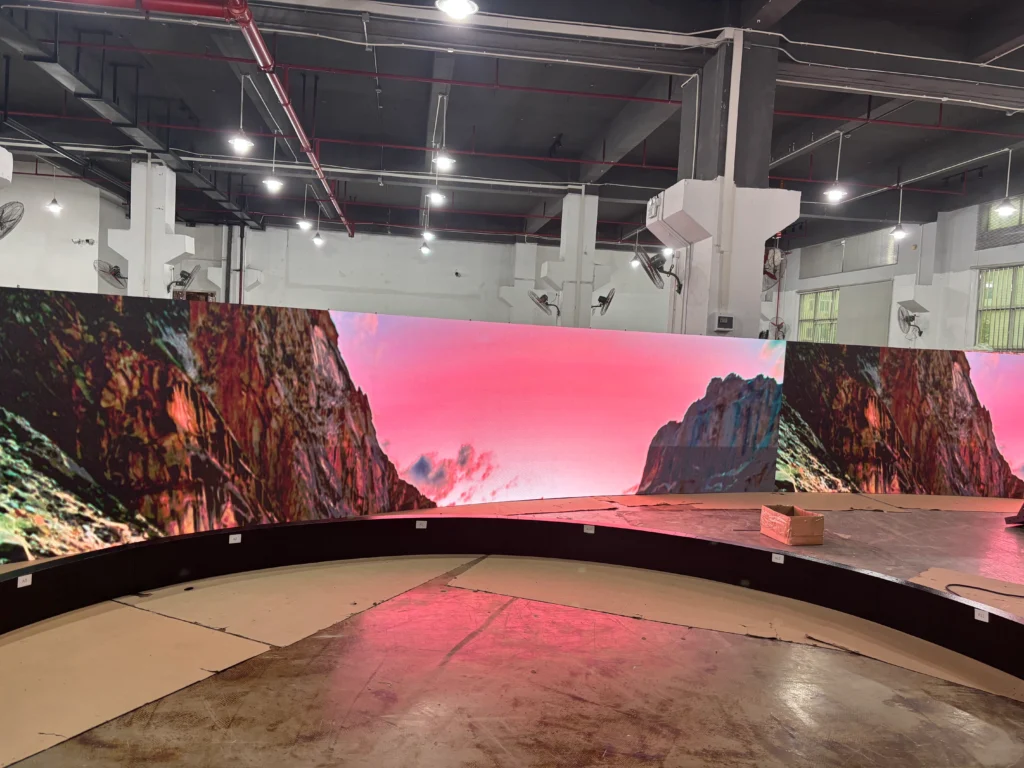
TW VISION manufacturer project case
Installation location: IL, USA
Radius: 13.72m(45ft)
Screen size: 14.08×4.96m(46.2×16.273ft)
Module qty: 44x31pcs
Module size:320x160mm
Pixel: 1.9
Refresh Rate: 7680HZ
Broadcast usage
Power: 110-240V auto, CE UL
Control System: NOVASTAR H5
Manufacture picture during production
The bendable led display project aging in TW VISION‘s factory.
Comparing Custom Screen Quotes and Long-Term Support
Compare quotes by total system cost, not by per-module price, because custom bent screens carry support and spare-part costs that cheaper vendors may not disclose. A low per-panel price often hides a proprietary control system or missing installation documentation.
When you shortlist a bendable LED display manufacturer: custom screens & installation support should be a weighted criterion, not an afterthought. Ask for a line-item quote that separates modules, receiving cards, power supplies, spares, and support hours.
In one museum installation, the lowest bid did not include spare modules or remote support. The final cost exceeded the higher bid after two service calls, because the owner had to pay for expedited replacement modules and an outside integrator.
Processor compatibility is another hidden cost. Some bendable modules only work with one receiving card brand, which can lock you into a single supplier for future replacements.
Check whether the manufacturer can provide a full spare-module kit at the time of purchase. A bendable LED display manufacturer: custom screens & installation support partner should recommend a spare quantity based on your curve geometry and usage environment.
How to apply this: build a three-column comparison sheet with price, support scope, and spare-module lead time before choosing a bid.
Frequently Asked Questions About Bendable LED Display Manufacturer: Custom Screens & Installation Support
How do I know if a bendable LED module can handle my required curve radius?
Ask the bendable LED display manufacturer: custom screens & installation support documentation for the rated minimum concave and convex radius. If your CAD model shows a tighter curve, the mask may buckle or solder joints may crack over time. One exception is a shallow curve that only stresses one axis, but that still needs a physical sample test.
Always flex one module on the actual substrate before production.
Can bendable LED screens be used outdoors?
Yes, but only if the module carries the right IP rating for your environment. A bendable LED display manufacturer: custom screens & installation support provider should confirm whether the flexible modules are rated IP65 front and rear for full outdoor exposure.
In a covered walkway, IP43 front protection may be enough, but rear sealing still matters because condensation collects behind curved modules. Inspect the gasket and seal design before you approve the outdoor installation.
What control system works best for curved LED walls?
Use a processor with per-tile geometry correction, such as NovaStar or Brompton Technology. A bendable LED display manufacturer: custom screens & installation support team should load the correct receiving card profile for your specific module. If you use a basic sender box without curve mapping, content may tear at the seam or stretch at the edges.
Test a single module with your processor before deploying the full wall.
How much spare module inventory should I keep?
Most permanent curved installations keep spare modules equal to about 2 to 5 percent of the total tile count, but custom bendable modules often have longer lead times. Ask a bendable LED display manufacturer: custom screens & installation support provider for the replacement lead time before you order.
In one museum case, a curved corner module required six weeks to re-manufacture, so the owner kept four extra tiles. For event use, keep more spares because damage risk is higher.
What is the most common mistake in bendable LED installation?
Forcing a module beyond its rated radius is the biggest mistake. A bendable LED display manufacturer: custom screens & installation support manual will list a maximum curve, and exceeding it can cause mask deformation and dead pixels. Another mistake is skipping processor geometry correction, which leaves seams visibly misaligned.
In a retail concave display, content looked correct at the center but stretched at the edges until the processor profile was updated.
Conclusion
– Choose a supplier that provides a rated bend radius, not just a flexible module photo.
– Verify processor compatibility with real tools like NovaStar or Brompton Technology.
– Require installation support and a written checklist before modules ship.
– Compare quotes by total system cost, including spares and support hours.
Your final decision should weigh a bendable LED display manufacturer: custom screens & installation support as a complete system, not a per-module price. Start by sending your CAD radius map to three suppliers and requesting a sample module with a receiving card profile.
