Understanding COB Packaging Technology Key to Durability and Image Quality in LED Roll Up Screens

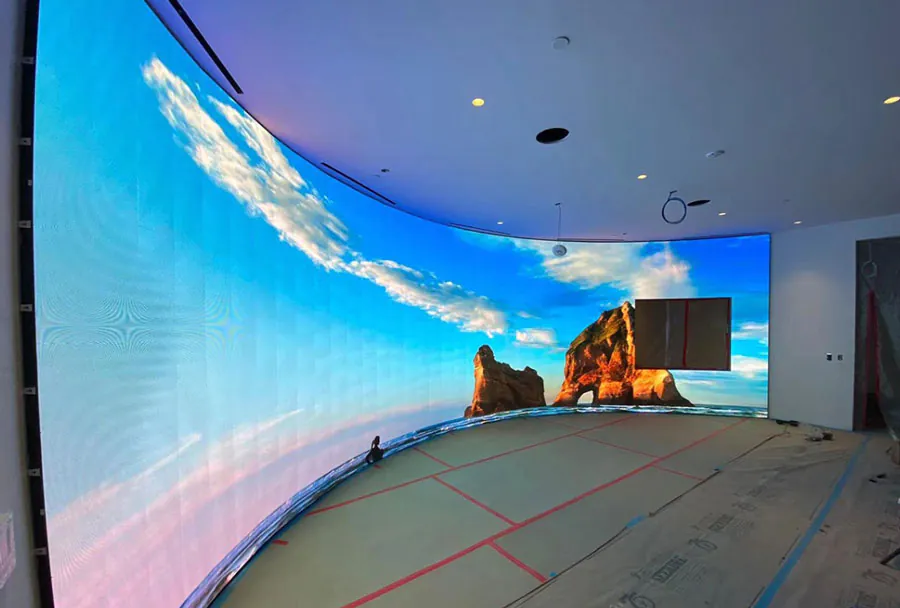
Flexible, roll-up LED screens are gaining traction across rental events, retail installations, and architectural applications because they combine portability with large-format visual impact. Yet the advantages of a thinnable, rollable display can be undermined by early failures or compromised image fidelity unless the LED packaging and assembly are engineered for both resilience and optics. Chip-on-Board (COB) packaging has emerged as a strong contender to address those challenges. This article explains how COB works, why it matters for roll-up LED systems, and what manufacturers, integrators, and buyers should evaluate to ensure both long-term durability and excellent image quality.
Understanding COB Packaging Technology Key to Durability and Image Quality in LED Roll Up Screens
What is COB and why is it different?
COB (Chip-on-Board) refers to a packaging approach in which bare LED dies are mounted and directly bonded onto a substrate (typically a flexible or rigid printed circuit), then encapsulated with protective materials. Unlike conventional SMD (Surface-Mount Device) packages, which place LEDs inside a discrete plastic or ceramic package with leads, COB eliminates the individual packaging step and results in a lower profile, higher fill factor, and closer proximity between dies.
For roll-up led displays, the result is a thinner, lighter pixel module with reduced mechanical stress at the interconnects. That said, the differences go beyond thickness: COB alters thermal paths, mechanical behavior under flex, moisture ingress risk, and optical control — all of which influence durability and image performance.
How COB enhances durability in roll-up screens
– Mechanical robustness: With dies directly bonded and encapsulated, COB removes solder joints and component bodies that are common failure points on flexing panels. The encapsulant distributes mechanical stresses more evenly across the die and substrate, reducing micro-cracking and detachment under repeated rolling cycles.
– Reduced profile and strain: The lower component height reduces bending radius constraints. This allows tighter rolling without concentrated strain at the LED package edges, cutting down on delamination and conductor fatigue.
– Improved moisture and dust resistance: Properly formulated encapsulation and edge-sealing methods create a more continuous barrier than multiple discrete packages with crevices. This decreases risk of moisture-induced corrosion and short circuits — crucial for rental gear exposed to variable environments.
– Thermal reliability: COB designs often enable a more direct thermal path from the die to the substrate and heat spreaders, easing heat accumulation that accelerates lumen depreciation and color shift.
However, durability gains depend on execution: encapsulant chemistry, adhesion to flexible substrates, edge sealing, and how connector interfaces are designed all determine real-world longevity.
How COB improves image quality
– Higher fill factor: Eliminating the package outline and keeping dies closer together increases the active-emitting area per pixel. This improves perceived resolution and uniformity, especially at close viewing distances.
– Better optical uniformity: With controlled potting and a smoother surface, diffusion and scattering of light can be more consistent across a module. That reduces hot spots and non-uniform color/brightness that are common in poorly packaged SMD arrays.
– Color consistency and binning advantages: COB allows tighter placement of RGB or RGBW dies and potentially better matching thermally and optically, minimizing chromatic shifts across the screen. It also supports finer control of phosphor placement for white LEDs.
– Smaller pixel pitch feasibility: Because COB reduces package size constraints, manufacturers can achieve smaller pitches with fewer assembly complexity issues, enabling finer-grain imagery in roll-up formats.
Optical design choices—microlens arrays, secondary diffusion layers, and anti-reflective coatings—further determine contrast, viewing angle, and color gamut.
Key technical considerations and trade-offs
– Encapsulant selection: Silicone and epoxy are common choices. Silicone typically offers superior flexibility and thermal stability, while epoxies can provide excellent adhesion but may crack under repeated bending. The encapsulant must balance elasticity, UV stability, refractive index, and adhesion to the flexible substrate.
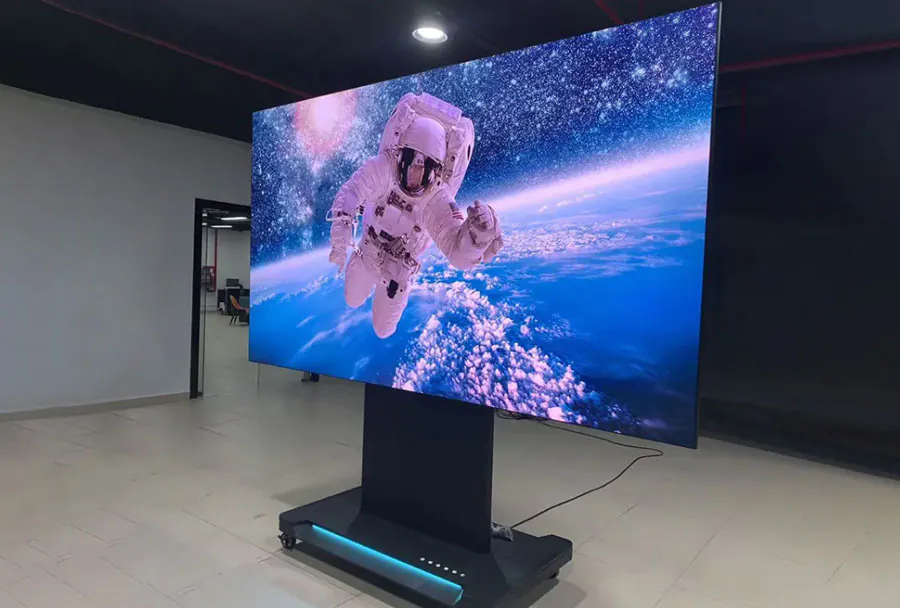
– Thermal management: COB reduces thermal interfaces, but flexible substrates often have poorer thermal conductivity than rigid metal-core PCBs. Integrating lightweight metal heat spreaders, thermally conductive layers, or strategically placed thermal vias during module lamination helps maintain LED junction temperatures.
– Repairability: COB modules are generally less serviceable at the component level than SMD modules, because dies are encapsulated and direct replacement is more difficult. Design for modularity — using replaceable roll-up strips or panels — mitigates field-repair challenges.
– Manufacturing precision: Accurate die placement, uniform encapsulation thickness, and clean reflow-free bonding are critical. Process control and optical metrology are necessary to ensure pixel-level uniformity.
– Cost: COB can reduce BOM and assembly steps, but requires investment in die-bonding tools, encapsulation processes, and quality control. For high-volume or premium segments, the lifecycle advantages often justify the upfront cost.
Comparison table: COB vs SMD for roll-up LED applications
| Feature | COB | SMD | Impact on Durability | Impact on Image Quality |
|---|---|---|---|---|
| Mechanical profile | Low, thin encapsulated dies | Higher, discrete package bodies | Lower strain concentration; better flex life | Enables tighter pixel arrangement, smoother surface |
| Thermal path | Direct die-to-substrate path | Heat passes through package then PCB | Better heat dissipation if substrate/heat spreader used | Reduced thermal-induced color shift if cooled |
| Moisture protection | Continuous encapsulation/edge seal | Gaps around packages; additional potting needed | Lower ingress risk with proper sealing | Fewer localized degradation zones; steadier brightness |
| Repairability | Lower (encapsulated dies) | Higher (replaceable packages) | May require panel/strip replacement strategy | Potentially more cost-effective to maintain uniformity |
| Manufacturing complexity | High precision die-bonding and encapsulation | Established SMT processes | Requires strict QA to avoid hidden defects | Enables higher fill factor and smaller pitch |
Design, manufacturing, and quality-control best practices
– Substrate and heat-spreader engineering: Use hybrid constructions (flex substrate laminated to thin metal foils or thermally conductive films) to improve heat dissipation without sacrificing rollability.
– Encapsulant specification: Define the elastic modulus, Tg, UV resistance, and refractive index to match mechanical and optical goals. For rental and outdoor use, prioritize low-hygroscopic silicones with UV stabilizers.
– Edge sealing and connector design: Ensure seams, cable entries, and connector joints are protected with flexible potting, gaskets, or folded barriers to prevent ingress during rolling and unrolling.
– Process monitoring: Implement optical inspection (AOI), thermal cycling, and flex fatigue testing during production. Track lumen maintenance (Lx decay) and color shift across burn-in cycles.
– Modular architecture: Design modules as replaceable strips or panels so individual defective sections can be swapped without scrapping the entire roll-up assembly.
– Environmental testing: Perform salt spray, humidity-temperature cycling, and mechanical roll/unroll tests that replicate expected field use cycles.
What buyers and specifiers should ask for
– Flex-cycle rating: Request test data showing the number of roll/unroll cycles the module can withstand before measurable pixel failure or delamination.
– Thermal characterization: Ask for junction temperature versus ambient at typical operating brightness and duty cycle.
– Optics and uniformity metrics: Require measurements for luminance uniformity, color deviation (ΔE), and viewing-angle performance.
– Ingress protection and material specs: Get details on encapsulant chemistry, edge sealing methods, and any IP rating claims along with test reports.
– Repair strategy: Clarify what components are field-serviceable and ensure spare-module availability or swap procedures.
– Warranty terms: Examine what the warranty covers (e.g., pixel failures, burn-in, color shift) and duration for rental vs fixed installations.
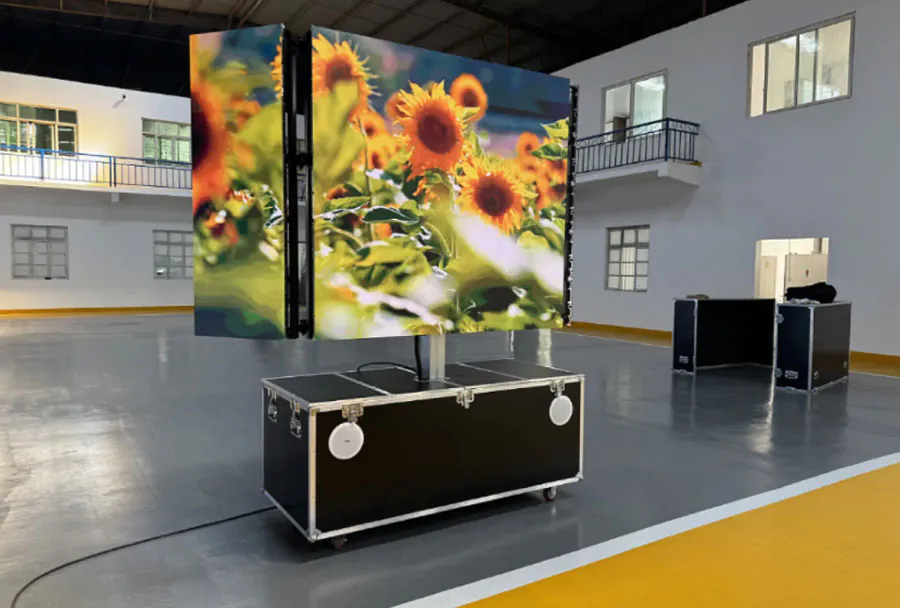
Field maintenance and lifecycle considerations
Routine care should focus on preventing mechanical abuse, avoiding sharp bending beyond the specified minimum radius, and protecting seams from particulates and liquids. For rental use, implement pre- and post-event inspection routines to catch early signs of wear: micro-cracking in encapsulant, loose connectors, or module edge delamination. Record usage cycles to plan preventive replacement of high-stress modules before visible degradation appears.
For installations expected to last many years, factor in LED lumen depreciation and color drift into brightness specification so that long-term performance meets audience expectations without excessive overdrive that increases thermal stress.
COB packaging delivers compelling advantages for LED roll-up screens by enabling thinner assemblies, improving mechanical resilience under flex, and enhancing pixel-level optical uniformity. However, its benefits are realized only through careful material choice, thermal engineering, and manufacturing control. Buyers and specifiers should evaluate flex-cycle data, thermal performance, encapsulant chemistry, and repairability to ensure a solution that balances portability with durable, high-quality imagery. When properly implemented, COB-based roll-up LED modules offer a robust platform for high-impact visual experiences across events, retail, and architectural applications — combining the convenience of flexible form factors with the visual standards audiences expect.