

Large LED Screen Buying Guide: Types, Applications & Key Specs

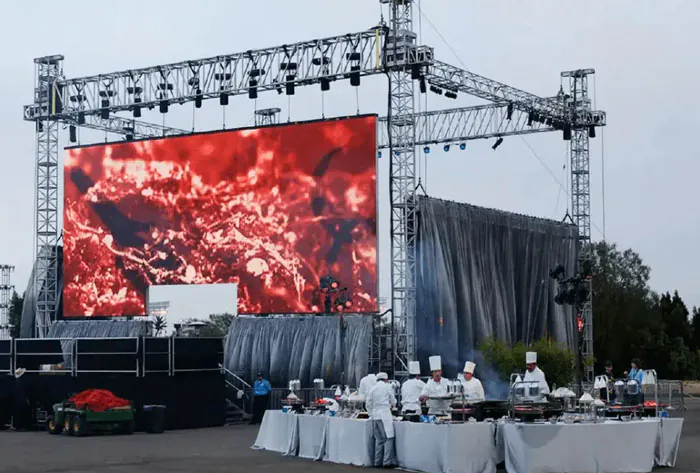
Large LED Screen Buying Guide: Types, Applications & Key Specs starts with an uncomfortable truth: the most expensive screen is not the right screen if its pixel pitch, brightness, and service access do not match your actual viewing conditions.
Table of Contents
- The 3 Core LED Screen Types You Must Compare
- Real-World LED Screen Applications by Industry
- Key Specifications That Decide Price and Performance
- Pixel Pitch and Minimum Viewing Distance
- Brightness and IP Rating
- How to Match Pixel Pitch, Brightness, and Viewing Distance
- When Content Type Changes the Pitch Rule
- Site Planning, Control Systems, and Installation Essentials
- What is the difference between SMD and COB LED screens?
- How far should viewers stand from a large LED screen?
- Do I need a special controller for a large LED screen rental?
- Can large LED screens work in direct sunlight?
- What is the typical lifespan of a large LED screen?
- Conclusion: Making the Right Large LED Screen Decision
A surprising fact for many first-time buyers is that two LED panels of the same physical size can differ dramatically in price and clarity because one uses a finer pixel pitch. The core problem is spec confusion: buyers compare watts, nits, and millimeters without first defining use case, ambient light, and maintenance access.
This guide breaks down LED types, real applications, and the key specs that drive price and performance. You will also get a practical comparison table, control-system names, and immediate steps to take before you request a quote.
TW VISION made front desk screen,TW VISION the professional manufacture for led screen.
The 3 Core LED Screen Types You Must Compare
Buyers often start with size, but the Large LED Screen Buying Guide: Types, Applications & Key Specs decision path should start with panel technology. Most large LED screens fall into three categories: DIP, SMD, and COB.
– DIP, or dual in-line package: used mainly for outdoor billboards where high brightness matters more than close-up image quality. DIP panels can be extremely bright but have larger gaps between pixels.
– SMD, or surface-mounted device: the workhorse for indoor video walls, retail displays, and many rental screens. SMD packs red, green, and blue diodes into a small package, giving good color mixing and a wide pitch range.
– COB, or chip on board: encapsulates diodes directly onto the PCB. COB offers better impact and moisture resistance, with fewer visible gaps and a smoother surface for close viewing.
Consider a shopping mall concourse with viewers 3 meters away. A 2.5mm SMD panel would handle that distance well; a 4mm DIP panel would look pixelated, while a 1.2mm COB panel might be overkill.
Whichever technology you lean toward, the Large LED Screen Buying Guide: Types、Applications & Key Specs path is simpler when you ask vendors for the minimum viewing distance each pitch can support.
How to apply this: Before requesting quotes, write down your closest viewer distance, then ask vendors to quote only panel types that work at that distance.
Real-World LED Screen Applications by Industry
Large LED screens serve different goals by industry. The Large LED Screen Buying Guide: Types、Applications & Key Specs treats application as the primary filter, because a church lobby screen and a roadside billboard have opposite requirements.
– Retail and corporate: indoor fine-pitch walls from 1.2mm to 2.5mm for close viewing in lobbies, command centers, and flagship stores.
– Broadcast and studio: high refresh rates and color accuracy, often using COB or fine-pitch SMD with 3840Hz refresh to avoid camera flicker.
– Sports and events: mobile or suspended panels that tolerate fast rigging, repeated setup, and moderate viewing distances.
– Outdoor advertising: high-brightness DIP or SMD panels with weather-sealed cabinets and 5,000+ nits.
A common scenario is a house of worship ordering a 3.9mm outdoor-rated panel for an indoor auditorium because it was cheaper, then finding it too dim for camera broadcast. Industry surveys consistently show that application mismatch, not panel quality, drives most buyer regret.
Applying the Large LED Screen Buying Guide: Types、Applications & Key Specs by application prevents buying a screen that works on paper but fails in the room.
How to apply this: List the three most important jobs your screen must do, then compare only panels that satisfy all three.
Key Specifications That Decide Price and Performance
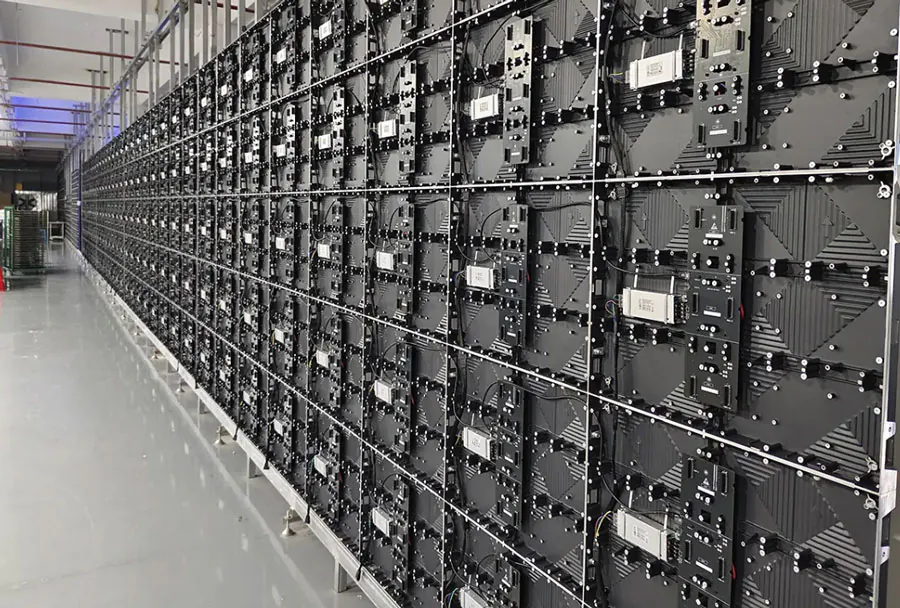
The Large LED Screen Buying Guide: Types、Applications & Key Specs cannot be complete without understanding the five specs that drive most quotes. Panel price rises sharply as pixel pitch shrinks, brightness rises, and refresh rates improve.
As AVIXA explains in its display guidance, pixel pitch is the foundational spec that determines how close a viewer can stand before noticing individual pixels.
| Spec | What it tells you | Action to take |
|---|---|---|
| Pixel pitch (mm) | Minimum viewing distance and image sharpness | Choose pitch based on closest viewer distance |
| Brightness (nits) | Visibility in ambient light | Indoor: 600–1500 nits; outdoor: 5,000+ nits |
| Refresh rate (Hz) | Flicker on camera | Require 3840Hz for broadcast or professional recording |
| IP rating | Dust and water resistance | Outdoor front: IP65 or higher; rear: IP54 minimum |
| Service access | Repair time and installation depth | Front service for flush-mounted walls |
Pixel Pitch and Minimum Viewing Distance
A clean Large LED Screen Buying Guide: Types, Applications & Key Specs comparison table keeps these five specs visible side by side. Pixel pitch is usually the first number to verify because it sets how close viewers can stand before the image breaks down into dots.
Model/SeriesPixel PitchBrightness (nits)Primary ApplicationKey Advantage
| TW VISION Series | Pixel Pitch | Brightness (nits) | Typical Applications | Key Advantage |
|---|---|---|---|---|
| FinePitch Series | 0.9–2.5 mm | 800–1,200 | Indoor lobbies, control rooms, corporate AV | High visual fidelity for close viewing |
| StandardPitch Series | 2.5–6 mm | 1,000–2,500 | Conference halls, retail displays, stages | Balanced cost and resolution for medium viewing distances |
| OutdoorPro Series | 6–16 mm | 4,000–7,000+ | Billboards, stadium screens, outdoor signage | High brightness and weather-resistant design |
| FlexibleCurve Series | 1.2–4 mm | 1,000–3,000 | Custom shapes, retail experiential installations | Curved and unconventional form-factor options |
| PixelPerfect Series | 0.7–1.5 mm | 800–1,500 | Visualization labs, broadcast studios, museum exhibits | Ultra-fine pixel pitch with broadcast-friendly refresh rates |
Brightness and IP Rating
Brightness is often overbought. An indoor board at 5,000 nits may create eye strain, consume more power, and cost more without improving readability. A common mistake is copying a spec sheet from an outdoor project into an indoor bid, then paying for brightness and weather sealing you do not need.
How to apply this: Build a one-page spec sheet with target pixel pitch, brightness, refresh rate, and IP rating before contacting suppliers.
How to Match Pixel Pitch, Brightness, and Viewing Distance
The practical rule within a Large LED Screen Buying Guide: Types、Applications & Key Specs is to convert viewing distance into pixel pitch. A widely used starting point is 1.5 to 2 meters of viewing distance per millimeter of pixel pitch.
– 1.2mm pitch: comfortable from about 1.8 to 2.4 meters
– 2.5mm pitch: comfortable from about 3.75 to 5 meters
– 4mm pitch: comfortable from about 6 to 8 meters
– 10mm pitch: comfortable from about 15 to 20 meters
If your closest viewer is 2 meters away, a 4mm panel will look noticeably pixelated. If your closest viewer is 20 meters away, a 2.5mm panel wastes budget. Brightness then adjusts for ambient light, while pixel pitch fixes the detail you can resolve.
The Large LED Screen Buying Guide: Types, Applications & Key Specs approach is to lock pitch first, then tune brightness.
When Content Type Changes the Pitch Rule
Content type also matters. Text-heavy dashboards need more pixels per square meter than video or abstract motion backgrounds. A fine-pitch panel may be justified for control rooms, while a coarser pitch works for brand imagery seen from a distance.
How to apply this: Measure your shortest and longest viewing distances, then use the 1.5–2 meter rule to narrow pitch options before design.
Site Planning, Control Systems, and Installation Essentials
The final part of a Large LED Screen Buying Guide: Types, Applications & Key Specs is the control layer. Many buyers budget for panels but forget the video processor, spare modules, and service access. NovaStar and Brompton Technology are two commonly used control platforms. NovaStar processors handle mapping, calibration, and redundancy in many LED video walls.
Brompton processing is often specified in high-end broadcast and rental projects for color accuracy and HDR support.
Before installation, verify three physical details. First, check wall load capacity and access for maintenance. Second, plan power and data cabling, including redundancy if the screen cannot be dark. Third, confirm front or rear service access: flush-mounted indoor walls usually need front-service panels.
A typical failure is a rear-service cabinet specified for a wall with no rear clearance, which can sharply increase maintenance labor and downtime.
Within a Large LED Screen Buying Guide: Types, Applications & Key Specs, control and service planning matter just as much as panel choice.
How to apply this: Ask your integrator for a complete bill of materials that includes processor, spare modules, cables, and a service plan—not just the LED tiles.
Frequently Asked Questions About Large LED Screen Buying Guide: Types、Applications & Key Specs
What is the difference between SMD and COB LED screens?
SMD places individual red, green, and blue diodes in a small package; COB encapsulates many diodes directly on the board. In the context of a Large LED Screen Buying Guide: Types、Applications & Key Specs, choose COB when you need better moisture resistance and fewer visible gaps; choose SMD for a wider range of available pitches and often lower initial cost.
Exception: some fine-pitch SMD panels now close much of the durability gap.
How far should viewers stand from a large LED screen?
A common starting point is 1.5 to 2 meters per millimeter of pixel pitch. A 2.5mm panel is comfortable from roughly 3.75 to 5 meters. In a Large LED Screen Buying Guide: Types、Applications & Key Specs, this rule prevents overbuying.
Exception: text-heavy content may require a longer distance or a finer pitch than video content does because small characters reveal pixelation more quickly.
Do I need a special controller for a large LED screen rental?
Yes, rental builds usually need a video processor or controller that can map tiles, adjust scaling, and lock frame rates. In a Large LED Screen Buying Guide: Types、Applications & Key Specs, confirm the processor can handle your input resolution and provide a backup signal path.
Exception: simple single-panel displays may run from an onboard media player, but multi-tile rentals rarely work reliably that way.
Can large LED screens work in direct sunlight?
Yes, but only with sufficient brightness. Outdoor screens typically need 5,000 nits or more; indoor screens often use 600 to 1,500 nits. For a Large LED Screen Buying Guide: Types、Applications & Key Specs, check front-facing IP rating and active cooling before installing in direct sun.
Exception: shaded outdoor areas may not need maximum brightness, but they still need weather protection and glare control.
What is the typical lifespan of a large LED screen?
Most manufacturers rate panels for tens of thousands of hours to half brightness. In a Large LED Screen Buying Guide: Types、Applications & Key Specs, treat lifespan as an estimate that assumes proper heat management and no physical impact. Exception: frequent 24/7 operation at maximum brightness may reduce useful life faster than the rated hours suggest, especially in high-temperature outdoor cabinets.
Conclusion: Making the Right Large LED Screen Decision
The Large LED Screen Buying Guide: Types、Applications & Key Specs should leave you with one principle: buy for viewing distance, ambient light, and maintenance access first, then compare panel price.
– Choose panel technology, DIP, SMD, or COB, by viewing distance and environment.
– Match pixel pitch using the 1.5–2 meter per millimeter guideline.
– Verify brightness, refresh rate, IP rating, and service access before signing.
– Include control hardware from suppliers like NovaStar and Brompton Technology in the budget.
Use the Large LED Screen Buying Guide: Types、Applications & Key Specs to create a one-page specification sheet with your closest viewer distance, target brightness, IP rating, and service access. Send that same sheet to at least three suppliers so quotes become directly comparable.
Related Articles
- 2026 Folable LED Screen Price: Cost Factors & Custom
- LED Display for home theater: buying guidance and tips
- LED Display for Gaming Rooms: 5 Best Secrets That Actually
