

Foldable LED Screen Price in 2026: Cost Factors and Custom Quotes

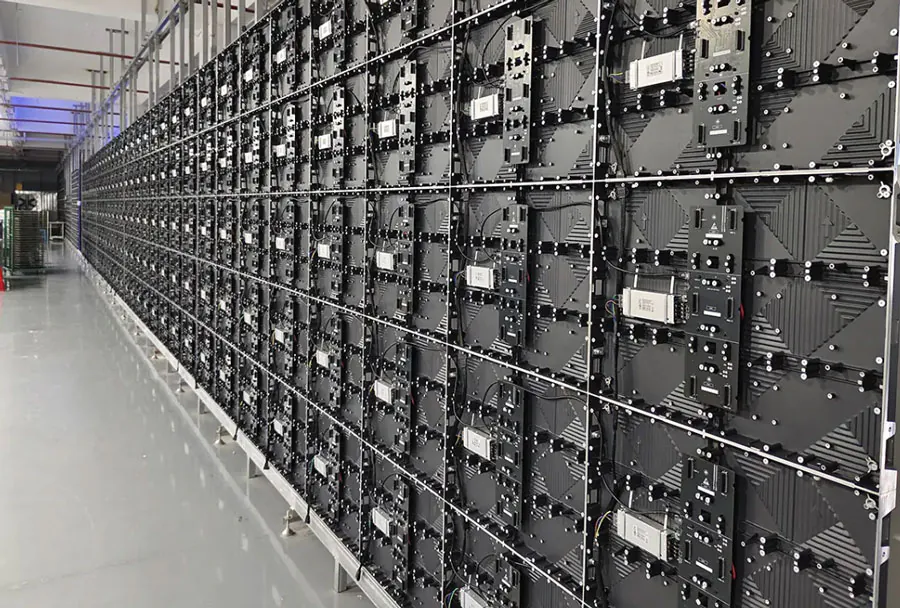
A foldable LED screen price in 2026 starts near $1,100 per square meter for a P2.5 tri-fold poster and climbs past $6,000 for fine-pitch custom work, so the headline number means little until you know what sits behind it. Two suppliers can quote the same pixel pitch and still land 40 percent apart, because hinge quality, tooling, LED binning and freight terms all move the total. That is why a foldable LED screen price should be read as a bundle of five variables rather than a single figure per square meter. This guide walks through those variables, shows where custom engineering changes the quote, and ends with a request-for-quotation template you can send to three suppliers the same day.
In this guide
What Determines a Foldable LED Screen Price in 2026
Pixel pitch is the single biggest lever behind any foldable LED screen price quote. Pitch measures the distance between individual LED clusters, written as P1.2, P2.5 or P3.9, and a smaller number means more LEDs packed into every square meter. More LEDs drive up the bill of materials and the number of driver chips required.
The effect is steep. Moving from P3.9 to P1.9 roughly quadruples the LED count in the same surface area, so per-square-meter pricing rises sharply even though individual LED components keep getting cheaper. TrendForce’s LEDinside division has tracked this shift toward fine-pitch and flexible form factors for several years, and its market reports remain the most widely cited benchmark for the trend.
A second cost layer sits in the fold itself. Each hinge or flex zone must carry signal across thousands of microscopic connections, and it must survive repeated folding without a single dead column. Cheap hinges show up first as seam lines, then as failed scan lines, which is why two P2.5 panels with identical pitch can differ by 30 percent.
A rental company that runs P3.9 in the field, for example, saves real money by keeping that pitch on secondary screens and reserving P2.5 for premium client work. Apply the same rule to any quote: ask for the exact pixel pitch, the LED count per square meter and the driver IC count before you compare totals, because those three numbers decide most of the difference.
Custom Solutions: Where the Quote Stops Being Standard
Custom engineering is the second biggest driver of a foldable LED screen price. Standard flat panels benefit from mass production and stable yields, while a custom foldable display carries tooling fees, low-volume assembly runs and specialized hinge hardware.
Contract manufacturers commonly charge a one-time tooling fee that ranges from a few hundred to several thousand dollars, depending on the fold mechanism and the radius of curvature. Fold direction matters as well: a simple one-way crease costs less to engineer than a multi-axis panel that folds both horizontally and vertically, because every additional axis multiplies the tolerance work.
A retail brand needed a curved foldable column wrap for a store rollout. The first quote included a $3,000 tooling fee, which dropped to $800 once the order grew from twelve to forty units, because the supplier amortized the engineering cost across more panels. The panels themselves barely changed; the order volume did all the work.
Therefore, ask two direct questions before signing. First, does the supplier amortize tooling across your full order volume, or bill it as a separate non-refundable line? Second, what is the volume breakpoint at which that fee disappears? Suppliers who answer both in writing tend to hold the price they quoted, and suppliers who dodge both tend to reopen the number later.
Price Ranges by Configuration
Placing your project inside a known range helps you spot outliers within minutes. The table below reflects commonly quoted ranges from manufacturer directories and recent project quotes, although exact figures still shift with order size, panel yield and currency moves.
| Configuration | Typical price range per m² | What to check | Action to take |
|---|---|---|---|
| Standard flat P3.9 | $600–$1,100 | Panel-to-panel consistency | Request a factory demo video |
| Foldable P2.5 | $1,100–$2,400 | Hinge cycle rating | Ask for 10,000+ fold test data |
| Custom curved P2.5 | $1,800–$4,000+ | Curvature tolerance | Negotiate shared tooling |
| Rental-grade foldable | $1,500–$3,200 | Frame weight and latch | Compare per-event cost |
| Fine-pitch P1.5 foldable | $2,800–$6,000+ | Heat dissipation design | Request a thermal report |
Every quote you receive should map onto one row before you compare offers. A supplier quoting far below the range for the same pitch usually cuts corners on LED binning, frame thickness or spare-part support, and those cuts surface as dead pixels after the second fold. A supplier quoting far above the range may simply be carrying inefficient production that you should not fund. Compare only inside the same row and pitch class, then let hinge data and warranty terms break the tie.
Manufacturing Region, Freight and Duties
Geography reshapes the number quietly, through labor rates, component tariffs and freight timing. Most foldable LED modules are assembled in Shenzhen and the surrounding Pearl River Delta, where dense supply chains keep base production costs low and component lead times short.
Landed cost tells a different story once you add air freight, ocean shipping, import duties and local certification. Some buyers purchase bare modules from a Shenzhen supplier and commission a local integrator for the folding frame and hinge work, which keeps duty low on the electronics while local labor handles the mechanical fit.
Others prefer a regional distributor who manages warranty replacements and on-site service in the local language. Google Trends data for foldable LED searches shows steady growth in North America and Europe, so more distributors now stock these panels locally instead of drop-shipping them.
A European AV firm importing from Asia may pay 8 to 25 percent in duties depending on tariff classification, plus value-added tax on the landed total. The same firm might receive a local distributor quote only 10 to 15 percent above factory price yet gain same-week replacement coverage, which usually beats the saving on a single failed panel. Ask for a landed-cost breakdown that lists FOB factory price, freight, insurance, customs duty and local VAT as separate lines, and use the official US tariff schedule to sanity-check any classification you are given.
Budgeting the Five-Year Total
The cost most buyers forget is total cost of ownership, and it decides whether a cheap foldable LED screen price stays cheap. A panel can look affordable on the purchase order and become expensive after power, spares and service time.
Fine-pitch foldable panels draw more power per square meter as LED density rises, and their flexible circuits often need more frequent maintenance than rigid boards. A three-year warranty therefore costs a modest premium against the panel price but avoids repair bills that can erase the initial saving entirely.
Spare modules matter just as much. Most suppliers recommend holding 2 to 3 percent of the total module count as backup inventory, especially for rental fleets that fold and ship panels every week. Negotiate that spare package at the same time as the main order, because buying spares later usually carries a minimum-order penalty.
Build a five-year budget with three columns before you compare vendors: purchase, energy and maintenance. Then add the installation extras that panel quotes rarely include, since a curved foldable wall normally needs custom brackets, flight cases, power distribution and commissioning labor. On most projects those items push the total 20 to 30 percent above panel cost, which is exactly the gap a sticker-price comparison hides. For the flat-panel baseline behind those numbers, see our LED screen panel price guide.
Frequently Asked Questions
How much does a small foldable LED screen cost in 2026?
A panel of roughly one square meter usually lands between $1,100 and $3,000, depending on pixel pitch and hinge quality, while larger custom walls scale differently. Expect tooling to dominate the quote for a one-off prototype.
Can I avoid paying separate tooling fees on a custom order?
Often, yes. Tooling typically disappears once an order crosses a supplier-defined threshold, commonly twenty to fifty units, because the supplier then recoups engineering across the batch. A buyer ordering two bespoke panels may find tooling costs more than the panels themselves.
Why do suppliers quote different prices for the same pixel pitch?
Pitch is only one line in the bill of materials. Chip brand, binning tolerance, driver ICs and PCB material all differ, and some suppliers add coating for outdoor durability. Request the full BOM and a sample module, then compare brightness and color consistency directly.
Is buying direct from China cheaper than a local distributor?
Factory pricing is usually lower on paper, yet landed cost plus warranty logistics can flip the math. Distributors often quote 10 to 15 percent above factory price but handle replacements in days. Buyers with in-house technicians usually gain from direct sourcing; buyers without them often recover the premium quickly.
What hidden costs should I plan for?
Expect spare modules, flight cases, power distribution, content software, custom brackets and commissioning labor. A curved wall may also need a structural review. Together these items typically add 20 to 30 percent to the panel price, so request a complete install-and-operate quote up front.
Conclusion
A foldable LED screen price comes down to five controllable variables: pixel pitch, customization depth, configuration class, sourcing region and total cost of ownership. Pitch sets the floor, tooling sets the ceiling, and landed cost decides which quote actually wins.
Your next step is a one-page request for quotation that lists pixel pitch, fold type, order volume, warranty term and a landed-cost breakdown as mandatory fields. Send the same document to a factory, a distributor and a local integrator, then compare responses inside the same table row. Once the fields match, the prices finally become comparable, and the cheapest quote stops being a guess. For flexible and foldable options by size, our flex screen price guide covers the adjacent range.
