

outdoor LED display for commercial advertising

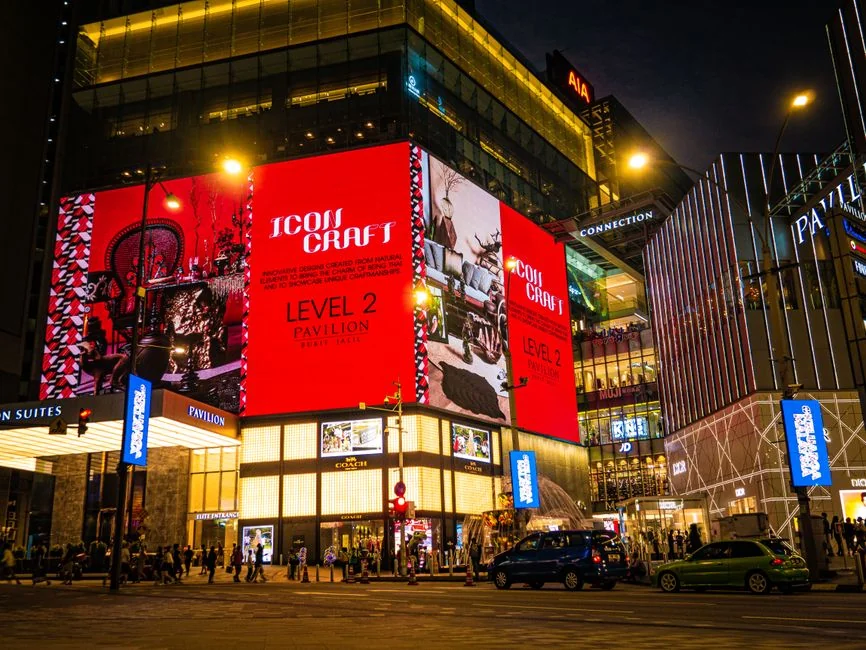
Selecting the right outdoor LED display for commercial advertising: choosing the right screen directly affects ad visibility, operating cost, and repair burden. According to the Out of Home Advertising Association of America, digital out-of-home continues to attract ad budgets because screens can update creative in near-real time and deliver measurable reach in high-traffic locations.
Table of Contents
- 1. Define Viewing Distance and Screen Size Before You Buy
- 2. Match Brightness and Contrast to the Installation Environment
- 3.Set Realistic Protection Ratings for Weather and Dust
- Front face vs. rear cabinet ratings
- Snow, ice, and coastal salt
- 4. Compare Pixel Pitch, Resolution, and Content Fit
- 5. Plan Thermal Management and Power Redundancy Before Installation
- 6. Design for DOOH Content, Proof-of-Play, and Connectivity
- Content proof and ad compliance
- Connectivity choices
- Make Service Access and Monitoring Part of the Buying Decision
- Compare Total Cost of Ownership
- How much does an outdoor LED display for commercial advertising cost per square meter?
- Can I use an indoor LED screen outdoors if it is under an awning?
- What is the best pixel pitch for a drive-by audience in commercial advertising?
- How do I comply with local sign codes when choosing an outdoor LED display?
- Who should install and service an outdoor LED display for commercial advertising?
- What is the difference between a billboard LED display and a typical DOOH screen?
- How bright should a roadside LED display be at night?
- Can an outdoor LED display for a commercial building run 24/7?
- What IP rating does an outdoor LED display need in rainy climates?
- How do you reduce glare on a roadside LED display?
- Conclusion
The problem for buyers is that price-focused comparisons often ignore the specs that separate a reliable direct-sun screen from one that washes out, fails inspection, or becomes a service headache. This guide breaks down practical checks that cover viewing distance, brightness, weatherproofing, pixel pitch, and total cost of ownership.

1. Define Viewing Distance and Screen Size Before You Buy
The first call you make in choosing the right outdoor LED display for commercial advertising: how to choose the right screen is measuring how far away your audience will be. A common out-of-home design rule treats 1 inch of letter height as readable from roughly 10 feet away, and many operators use that as a starting point for text-heavy ads.
If your primary viewer is a driver passing at 150 feet, a screen sized for a 30-foot pedestrian zone will not deliver legible text. The Out of Home Advertising Association of America points out that large-format digital displays perform best when creative is matched to the actual viewer distance and dwell time.
A well-sized outdoor LED display for commercial advertising: how to choose the right screen should let a driver read the key message without slowing down or squinting.
Billboard viewing distance
For billboards, start with viewing distance and vehicle speed. Drivers at highway speed have only seconds to read a message, so a coarse pitch and large text often outperform a high-resolution image.
One common scenario is a 10 mm or coarser billboard pitch that remains legible at 250 feet and costs significantly less per square meter than a 4 mm display.
Roadside and commercial building proximity
Roadside and commercial-building displays usually need a balance between resolution and cost. A storefront display viewed from sidewalks benefits from a finer pitch, while a commercial facade above an intersection may use a mid-range pitch.
Placement comparison at a glance
| Placement | Brightness need | Pixel pitch guidance | Action to take |
|---|---|---|---|
| Billboard | Very high for direct sun | Coarser pitch; long viewing distance | Confirm midday luminance |
| Roadside | High for mixed sun and shade | Medium pitch | Add automatic brightness control |
| Commercial building | Medium to high | Finer for close viewers | Check facade wind load and access |
| DOOH network | High contrast for video | Match viewer distance | Enable remote proof-of-play |
2. Match Brightness and Contrast to the Installation Environment
Brightness, measured in nits, is the first spec that separates a readable direct-sun screen from an outdoor LED display for commercial advertising: how to choose the right screen that disappears at noon. Manufacturer documentation from Samsung LED Displays shows outdoor direct-sun models rated for 5,000 nits or higher, while many indoor panels sit well below 1,500 nits.
The reason brightness matters more than resolution in direct sun is contrast. If ambient light overpowers the screen, even a fine-pitch panel becomes unreadable. A screen facing west may need higher afternoon brightness than one shaded by a building. Your actual sun path, not a generic bright-enough spec, should drive the decision.
That is why the right outdoor LED display for commercial advertising: how to choose the right screen includes brightness matched to the specific site orientation.
How to apply this: Walk the site at 11 a.m. and 2 p.m., note where sunlight hits the screen face, and request a photometric report or daytime demo before purchase.
3.Set Realistic Protection Ratings for Weather and Dust
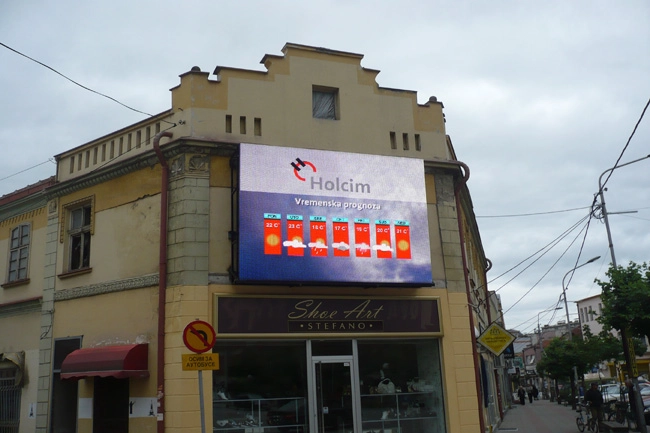
The IEC 60529 standard defines IP65 as dust-tight and protected against low-pressure water jets from any direction. Many roadside and commercial installations use an IP65-rated front face, while the rear cabinet may be IP54 if it is shielded inside a structure.
An Outdoor led display for Billboard、Roadside、Commercial Building、DOOH in a coastal or rainy climate usually benefits from a higher corrosion specification. Salt, humidity, and heavy rain test seals, connectors, and module gaskets. A billboard in Phoenix faces different risks than a roadside pole in Seattle, so the same generic IP rating is not enough.
When you compare quotes for an Outdoor led display for Billboard、Roadside、Commercial Building、DOOH, ask for the exact IP rating of both the front face and the rear cabinet. Do not assume that a single module rating covers the entire system. Gasketed seams, coated fasteners, and condensation drainage paths matter just as much as the number printed on the module.
Front face vs. rear cabinet ratings
The front face carries the weather load, but the rear cabinet still needs ventilation. Look for gasketed module seams, coated fasteners, and drainage paths that allow condensation to exit without pooling. In one case, an operator solved repeated module failures by moving to a ventilated cabinet with sealed driver compartments.
Snow, ice, and coastal salt
Sidewalk-level displays can collect snow and road spray. Coastal locations degrade standard steel frames quickly, so powder coating and stainless hardware matter as much as the module rating.
How to apply this: request the exact IP rating for the front face and the rear cabinet, and ask for a corrosion test certificate for your climate.
4. Compare Pixel Pitch, Resolution, and Content Fit
Pixel pitch determines the closest distance at which an outdoor LED display for commercial advertising: how to choose the right screen remains comfortable to view. Pixel pitch is the distance in millimeters between individual LED clusters.
A P4 panel has a 4 mm pitch and suits closer viewing, while a P10 panel has a 10 mm pitch and works better for longer distances.
The content you plan to run also affects pitch choice. A screen showing large logos and simple text can use a coarser pitch. A screen running detailed product images or video needs a tighter pitch or a larger panel to keep the image smooth.
Before you compare models, define the closest viewer, the most common content type, and the minimum readable text size. Then use those numbers to shortlist pitches.
| Specification | What it tells you | Action to take |
|---|---|---|
| Pixel pitch | Closest comfortable viewing distance | Match pitch to nearest audience |
| Brightness | Visibility under direct sun | Require 5,000+ nits for sunny faces |
| IP rating | Dust and water resistance | Verify IP65 front and rear rating |
| Refresh rate | Flicker-free footage on camera | Ask for 3840Hz or higher if filmed |
| Cabinet access | Repair speed and labor cost | Prefer front-service panels |
| Control software | Remote content scheduling | Demo the platform before purchase |
How to apply this: Create a shortlist of two or three pixel pitch options, then ask each vendor to show sample content at your actual viewing distance.
5. Plan Thermal Management and Power Redundancy Before Installation
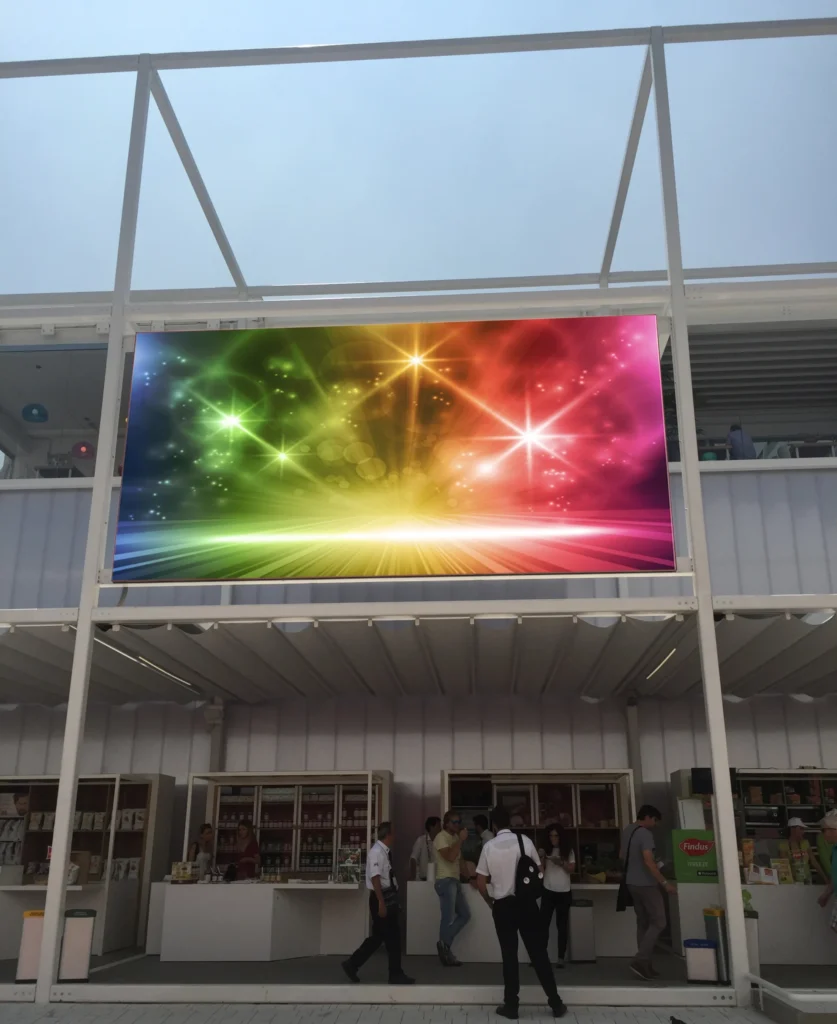
Heat shortens LED life and shifts color. A south-facing Outdoor led display for Billboard、Roadside、Commercial Building、DOOH can absorb far more solar energy than the same screen on a shaded wall, so cooling cannot be an afterthought. LED manufacturers typically rate module life only within a specified operating temperature range, and that assumes proper thermal design.
Passive cooling works for some moderate climates, but high-output direct-sun installations often need active ventilation or air conditioning. The real issue is internal temperature rise, not ambient temperature alone. A screen that exceeds its rated temperature may dim, shift color, or trigger a protective shutdown.
Power design matters just as much as heat. Roadside displays should include surge protection, isolation transformers, and enough service capacity for startup inrush current. A commercial building display may share an electrical panel with other tenant loads, so confirm the circuit can handle the screen plus any heating or cooling components.
A well-designed Outdoor led display for Billboard、Roadside、Commercial Building、DOOH will include a thermal management plan that accounts for local peak solar load. Ask the supplier to simulate the display in your orientation, not just quote a generic operating temperature.
How to apply this: request a thermal report showing maximum internal temperature at your local peak solar load, and verify the electrical panel has at least the manufacturer’s recommended service capacity plus surge protection.
6. Design for DOOH Content, Proof-of-Play, and Connectivity
A digital out-of-home screen is an advertising medium, so the content workflow matters as much as the glass and modules. According to the Out of Home Advertising Association of America, digital out-of-home includes advertising on digitally powered screens in public places, from roadside billboards to urban formats.
Buyers who ignore the DOOH workflow end up with a display that looks great but cannot run a compliant ad campaign.
An Outdoor led display for Billboard、Roadside、Commercial Building、DOOH needs network connectivity for scheduling, monitoring, and proof-of-play. Many operators use a media player with a content management system, and processors from companies such as NovaStar are widely used to drive the display. For larger networks, systems like Daktronics Venus Control Suite provide remote scheduling, diagnostics, and proof-of-play.
Content proof and ad compliance
Advertisers and media buyers often require proof that a spot actually played at the promised time. Your player should store play logs and send them to a central system, not just display a video file locally. For a networked Outdoor led display for Billboard、Roadside、Commercial Building、DOOH, this is especially important when the screen is part of a larger DOOH network.
Connectivity choices
Wired Ethernet is the first choice for reliability, but many roadside locations need cellular backup. Confirm that the cellular modem is industrial-grade and can fail over without losing the current playlist.
How to apply this: map the full content path from ad server to screen, and ask the supplier for a proof-of-play log sample before you buy.
7.Make Service Access and Monitoring Part of the Buying Decision
Maintenance cost often exceeds the original hardware cost over the life of an Outdoor led display for Billboard、Roadside、Commercial Building、DOOH. If the screen requires a lift truck and lane closure every time a module fails, the total cost of ownership rises quickly. A commercial building display in a pedestrian zone may require front-service modules and a safe working platform.
Remote monitoring is a non-negotiable requirement for most operators. You need to know about a failed power supply, a hot module, or a communication fault before the screen goes dark during a paid campaign. Processing platforms such as Brompton Technology provide detailed diagnostics and color control for high-end LED installations.
A common scenario is a roadside display with one failed module that is not replaced for weeks because the operator cannot identify the tile number. Remote monitoring can extend the useful life of an Outdoor led display for Billboard、Roadside、Commercial Building、DOOH by pinpointing the exact module and its status.
Spare module programs also shorten repair time, because LED batches can vary slightly in color after months of use.
How to apply this: ask the supplier for a front-service design, a remote monitoring demo, and a spare parts recommendation tied to your service radius.
Frequently Asked Questions About Outdoor LED Display for Commercial Advertising: How to Choose the Right Screen
How much does an outdoor LED display for commercial advertising cost per square meter?
Cost per square meter varies widely because pixel pitch, brightness, and cabinet type change the price. A coarse-pitch P10 screen may fall near the lower end, while a fine-pitch P4 or high-brightness screen costs substantially more.
One exception is a small order under 10 square meters, where setup and engineering fees may lift the per-square-meter price above a larger project’s rate. For an outdoor LED display for commercial advertising: how to choose the right screen, always compare quotations with the same pixel pitch and brightness.
Can I use an indoor LED screen outdoors if it is under an awning?
No, indoor LED panels generally lack sealed cabinets, high brightness, and outdoor-rated power supplies. Even under an awning, humidity and temperature swings can cause condensation, delamination, and warranty voiding. If the screen is fully enclosed in a climate-controlled display case, some operators use high-brightness indoor panels, but this is the exception.
For an outdoor LED display for commercial advertising: how to choose the right screen, insist on an IP-rated outdoor cabinet.
What is the best pixel pitch for a drive-by audience in commercial advertising?
For highway or arterial drive-by viewing at roughly 60 feet or more, many buyers use P8 to P16 panels, but this is not a fixed rule. If drivers stop at a traffic light within 30 feet, a P6 or P8 screen may read more smoothly.
The exception is a sign on a fast highway where only a bold logo must be legible; there a larger pitch can work. For an outdoor LED display for commercial advertising: how to choose the right screen, start from the closest real viewing distance.
How do I comply with local sign codes when choosing an outdoor LED display?
Local sign ordinances can limit screen size, brightness, dwell time, and whether animation is allowed. Some cities require a dimming schedule that lowers nighttime brightness to a set nit level. A screen that meets manufacturer specs can still fail a site permit if the sign code sets a lower brightness cap.
For an outdoor LED display for commercial advertising: how to choose the right screen, pull the municipal sign code before finalizing the model, not after installation.
Who should install and service an outdoor LED display for commercial advertising?
Use a factory-trained or vendor-approved installer who can provide a structural load report and wiring certification. One exception is a small wall-mounted screen under 10 square meters, where a licensed commercial sign contractor may be sufficient. A display that requires frequent front access will benefit from a local service partner.
For an outdoor LED display for commercial advertising: how to choose the right screen, secure a service agreement that includes spare modules and emergency response times.
What is the difference between a billboard LED display and a typical DOOH screen?
An Outdoor led display for Billboard、Roadside、Commercial Building、DOOH can serve different goals. Billboard displays are usually larger, viewed from long distances, and use coarser pixel pitch. A DOOH screen is often smaller and placed where people pause. One exception is a billboard inside a transit hub that behaves like a DOOH screen because viewers are closer and dwell time is longer.
How bright should a roadside LED display be at night?
outdoor LED display for commercial advertising should dim automatically at night. A display that is readable at noon is often blinding after sunset, and municipalities may fine operators for light trespass. One exception is a highway screen with no nearby homes, but automatic dimming remains the safer default for most locations.
Can an outdoor LED display for a commercial building run 24/7?
An outdoor LED display for commercial advertising can run 24/7 if thermal design, power redundancy, and service access are adequate. Continuous playback raises internal temperatures and shortens component life without proper cooling. A screen near a hotel may need an automatic mute or lower brightness overnight to meet local noise and light ordinances while still running content.
What IP rating does an outdoor LED display need in rainy climates?
In rainy climates, an outdoor LED display for commercial advertising should use at least IP65 on the front face and sealed connectors. Heavy wind-driven rain can defeat a lower rating. One exception is a screen mounted under a deep canopy, where IP54 may be acceptable because it is shielded from direct rainfall, but condensation and humidity still need drainage.
How do you reduce glare on a roadside LED display?
Glare is reduced by increasing contrast rather than raw brightness alone. An outdoor LED display for commercial advertising can use louvered modules, matte coatings, and automatic brightness control to stay legible without washing out.
A common mistake is pushing brightness so high that the screen creates its own halo at night; instead, test readability at the actual driver angle and distance.
Conclusion
– Measure viewing distance first, then match pixel pitch and screen size to that real-world range.
– Specify brightness for direct-sun or shaded conditions instead of relying on a generic outdoor model.
– Verify IP, IK, and thermal management ratings before comparing price.
– Compare three-year total cost, including spare modules, energy, and service labor.
Choosing an outdoor LED display for commercial advertising: how to choose the right screen should be treated as a three-to-five-year investment, not a one-time hardware purchase. Request written quotes from at least three vendors, then test sample content at your actual site before committing.
