

Outdoor LED Display for Retail: 5 Easy Secrets That Work

An outdoor LED display for retail is one of the most visible storefront upgrades a business can make. The biggest surprise for new buyers is that indoor brightness levels often fail outdoors. A screen built for a lobby can wash out completely in direct sun, while a properly specified outdoor panel stays readable from across the street.
Table of Contents
- 1. Match Brightness to Your Storefront Conditions
- 2. Pick the Right Pixel Pitch for Viewing Distance
- 3. Build a Content Plan That Stops Shoppers
- 4. Protect the Display From Weather and Heat
- 5. Measure Performance Without Guessing
- Do I need a permit for an outdoor LED display for retail?
- Can an outdoor LED display for retail run 24/7 without distracting drivers?
- What happens when one module goes dark on an outdoor LED display for retail?
- How does energy use compare between LED and old lightbox signs?
- Can I control several outdoor LED display for retail locations from one dashboard?
- Conclusion
The problem: retailers often choose on price, pixel count, or a vendor’s one-page spec sheet, without matching the display to actual storefront conditions. That leads to washed-out images, wasted energy, or a sign that fails inspection.
The following five secrets cover brightness, pixel pitch, content planning, weather protection, and performance measurement. Each section ends with one action you can apply before you buy or install.
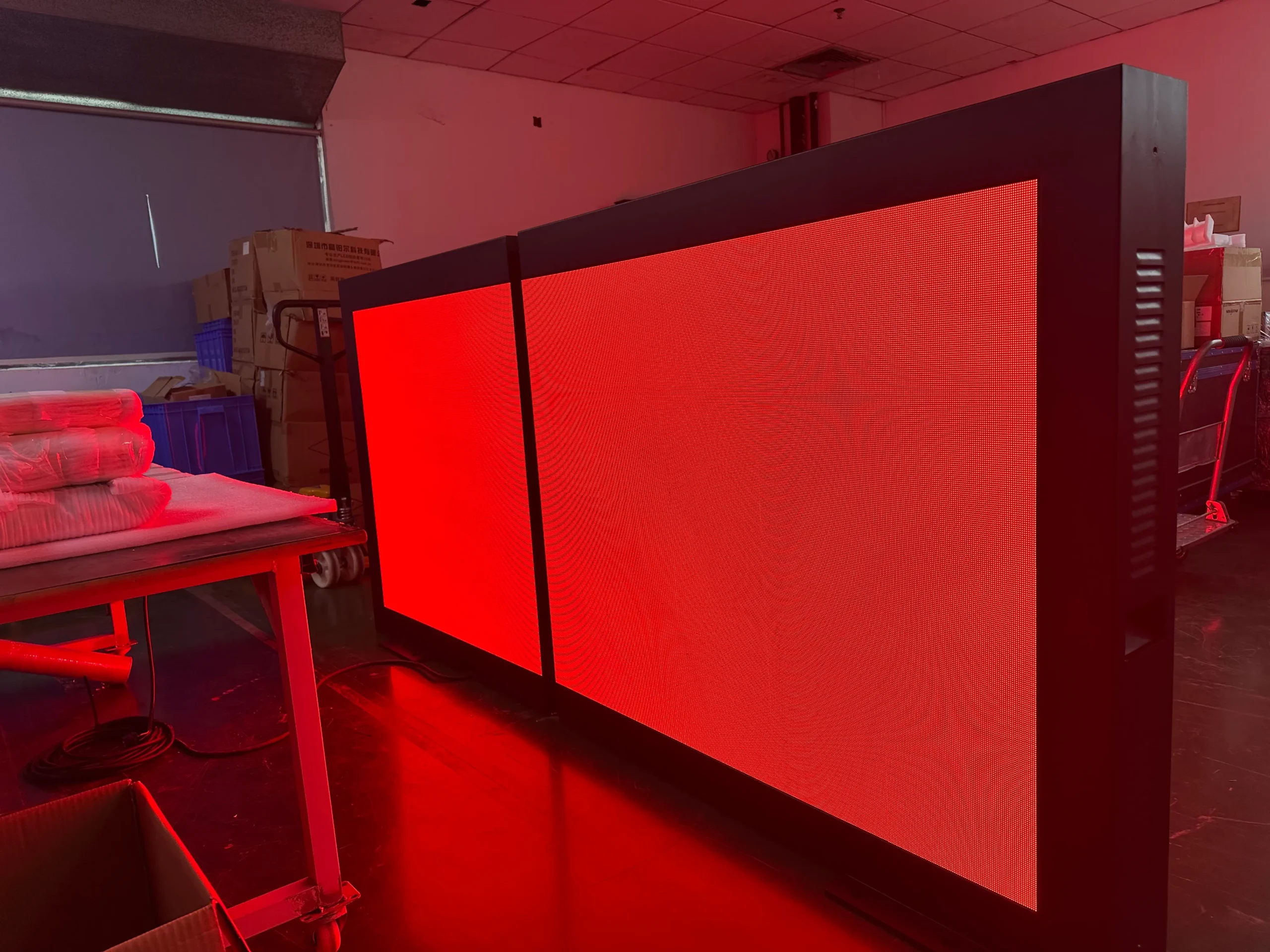
P3 outdoor led video wall made by TW VISION. Size: 1920x960mm, resolution: 640×320. Product series: TW VISION PO-F series
1. Match Brightness to Your Storefront Conditions
An outdoor LED video wall for retail only performs when it stays readable in full daylight. Indoor screens typically run at 300 to 700 nits, but commercial outdoor modules commonly range from 4,500 to 6,500 nits for direct-sun visibility. If your storefront faces north and sits under an awning, you may not need 6,000 nits.
Sun angle changes by season, so a display that looks sharp in June can struggle in December. If the screen faces west into afternoon sun, the right outdoor LED video wall for retail needs enough nits to fight glare.
Ask the vendor for an orientation-specific brightness plan, not a generic spec.
How to apply this: stand at your storefront at 9 a.m., noon, and 4 p.m., then choose a brightness level based on the worst sun hour.
2. Pick the Right Pixel Pitch for Viewing Distance
Pixel pitch is the key spec that determines how sharp an outdoor LED video wall for retail looks from the sidewalk. The smaller the pitch in millimeters, the closer a viewer can stand before seeing individual pixels. A 10mm pitch is often comfortable from roughly 30 feet away, while a 4mm pitch suits close window shoppers.
Buying the tightest pitch available for an outdoor LED display for retail may waste budget if your nearest customer path is across a parking lot. The table below matches common pitch ranges to retail viewing zones.
| Pixel Pitch | Comfortable Viewing Distance | Typical Retail Use | Action to Check |
|---|---|---|---|
| 4mm | 12–16 ft | close window shoppers | measure distance from glass |
| 6mm | 18–25 ft | street-side storefront | confirm sidewalk sightline |
| 8mm | 25–33 ft | mid-distance facade | avoid paying for unneeded sharpness |
| 10mm | 30–40 ft | roadside or pylon | review local sign size rules |
| 16mm | 50+ ft | highway-facing | check mounting height |
Quick comparison by retail location
| Retail location | Typical viewing distance | Pixel pitch to consider | What to check |
|---|---|---|---|
| Sidewalk boutique | 3–10 ft | P2.5–P4 | Glare from glass and narrow walkway |
| Strip mall storefront | 10–30 ft | P4–P6 | Sun angle at noon |
| Highway-facing retailer | 30–100 ft | P6–P10 | Local billboard rules |
| Mall entrance or plaza | 10–50 ft | P4–P8 | Lease sign rights |
| Drive-thru menu board | 3–15 ft | P3–P6 | Readability from vehicle |
How to apply this: measure the exact distance from your hottest customer footpath to the display, then buy one pitch step above the minimum you need.
3. Build a Content Plan That Stops Shoppers
Content, not hardware, is what makes an outdoor LED video wall for retail earn its place. A short loop with clear product names, prices, and one call to action often outperforms a static poster.
Industry practice commonly uses scene lengths around four to six seconds because that is long enough to read but short enough to hold attention while people walk by.
Consider a corner storefront that switches from a static “Open” sign to a 10-second loop showing the day’s special, a product photo, and a phone number. The display becomes a silent salesperson instead of a digital poster.
Platforms like Yodeck and OptiSigns let you schedule content remotely, change pricing from a phone, and assign different playlists by time of day.
How to apply this: create three content blocks — morning, lunch, and evening — and rotate each one weekly so regular passersby see something new.
Mesh LED screen P4 with brightness 4500 nits from TW VISION.
4. Protect the Display From Weather and Heat
An outdoor LED video wall for retail must be treated as an exterior building system, not an indoor screen. Look for a cabinet with an IP65 or higher front rating and at least IP54 rear protection; these ratings measure resistance to dust and water. Direct sunlight also drives heat into the modules, and trapped heat shortens LED life.
Energy efficiency matters too. According to Energy Star, “LED lighting products produce light up to 90% more efficiently than incandescent light bulbs.” That efficiency advantage is why a bright outdoor LED display for retail can replace a larger, hotter lightbox without tripping the same electrical load.
How to apply this: ask the installer where air intake and exhaust vents are located, and confirm the display has a light sensor for automatic night dimming.
5. Measure Performance Without Guessing
An outdoor LED video wall for retail only justifies its cost when you track what happens after installation. Before mounting, record a 30-day baseline of foot traffic, transaction counts, and weekday versus weekend sales. After the screen runs, compare the same numbers.
Many digital signage platforms include proof-of-play logs that show when each piece of content ran. Use those logs alongside store traffic data to see whether morning specials lift visits during slow hours. Results vary by location, season, and offer, so do not expect one universal percentage lift.
A practical outdoor LED display for retail setup pairs cloud playback reports from Yodeck with your point-of-sale system’s daily transaction report. That gives you a direct link between content schedule and sales response.
How to apply this: set a 45-day review date after launch and decide in advance which metric — foot traffic, average transaction value, or specific item sales — determines success.
Frequently Asked Questions About Outdoor LED Display for Retail
Do I need a permit for an outdoor LED display for retail?
In many municipalities, any illuminated sign visible from a public sidewalk or road triggers a permit review. Size, brightness, hours of operation, and distance from intersections often matter. In one case, a storefront in a historic district can face stricter design rules than a strip mall. Check your local planning or building department before ordering hardware.
Treat permitting as part of the outdoor LED display for retail budget, not an afterthought.
Can an outdoor LED display for retail run 24/7 without distracting drivers?
A well-designed outdoor LED video wall for retail can run all day if it has an ambient light sensor. Auto-dimming lowers brightness after sunset to meet local night limits. Without this, a screen readable in noon sun can become dangerously bright at night. A common scenario: a convenience store near a road may face a municipal requirement to cap nighttime brightness.
Ask your installer to demonstrate the auto-dim schedule before purchase.
What happens when one module goes dark on an outdoor LED display for retail?
Modular LED cabinets make repair straightforward. A failed module usually shows as a black square or color mismatch. You can order a replacement module from the manufacturer and swap it from the front or back, depending on the cabinet design. Front-service models are often better for tight storefronts; rear-service units need clearance behind the display.
Keep one spare module on hand to minimize downtime for your outdoor LED display for retail investment.
How does energy use compare between LED and old lightbox signs?
An outdoor LED display for retail generally uses less energy per square foot than fluorescent or halogen lightboxes with similar visibility. LED modules convert more electricity into light, while older bulbs waste more as heat. The difference depends on brightness settings, daily runtime, screen size, and local electricity rates.
In many retail retrofits, operators report lower lighting demand after switching, but actual savings require a utility bill comparison to verify for your location.
Can I control several outdoor LED display for retail locations from one dashboard?
Yes, cloud-based signage platforms such as Yodeck or OptiSigns let you push content to every outdoor LED display for retail unit from a single account. You can schedule playlists, monitor playback status, and update pricing remotely. One edge case: locations with weak broadband may need an offline playlist stored on the media player.
Confirm each site has either a hardwired connection, Wi-Fi, or a cellular backup before committing to a multi-store rollout.
Conclusion
An outdoor LED display for retail is a capital investment that pays back through visibility, speed, and relevance to the people walking past your store. If you treat it like a standard TV, you will likely overpay for interior brightness or under-spec for afternoon heat. Instead, anchor every choice in measurable storefront conditions.
Keep these takeaways in mind:
– Match brightness to your storefront’s worst sun angle, not its average.
– Buy pixel pitch based on real viewing distance, not a spec sheet.
– Plan short content loops with a clear offer and remote scheduling.
– Protect the cabinet, monitor heat, and set night dimming from day one.
Your next step: measure your storefront distance and sun exposure this week, then request two vendors quote an outdoor LED display for retail based on that measurement.
