

Portable Video Wall: The Complete Buying and Setup Guide

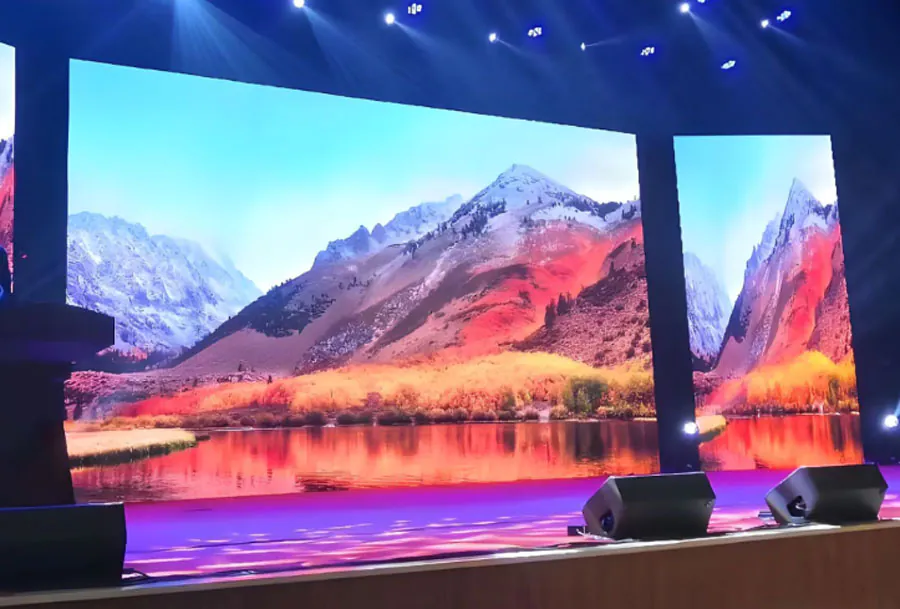
A portable video wall delivers the scale and brightness of a large LED screen without tying that screen to one address. The panels travel in road cases, assemble with basic training, and rebuild into a different size or shape at the next venue. That mix of visual impact, fast deployment and transportability is why event producers, retailers, churches and touring teams now treat a portable video wall as core equipment rather than a display bought for one site. This guide explains how these systems work, which formats exist, how to specify one, what drives the cost and how to keep it performing after years of load-in and load-out.
Table of Contents
- What Is a Portable Video Wall and How Does It Work?
- Foldable, Podium or Modular? Three Common Formats
- Key Benefits of a Portable Video Wall
- How to Choose the Right Portable Video Wall
- Best Applications for a Portable Video Wall
- Setup, Transport and Maintenance Tips
- What Does a Portable Video Wall Cost?
- US Stock and Delivery from Atlanta
- FAQ About Portable Video Walls
- Conclusion
What Is a Portable Video Wall and How Does It Work?
A portable video wall is a modular display system built from LED cabinets or folding panels that connect physically and electronically into one seamless canvas. Unlike a fixed wall, every part is designed to be carried, stacked and rebuilt, so the same hardware can serve a hotel ballroom on Friday and an exhibition hall the following week.
Each panel contains red, green and blue LEDs, a receiving card, a power supply and a locking frame. A video processor maps the incoming signal across the cabinets, which lets content run across the full wall or split into separate windows. Panels usually mount on folding frames, wheeled bases, ground-stacked trusses or quick-lock stands, and most touring systems ship in foam-lined road cases.
A complete system normally includes:
- LED display panels or folding poster units
- Support frames, truss or wheeled bases
- Video processor and controller
- Power distribution and data cabling
- Spare modules, tools and transport cases
- Optional wireless control accessories for content updates
Pixel pitch still governs clarity. The working rule is roughly 1 mm of pitch per metre of minimum viewing distance, so a P2.6 panel suits close indoor audiences while P4 to P6 works for stage backdrops and larger halls. Brightness must match the room: 800 to 1,500 nits is comfortable indoors, while daylight or outdoor use needs far higher output plus an IP-rated cabinet.
Systems also differ in how the image is produced. Folding units and cabinets use direct-view LEDs, while some walls assemble LCD panels on a frame. Direct-view LED wins on brightness, contrast and seamlessness; LCD can suit budget-limited indoor presentations where ambient light is low. Refresh rate matters when cameras are present, because a low refresh rate produces banding on phones and broadcast footage.
Foldable, Podium or Modular? Three Common Formats
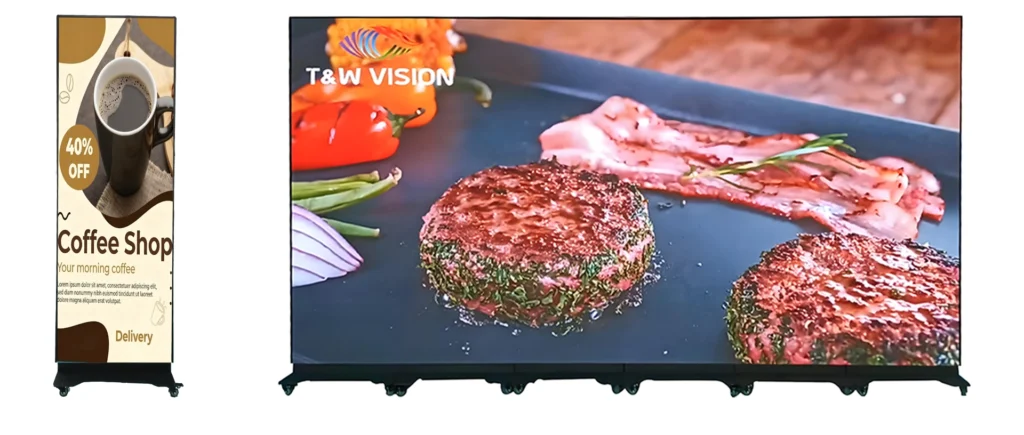
Portable screens are not one product category. The right format depends on who sets it up, how often it moves and how large the final canvas needs to be.
Foldable LED poster and LED banner
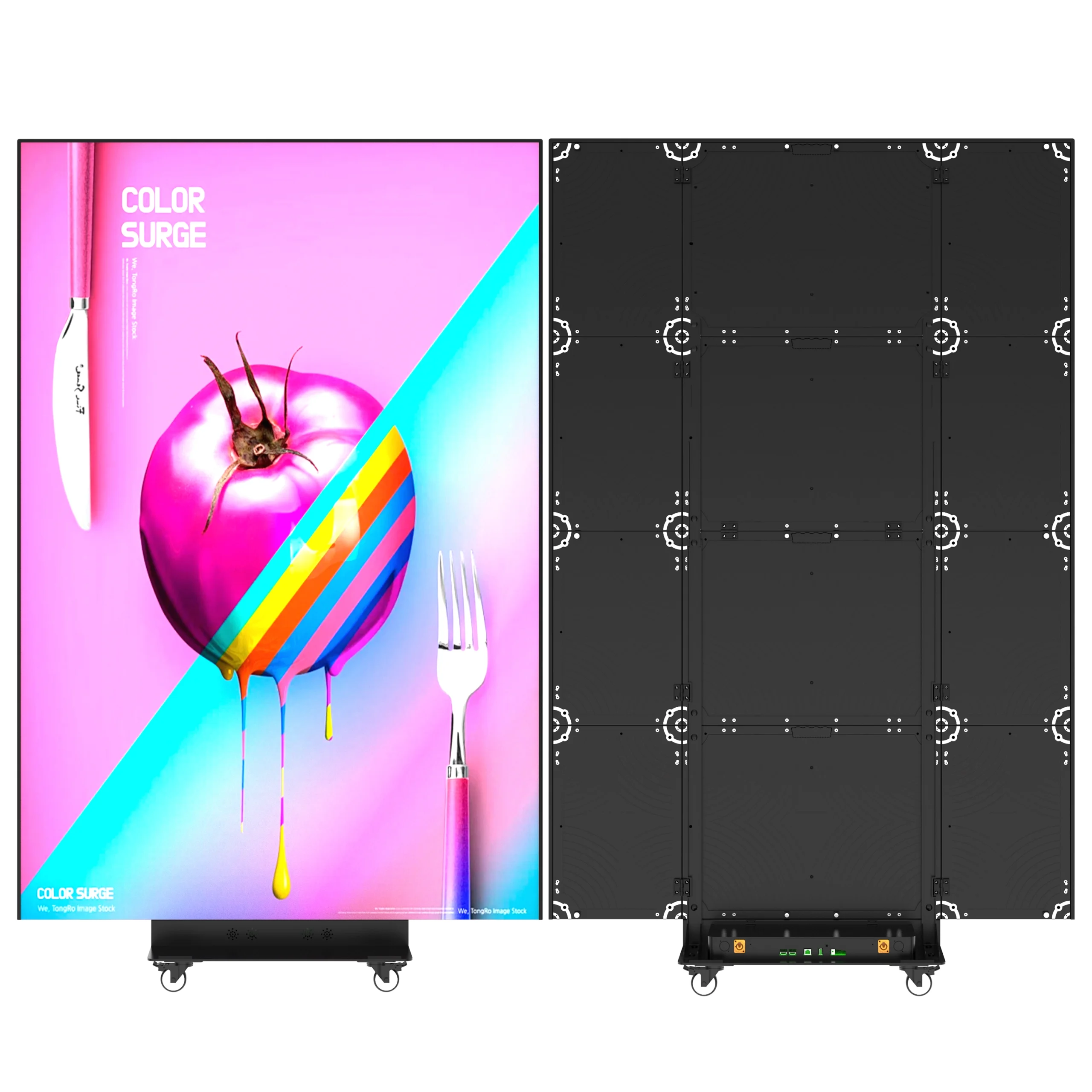
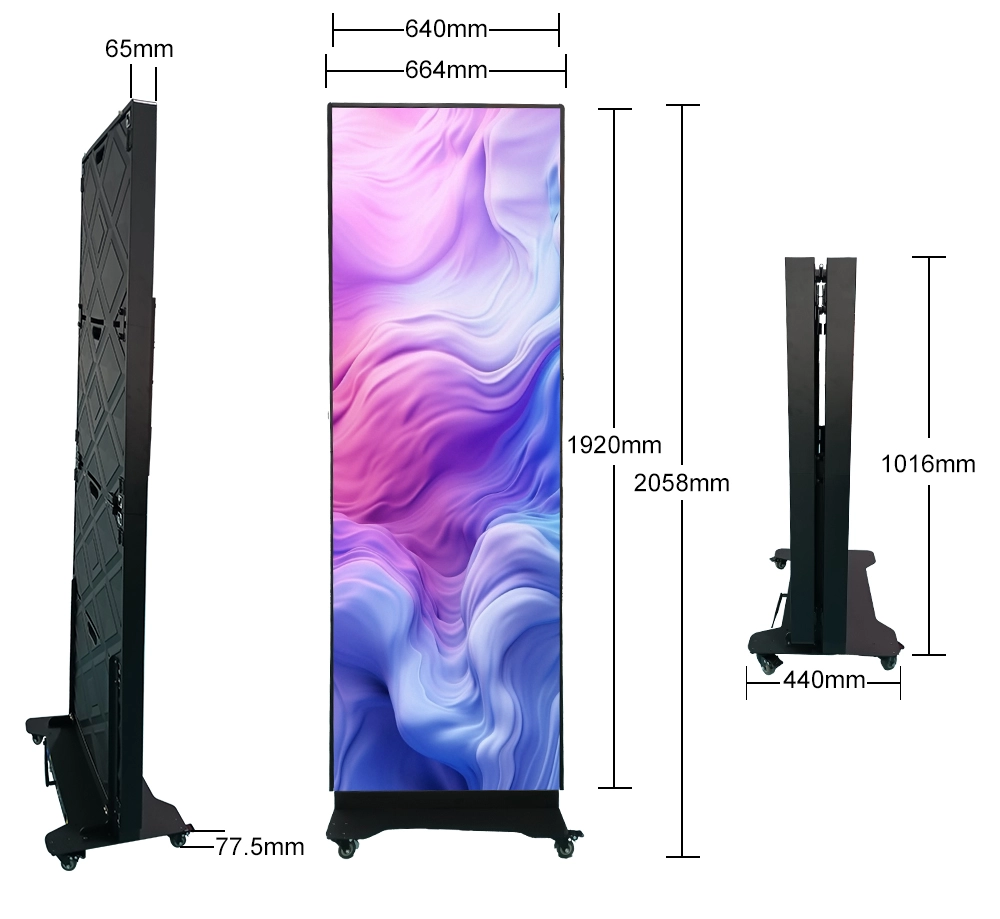
These are the most transportable option: a single unit folds flat, rolls through a doorway and opens into a bright standing screen. A tri-foldable LED poster can be carried by one person and placed in a lobby, showroom or church foyer within minutes. Several units can be lined up or linked to form a wider wall without extra support structure.
LED podium and front-desk screens
An LED podium integrates the screen into a lectern, so a speaker can present while the audience sees branding, slides or a live camera feed. The same cabinet format works as a front-desk display in reception areas and showrooms. It is a popular choice for conferences, churches and corporate lobbies where a full wall would be too much hardware.
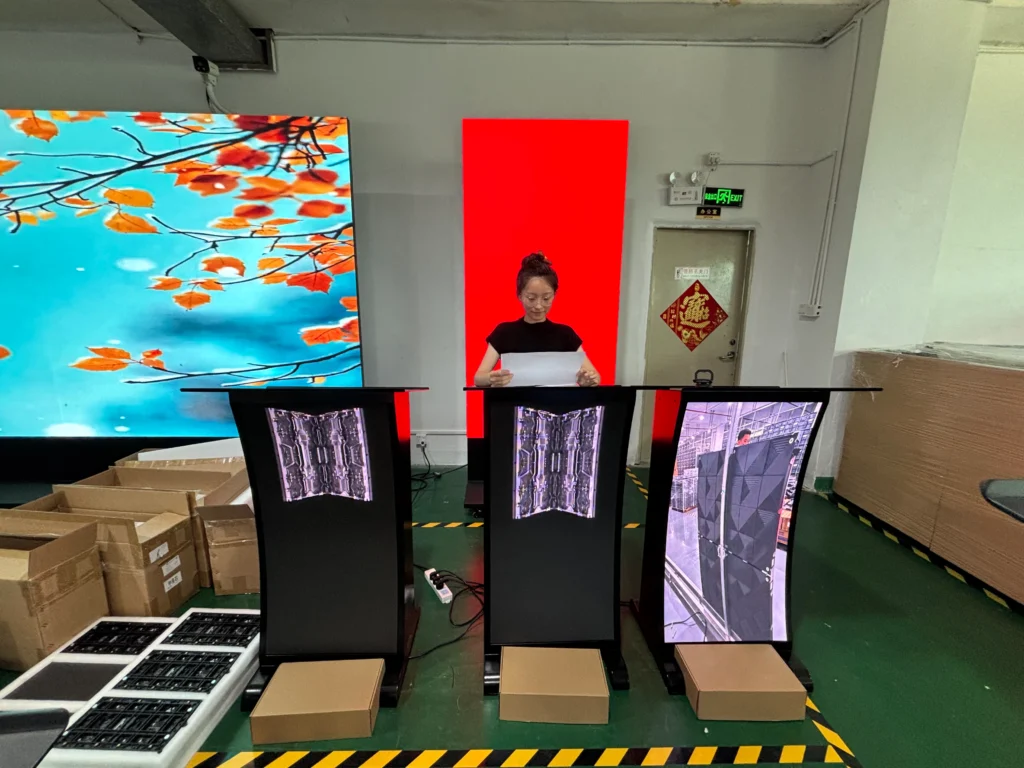
TW VISION builds both a dedicated LED podium display and a flexible LED poster and banner range for this kind of walk-in deployment.
Modular panels on truss or wheeled frames
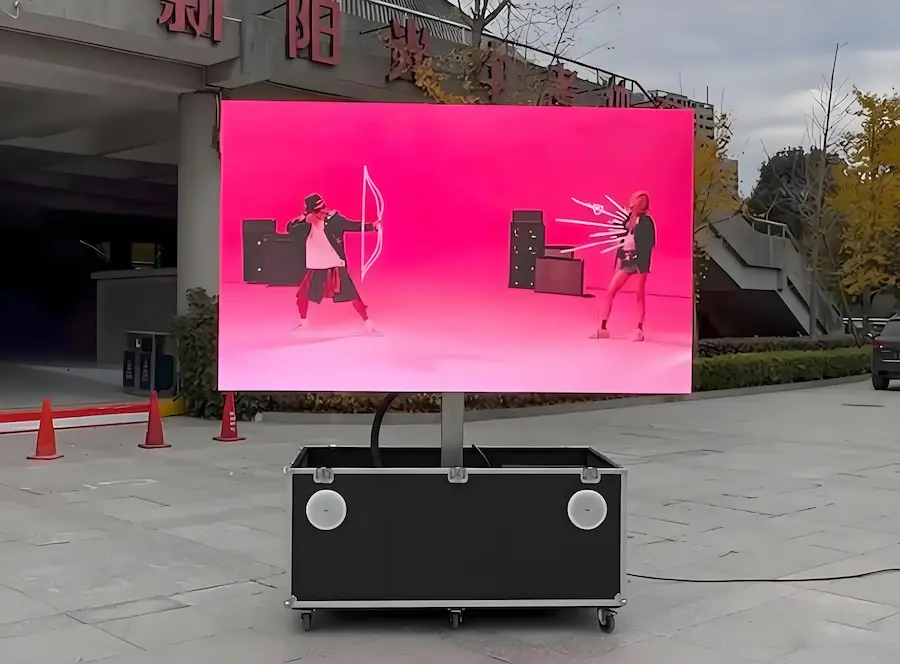
For stage backdrops and exhibition walls, standard touring cabinets can be supplied with ground-stack bases or suspension frames. This format scales from a 3 x 2 m backdrop to a full arena wall, packs into fewer cases per square metre and can be rebuilt in a different aspect ratio at every venue.
Key Benefits of a Portable Video Wall
The case for owning or specifying a portable video wall comes down to how much visual value one set of hardware can deliver across many rooms and events.
Mobility and flexibility
The obvious advantage is that the screen goes where the audience is. Touring productions, schools, marketing teams and multi-site brands can move one system between venues, room layouts and event formats instead of buying a display for each site.
Fast setup and breakdown
Tool-free locks, pre-routed power and data, and labeled cases cut setup hours on both ends of an event. Faster builds mean lower crew costs and more time for content checks before doors open.
Strong visual performance in ambient light
Direct-view LED holds contrast in bright rooms where projection washes out. That makes a portable video wall reliable in conference halls, shopping centres, expo floors and covered outdoor plazas.
Scalable screen sizes
Because the canvas is modular, the same cabinets build a compact presentation screen or a wide stage backdrop. Buyers can start with a practical size and add panels later rather than replacing the whole system.
Professional branding opportunities
Motion graphics, product demos and live video look sharper on a seamless LED surface than on tiled monitors or printed banners. Consistent branding across venues is easier when the same hardware and content template travel together.
Better audience engagement
People respond to movement, colour and scale. A portable video wall pulls attention in a crowded hall or shopfront and keeps it there through changing content rather than a static poster.
Reusability and return on investment
Organizations that exhibit, tour or host regular events get more value from one system across many dates than from buying separate displays for each site. Ownership also gives full control over scheduling, content and presentation quality.
How to Choose the Right Portable Video Wall
Specify around the venues you actually use, not the largest wall you can imagine. Performance, logistics and support all need to line up.
1. Define the use case
Decide whether the screen stays indoors, travels outdoors or both. Indoor work rewards fine pitch and a clean finish; outdoor work demands higher brightness, weather protection and a stronger frame.
2. Consider viewing distance
Measure the closest audience position, then apply the 1 mm per metre guideline. A finer pitch than the distance requires adds cost without adding visible detail.
3. Evaluate portability features
Check for lightweight cabinets, rolling or stackable cases, quick-lock connections, integrated cabling, folding or wheeled frames, fast calibration tools and front or rear service access. These details decide whether one crew can build it and how fast a failed module can be replaced.
4. Check image quality specifications
Compare pixel pitch, brightness, refresh rate, contrast, colour uniformity and viewing angle. For camera-facing events, ask for 1,920 Hz or 3,840 Hz refresh so the wall stays clean on camera.
5. Review control system compatibility
The processor must accept laptops, media servers, cameras and live feeds without extra converters. Confirm that local technicians know the platform and that spare receiving cards are available locally.
6. Assess durability
Frequent transport wears corners, connectors and frames. Reinforced edges, protected latches and quality connectors separate touring-grade cabinets from ones that only look rugged.
7. Compare total cost of ownership
Add cases, spares, training and service to the purchase price. A higher quote can be cheaper over five years if it cuts crew size or downtime.
8. Ask about warranty and technical support
Response time matters more than warranty length when a screen fails before a show. Ask who answers the phone and how spares ship.
Best Applications for a Portable Video Wall
The same hardware serves very different jobs, which is exactly why portability has commercial value.
Corporate events and conferences
Keynotes, annual meetings, training days and hybrid events all need a clean branded backdrop that can be set up in a hotel ballroom without permanent building work.
Trade shows and exhibitions
Exhibitors use a portable video wall to stop traffic, play product films and adapt to different booth sizes from one show to the next.
Retail promotions and pop-up stores
Seasonal campaigns and product launches change quickly. A movable screen lets a brand refresh windows and activation spaces without reprinting graphics.
Houses of worship
Lyrics, sermon visuals, livestream support and holiday productions are common uses, especially for congregations that meet in multipurpose or shared venues.
Weddings and private events
Planners use LED walls for custom backdrops, photo moments and live camera feeds where a permanent screen is impossible.
Concerts and touring productions
Touring crews need fast load-in and consistent image quality across venues. A modular wall pairs naturally with a stage LED screen setup for IMAG and artist visuals.
Education and training
Universities and training centres share one system across lectures, ceremonies, sports events and campus outreach, which improves utilization compared with room-specific displays.
Sports and fan engagement
Fan zones, sponsor activations and community events use portable screens for live feeds, replays and halftime content in spaces without permanent video infrastructure.
Setup, Transport and Maintenance Tips
A portable video wall is robust, not indestructible. Most failures trace back to handling, power or missed inspections rather than the LEDs themselves.
Plan the setup area
Check floor stability, power access, ceiling clearance and sightlines before unloading. A few minutes of site review prevents improvising under time pressure.
Train the setup team
Staff should know panel alignment, locking order, cable routing, processor settings and safety checks. Standard training shortens builds and protects the hardware.
Use protective transport cases
Foam-lined road cases absorb shock and keep dust out of connectors. For equipment that travels weekly, case quality affects lifespan as much as cabinet quality.
Clean the panels properly
Use manufacturer-approved cleaners and soft cloths. Harsh chemicals can cloud the mask and damage the surface, while dust buildup also reduces cooling efficiency.
Monitor power and signal integrity
Inspect connectors, data lines and distribution boards before each event. Voltage swings and poor grounding cause flicker, dropouts and damaged receiving cards.
Calibrate when needed
Brightness and colour can drift as panels age or when modules from different batches are mixed. Periodic calibration keeps seams invisible, which matters most for branded and broadcast content.
Keep spare parts available
Carry spare modules, cables and power supplies on site. A five-minute module swap is far cheaper than a dark section during a keynote.
Schedule preventive maintenance
Inspect frames, locks and fans on a fixed calendar, not only after a failure. Preventive checks catch loose hardware before it becomes a show-day problem.
Load-out deserves the same discipline as build. Number the cases, photograph cable runs before dismantling, and dry the panels before packing after an outdoor event. Storing a system in a damp room or an unheated container shortens LED and power-supply life.
What Does a Portable Video Wall Cost?
Price is driven by format, pitch, size and the support package around the screen. A single folding poster and a multi-cabinet stage wall sit at opposite ends of the range, so compare quotes on the same basis.
| Cost factor | What changes the number |
|---|---|
| Panel format | Folding poster and podium units cost less per square metre than touring cabinets with flight cases |
| Pixel pitch | Finer pitch needs more LEDs and tighter manufacturing, so price rises quickly below P2.5 |
| Brightness and IP rating | High-output outdoor cabinets with sealed housings cost more than indoor panels |
| Control and processing | Processor size, inputs and redundancy add to the system price |
| Transport and spares | Road cases, spare modules and support frames are part of the real budget |
| Service and training | Spare parts, training and warranty terms vary by supplier |
Because portable systems vary widely in panel format and pitch, compare quotes on the same specification rather than the headline price. Confirm whether training, spare modules and technical support are included, and ask for a stated spare ratio, typically 2 to 5 percent of modules for touring use. Freight, duties and taxes are often quoted separately, so check what the delivered price actually covers.
US Stock and Delivery from Atlanta
TW VISION holds portable video wall units, indoor LED modules and cabinets, plus spare modules, power supplies and receiving cards at its warehouse in Atlanta, GA. Every cabinet batch completes a 24-hour aging test before shipment. Buyers in the Atlanta area can collect locally, while orders across the United States ship by freight or parcel from the same stock. Availability depends on model, pixel pitch and quantity, so confirm the exact configuration and current stock level with the sales team before scheduling an event.
FAQ About Portable Video Walls
What is the main advantage of a portable video wall?
Mobility. It provides the impact of a large LED display while allowing the same system to be transported, rebuilt and reused across venues, which lowers long-term display costs for organizations that travel.
Can a portable video wall be used outdoors?
Some models are built for outdoor use with higher brightness and sealed cabinets. Check the IP rating against IEC 60529 and confirm structural wind loading before using it outside.
How long does setup take?
A folding poster can be ready in minutes. A multi-cabinet wall depends on size and crew, but modular locks and pre-routed cabling let an experienced crew build far faster than a permanent wall.
What pixel pitch is best?
Match pitch to the nearest viewer. Fine pitch suits close indoor audiences, while a wider pitch is sufficient and more economical for large halls or stage viewing distances.
Can it replace a projector?
In most event and commercial settings, yes. Direct-view LED stays visible in ambient light and avoids screen washout, though projection can still be cost-effective for very large, dark rooms.
How do I maintain it?
Transport in cases, clean with approved materials, inspect cables and locks before each event, calibrate periodically and keep spare modules on hand. Preventive care protects brightness and reliability.
Conclusion
A portable video wall solves a practical problem: how to deliver a large, bright, professional image in rooms that were never designed for one. By choosing the right format, matching pixel pitch to viewing distance, planning transport and maintaining the system properly, buyers get a display asset that works across many events instead of a single location. Whether you start with a folding poster, an LED podium or a full modular stage wall, the same rules apply: specify for the venues you use, buy for the life of the equipment, and keep the logistics as simple as the content is strong.
