How Storefront Glass Reflections Affect LED Display Brightness and Visibility

How Storefront Glass Reflections Affect LED Display Brightness and Visibility depends on what reaches a shopper’s eyes: the illuminated message, light reflected from the street, and light transmitted through the glazing. A surprising optical fact is that ordinary uncoated glass reflects light even when it looks completely transparent; adding brightness behind it does not remove that reflection.
Table of Contents
- 1. Understand Why Reflections Reduce Readability
- Brightness and contrast measure different things
- 2. Identify What Your Storefront Glass Does to Light
- Transmission and reflection need separate checks
- 3. Adjust Placement Around the Viewer and the Reflected Scene
- Test the approach, not just the central viewpoint
- 4. Specify Brightness for Conditions Outside the Glass
- Measure the installed result
- 5. Design Content and Verify Visibility Consistently
- Make the message survive the reflection
- Compare changes under controlled conditions
- Why does my display look darker through polarized sunglasses?
- Can a transparent LED display preserve visibility into the store?
- Why do I see rainbow patterns in the storefront window?
- Can condensation make a previously readable display look blurred?
- Do illuminated storefront displays need local approval?
- Turn Your Window Into a Measurable Display Environment
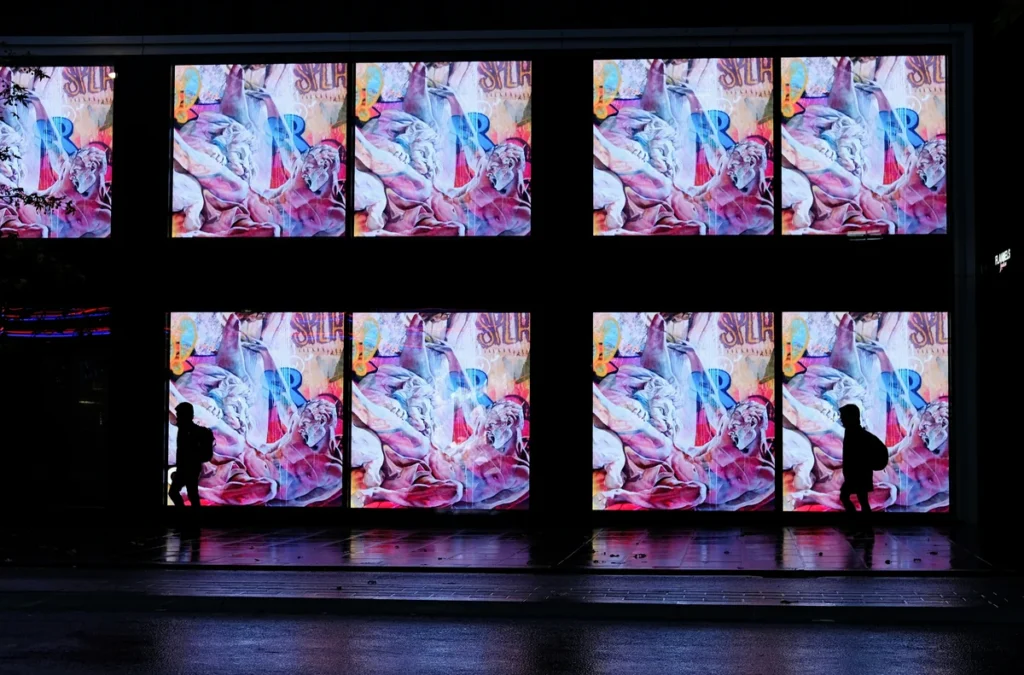
This creates a familiar problem: a display looks crisp inside the store but appears washed out from the sidewalk. Reflections of the sky, parked vehicles, and neighboring buildings can cover the message, while the glass reduces the amount of display light reaching the viewer.
A reliable solution starts with the whole viewing system. Glass construction, screen position, sunlight, content design, and automatic dimming all influence the result. Understanding their interaction helps you choose equipment, improve an existing installation, and test visibility under the conditions your customers actually encounter.
1. Understand Why Reflections Reduce Readability
Storefront reflections reduce readability by adding unwanted light over the image while the glass transmits only part of the display’s output.
The RP Photonics Encyclopedia’s explanation of Fresnel equations establishes the underlying principle: reflection at an optical boundary depends on refractive index, polarization, and angle of incidence. Glass can therefore transmit your message and reflect the street at the same time.
Brightness and contrast measure different things
Display luminance describes light emitted toward the viewer and is commonly specified in candelas per square meter, also called nits. Readability also depends on contrast: the difference between the visible message and its background.
A useful engineering relationship is:
Observed contrast = (transmitted white luminance + reflected luminance) ÷ (transmitted black luminance + reflected luminance)
This simplified model assumes the same reflected luminance overlays both image areas. As that reflected component grows, the ratio moves toward unity, making light and dark areas harder to distinguish.
Consider a dark promotional background reflecting a bright sky. The black pixels cannot cancel the reflected light, so the background appears gray.
Understanding How Storefront Glass Reflections Affect LED Display Brightness and Visibility starts with measuring contrast from outside. Assessing How Storefront Glass Reflections Affect LED Display Brightness and Visibility from inside the shop misses the reflection customers see.
How to apply this: Display white text on black, step outside, and check whether reflections obscure the letters or lift the background.
2. Identify What Your Storefront Glass Does to Light
Your glazing determines both how much display light reaches the sidewalk and which reflections appear over it.
Ask for the glazing manufacturer’s visible light transmittance, often abbreviated VLT. This is a measured optical property, not a description of how clear the window looks. As Lawrence Berkeley National Laboratory’s Windows and Daylighting resources explain, glazing performance involves distinct transmission, reflection, and absorption properties.
Transmission and reflection need separate checks
A lower VLT means less visible light passes through the glazing under the stated measurement conditions. However, VLT alone does not describe exterior reflectance, coating behavior, or performance at an oblique viewing angle.
How Storefront Glass Reflections Affect LED Display Brightness and Visibility therefore cannot be predicted from a “clear glass” label alone.
| Glazing factor | Visibility concern | Action to take |
|---|---|---|
| Tint | Reduced transmission | Request VLT |
| Reflective coating | Strong street reflections | Check exterior reflectance |
| Multiple panes | Possible ghost images | Inspect angled text |
| Applied film | Changed optical behavior | Test a sample |
| Surface residue | Haze and scattering | Clean before testing |
In a retrofit, an existing solar-control film may explain why a previously acceptable screen becomes harder to read. Obtain the film specification before recommending a brighter replacement.
Documenting How Storefront Glass Reflections Affect LED Display Brightness and Visibility requires the complete glazing assembly, including applied films.
How to apply this: Request the glass and film specifications, then compare a sample message through the actual window before purchasing equipment.
3. Adjust Placement Around the Viewer and the Reflected Scene
Display placement improves visibility when it reduces distracting reflections along the shopper’s actual line of sight.
The law of reflection states that the angle of reflection equals the angle of incidence, as explained in OpenStax’s treatment of reflection. That relationship explains why a screen can look readable from directly opposite the shop and disappear behind a sky reflection farther along the pavement.
Test the approach, not just the central viewpoint
Walk the routes customers use to approach the entrance. Check the display from across the street, near the window, and from accessible viewing positions.
How Storefront Glass Reflections Affect LED Display Brightness and Visibility changes with those positions because each viewer sees a different reflected scene.
Moving the screen closer to the glass can reduce the visible gap and some internal distractions, but it does not eliminate reflection at the exterior surface. Tilting the display also cannot independently redirect a reflection formed by fixed storefront glazing.
A recessed entrance may offer a useful opportunity: placing the message behind an already shaded window can improve visibility without altering the glazing.
For complex projects, Radiance provides physically based lighting simulation. A specialist can model sun position, geometry, and material properties, although useful results depend on accurate inputs.
Predicting How Storefront Glass Reflections Affect LED Display Brightness and Visibility still benefits from an on-site mockup.
How to apply this: Temporarily position the display at proposed locations and photograph the result from the main pedestrian approaches.
4. Specify Brightness for Conditions Outside the Glass
The right brightness is the output that maintains useful contrast through the installed glazing under the site’s expected daylight conditions.
There is no universal nit rating that guarantees storefront readability. The contrast relationship described earlier shows why: the required output depends on both transmitted screen light and reflected ambient light.
Measure the installed result
A screen’s advertised luminance does not establish the luminance a shopper receives through your window. Glazing transmission, viewing angle, operating mode, and the displayed content all affect that result.
How Storefront Glass Reflections Affect LED Display Brightness and Visibility should therefore be part of the acceptance test, not an issue discovered after installation.
Ask the supplier to demonstrate:
– Readable content during the window’s difficult daylight period.
– Stable output after the display reaches its operating temperature.
– Automatic brightness adjustment with the sensor in its intended position.
– Comfortable nighttime output from the pavement.
A common commissioning mistake is placing the ambient-light sensor where interior shade prevents it from detecting bright exterior conditions. The controller then responds to a lighting environment that differs from the shopper’s view.
Direct sunlight can also create a thermal problem behind glazing. Confirm the manufacturer’s permitted operating conditions, ventilation requirements, and any restrictions on solar exposure.
Evaluating How Storefront Glass Reflections Affect LED Display Brightness and Visibility alongside temperature behavior helps distinguish an optical problem from brightness reduction caused by heat.
How to apply this: Make outdoor readability and automatic dimming part of your supplier’s demonstration and installation acceptance criteria.

5. Design Content and Verify Visibility Consistently
Readable storefront content combines strong visual separation, appropriate letter size, and a message shoppers can recognize while moving.
The contrast relationship remains the key data point: reflected light raises the apparent dark level, reducing the separation between text and background. Content should preserve useful distinctions under that added light.
Make the message survive the reflection
Use bold lettering, uncomplicated backgrounds, and a clear information hierarchy. Avoid placing essential text over detailed imagery, where reflections introduce another competing layer.
How Storefront Glass Reflections Affect LED Display Brightness and Visibility becomes especially apparent when fine text or subtle tonal differences disappear before the main headline does.
For a café promotion, a short product name and price will usually be easier to assess during a walk-by test than a paragraph describing ingredients. Test the actual message rather than a supplier’s demonstration video.
Compare changes under controlled conditions
ImageJ is an image-analysis application that can inspect pixel values and compare regions in photographs. It can support relative comparisons when camera position, exposure, and processing remain fixed; ordinary photographs do not provide calibrated luminance measurements.
Record the time, weather, content, brightness setting, and viewing position with each test. Automatic camera exposure can otherwise make an ineffective adjustment appear successful.
A repeatable record turns How Storefront Glass Reflections Affect LED Display Brightness and Visibility into an installation-specific assessment.
How to apply this: Create a standard test message, lock the camera settings, and compare each change from the same marked sidewalk position.
Frequently Asked Questions About How Storefront Glass Reflections Affect LED Display Brightness and Visibility
Reflection problems also have several installation-specific edge cases that deserve separate checks.
Why does my display look darker through polarized sunglasses?
Polarized sunglasses can reduce the light reaching your eyes when their polarization interacts with the display or glazing. This is especially relevant to LCD-based signage marketed as an “LED display,” because its backlight technology does not make it a direct-view LED screen.
When evaluating How Storefront Glass Reflections Affect LED Display Brightness and Visibility, rotate the sunglasses during inspection and confirm which display technology you are buying.
Can a transparent LED display preserve visibility into the store?
Yes, “a transparent LED display“can preserve views through gaps in its structure, but its transparency specification does not guarantee readable advertising through reflective glazing. A retailer selling visually detailed merchandise may find that the display pattern competes with products behind it.
How Storefront Glass Reflections Affect LED Display Brightness and Visibility remains relevant because the exterior glass still adds reflections. Evaluate the merchandise and message together using a sample panel.
Why do I see rainbow patterns in the storefront window?
Rainbow patterns can arise when polarized light interacts with stress patterns in glass or with certain films. They may become obvious through polarized sunglasses even when ordinary viewing looks acceptable. How Storefront Glass Reflections Affect LED Display Brightness and Visibility does not explain every colored artifact, so compare the window with the screen switched off.
If the pattern remains, ask the glazing supplier to assess the glass and film combination.
Can condensation make a previously readable display look blurred?
Yes, condensation can scatter light and reduce image clarity even when the display’s output has not changed. A window that becomes hazy during cold weather may have surface moisture or a sealed-unit problem, depending on where the moisture appears. Investigating How Storefront Glass Reflections Affect LED Display Brightness and Visibility should include locating that moisture.
Accessible surface condensation and moisture between sealed panes require different building-maintenance responses.
Do illuminated storefront displays need local approval?
They may, depending on local sign rules, planning conditions, landlord requirements, and restrictions on brightness or moving content. A display installed inside a window can still fall within a jurisdiction’s sign definition, so indoor placement does not settle the issue.
How Storefront Glass Reflections Affect LED Display Brightness and Visibility informs the technical design, while the local authority determines applicable requirements. Check the proposed operating hours, animation, and location before installation.
How to apply this: Add any relevant edge-case checks to your site survey before approving the final installation.
Turn Your Window Into a Measurable Display Environment
Better storefront visibility comes from managing the complete path between the screen and the shopper. Understanding How Storefront Glass Reflections Affect LED Display Brightness and Visibility helps you connect equipment specifications with the conditions outside your premises.
– Check the glazing: Obtain transmission and reflectance information for the installed glass and any applied film.
– Test the viewing route: Assess reflections from the positions and directions customers actually use.
– Verify operating performance: Confirm daytime readability, thermal behavior, and appropriate nighttime dimming.
– Keep content legible: Use clear messages and repeatable comparisons to judge whether changes help.
A brighter display may help, but its value depends on the window, reflected scene, and viewing angle. Use those observations to decide whether your next investment should be different equipment, revised placement, shading, or clearer content.
How to apply this: Arrange an on-site demonstration during your hardest daylight conditions before approving a purchase or replacement.
Related Articles
- shop window tv display: 5 : guide to better retail impact
- Giant LED Display: Types Applications & Complete Buying
- High-Brightness Digital Signage Monitor for Outdoor Advertising