

Flexible LED Display Manufacturer for Immersive Visual

A Flexible LED Display Manufacturer for Immersive Visual Experiences does more than sell bendable LED modules; it controls the mechanical, thermal, and processing choices that decide whether a curved video wall disappears into the experience or becomes a visible maintenance burden. AVIXA, the Audiovisual and Integrated Experience Association, has described direct-view LED as a central platform for immersive environments.
Table of Contents
- Verify Mechanical Durability Before Pixel Pitch
- What the Flex-Cycle Test Method Reveals
- Examine the Processing Chain Behind the Panels
- Model Thermal and Power Behaviour in the Real Room
- Key Manufacturer Comparison Areas
- Check Installation Geometry and Service Reality
- Compare Total Cost of Ownership Across Manufacturers
- Building a Three-Year TCO Model
- What is the difference between standard LED modules and flexible LED modules?
- Which certifications matter for an immersive installation?
- Can flexible LED panels be used outdoors in immersive venues?
- How do I compare pixel pitch and bend radius when bidding a project?
- What should I ask about warranty and spare parts before signing?
- Conclusion
The problem is that most datasheets look similar across manufacturers even when field service and longevity differ sharply.
The difference usually shows up after installation: flex-cycle failures, colour banding on curved surfaces, thermal shutdown, or missing spare parts. Your job is to evaluate a manufacturer on five hidden performance areas before you choose. The five secrets below are the criteria experienced AV teams use.
TW VISION flexible led display P1.9(GOB) aging in the factory.
Verify Mechanical Durability Before Pixel Pitch
A datasheet’s pixel pitch tells you nothing about whether a module can survive repeated flex cycles in a curved installation.
What the Flex-Cycle Test Method Reveals
Start with bend radius, but ask for the cycle test method behind the number. A Flexible LED Display Manufacturer for Immersive Visual Experiences should be able to provide a test report for repeated bends, not just a one-time curvature limit. Many integrators report significant variation because the internal PCB stack, connectors, and magnetic mounts differ by supplier.
Thinner modules are not automatically better. The critical variables are substrate material, connector locking, and module depth. Industry teardown reviews consistently show that high-cycle designs use strain relief at the connector and a flex-rated PCB, not simply a softer face.
Ask for a reference project with the same or tighter radius as your design. The same flexible LED display manufacturer for immersive visual experiences may use different module generations for different curve classes, so a generic reference may not predict your result.
How to apply this: submit your tightest radius and request a written flex-cycle test method plus a reference project with that geometry.
Examine the Processing Chain Behind the Panels
The most important hidden variable in an immersive wall is not the panel itself, it is the video processing path.
High-end installations use Brompton Technology Tessera processors or Novastar control systems for colour, HDR, genlock, and low-latency playback. A credible Flexible LED Display Manufacturer for Immersive Visual Experiences should confirm which processors and firmware versions their panels have been qualified with.
Processor compatibility affects visual consistency more than module spec. If a panel cannot accept a processor’s calibration data correctly, curved surfaces may show banding or colour shifts. Many rental and staging teams treat processor compatibility as a gating requirement before any purchase.
Ask for a reference design that names the controller, firmware, receiving card, and calibration workflow. Do not accept a verbal compatibility claim; ask the flexible LED display manufacturer for immersive visual experiences to provide a written qualification matrix.
How to apply this: download the processor’s compatibility list and confirm your exact module and firmware combination appears before shortlisting.
Model Thermal and Power Behaviour in the Real Room
An immersive room traps heat, and LED power draw in a closed installation can rise well beyond the manufacturer’s open-air test condition.
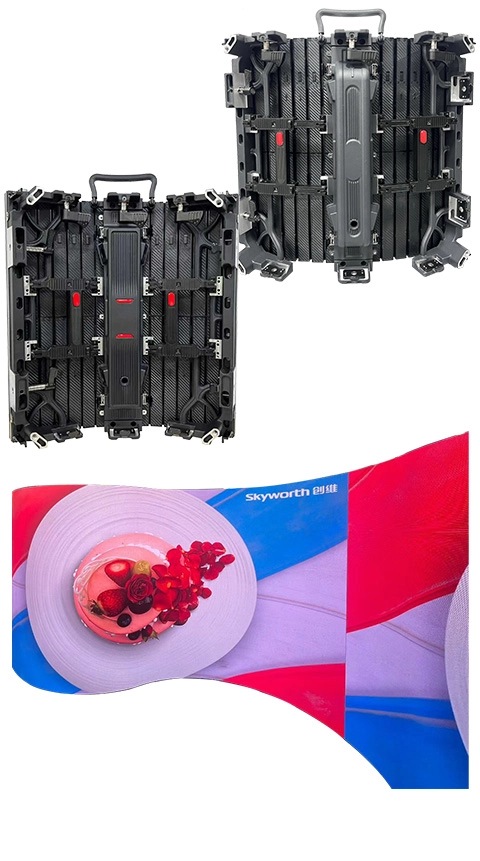
Compare calibrated maximum power, not quoted average power. A Flexible LED Display Manufacturer for Immersive Visual Experiences should provide thermal data for enclosures, recessed installations, or domes. Many AV teams report significant differences in temperature rise because LED drivers and power supply designs vary by brand.
Low power draw at reduced brightness can hide a module that runs hot at sustained high brightness. The same flexible LED display manufacturer for immersive visual experiences may offer a high-brightness variant that behaves differently from the standard part. Require measured BTU or kilowatt data per square metre at your target brightness and ventilation level.
Key Manufacturer Comparison Areas
Use a simple comparison grid to force every supplier onto the same data.
| Evaluation area | What to verify | Action to take |
|---|---|---|
| Flex-cycle rating | Bend radius and test cycles | Request the actual test report |
| Processing path | Processor and firmware match | Check Brompton or NovaStar compatibility |
| Power and thermal | Max calibrated draw | Ask for room-specific thermal data |
| Spare modules | Lead time and configuration | Lock lifecycle pricing |
| Service response | On-site vs ship-to-factory | Put the SLA in writing |
| Content mapping | Mapping tool compatibility | Test with MadMapper or Resolume |
Mapping tools such as MadMapper and Resolume are widely used in immersive builds, so include a mapping check in any manufacturer comparison.
How to apply this: give the manufacturer your room dimensions, ventilation plan, and target brightness, then require a written thermal performance sheet.
Check Installation Geometry and Service Reality
Flexible LED modules fail most often where creative geometry meets mechanical stress, so installation engineering matters as much as panel quality.
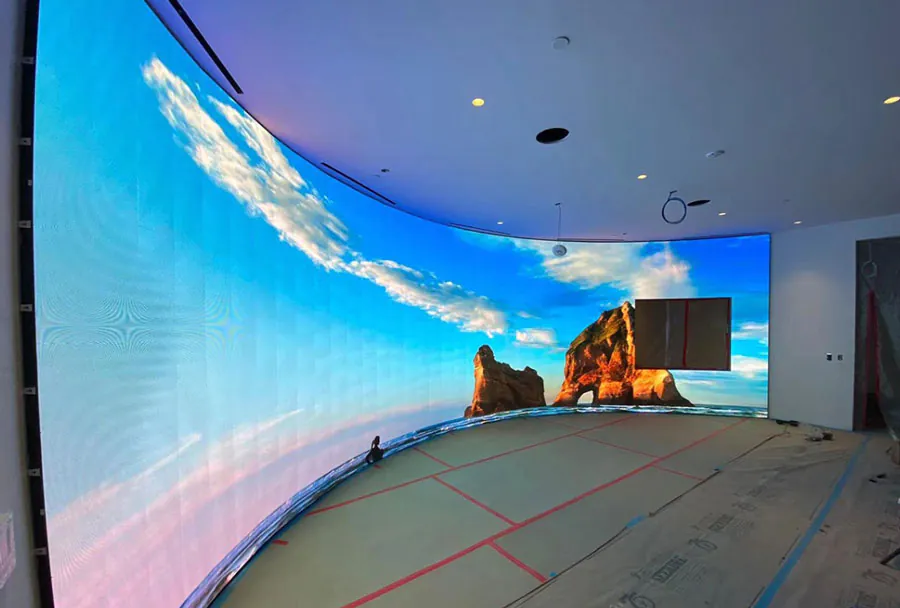
Ask for a reference build that matches your radius, corner detail, or dome curvature. The best Flexible LED Display Manufacturer for Immersive Visual Experiences will provide installation drawings and service access notes, not only a sales render. Industry service teams consistently report that missing field-service support creates more delays than panel defects.
If your project is in a public venue, request documentation for the complete assembly, including mounting hardware and power routing. The same flexible LED display manufacturer for immersive visual experiences may offer engineering review only as a paid service. Ask for that review early, because approval delays are cheaper to fix before fabrication than on site.
How to apply this: submit a dimensioned drawing of your most difficult curve and ask the manufacturer to mark module orientation, cable path, and service access points.
Compare Total Cost of Ownership Across Manufacturers
Purchase price is a small part of the lifecycle cost of an immersive LED wall.
Build a three-year model that includes power, spare modules, hot-swap labour, processor licences, and content tool updates. A Flexible LED Display Manufacturer for Immersive Visual Experiences should be able to provide expected part life and spare-module lead times. Without that data, a low bid can become expensive after the first service event.
Ask about software mapping compatibility as part of the commercial offer. Tools such as MadMapper and Resolume are commonly used in immersive builds, and the flexible LED display manufacturer for immersive visual experiences should confirm which mapping pipelines are tested with their curved modules.
Building a Three-Year TCO Model
Your TCO model should include five cost buckets: hardware, energy, spares, content and control licences, and on-site service. Weight hardware as only one portion of the whole; the other four buckets can exceed it in complex immersive spaces.
How to apply this: create a five-column TCO spreadsheet with hardware, power, spares, content tools, and service response, then ask each manufacturer to complete their column before bid evaluation.
Frequently Asked Questions About Flexible LED Display Manufacturer for Immersive Visual Experiences
What is the difference between standard LED modules and flexible LED modules?
Standard LED modules use a rigid PCB and flat mounting face, while flexible modules use a bendable substrate that can wrap around curved surfaces. The practical exception is hybrid design: a Flexible LED Display Manufacturer for Immersive Visual Experiences may sell a semi-flexible module that bends only on one axis.
Confirm whether your dome or corner geometry needs single-axis or multi-axis flex before ordering.
Which certifications matter for an immersive installation?
At minimum, check for UL or equivalent safety listing, CE marking where applicable, and fire-rating evidence for the complete display assembly. In public venues, local inspectors may require the exact combination of module, power supply, and mounting hardware to be listed, not just the panel.
Ask the Flexible LED Display Manufacturer for Immersive Visual Experiences for certification documents that include your integrator’s mounting system.
Can flexible LED panels be used outdoors in immersive venues?
Yes, but only with an appropriate IP-rated housing and outdoor-rated connectors. A covered outdoor immersive space can still accumulate humidity and dust, so an indoor-rated panel may fail even without direct rain. Confirm the Flexible LED Display Manufacturer for Immersive Visual Experiences provides front and rear ingress protection ratings and recommends a weatherproofing method for your specific enclosure.
How do I compare pixel pitch and bend radius when bidding a project?
Treat pixel pitch as the viewing-distance spec and bend radius as the geometry spec. A common bidding mistake is choosing a tight pixel pitch for close viewing, only to find the module cannot physically make the required curve.
For domes or tight columns, ask the Flexible LED Display Manufacturer for Immersive Visual Experiences to specify the minimum radius at your chosen pixel pitch before bid submission.
What should I ask about warranty and spare parts before signing?
Ask whether the warranty covers flex-cycle fatigue or only electrical failure, because curved installations stress connectors differently. Also request spare module pricing at the time of purchase, since custom curved parts can have long lead times later.
A Flexible LED Display Manufacturer for Immersive Visual Experiences should state how many spare modules they recommend and whether those spares are serialised and configuration-locked.
Conclusion
Selecting a Flexible LED Display Manufacturer for Immersive Visual Experiences is a systems decision, not a panel decision. The right choice reduces field service risk, shortens commissioning, and protects image quality on curved surfaces.
– Verify flex-cycle test methods, not just one-time bend radius.
– Confirm processor compatibility with Brompton Technology or Novastar before specifying.
– Require thermal and power data for your actual room conditions.
– Model three-year total cost of ownership with spares and service included.
Treat the decision as a long-term partnership with a flexible LED display manufacturer for immersive visual experiences that documents its claims, not one that relies on promises. Send the same written technical questionnaire to two or three manufacturers, compare their test reports and reference drawings, and choose the one that answers with data.
Related Articles
- https://www.cstwvision.com/flexible-led-screen-for-home-theater/
- https://www.cstwvision.com/flexible-led-screen-solutions-custom-curved-and-creative-led-screens-by-tw-vision/Small Pixel Pitch LED Display: Resolution,Viewing Distance & Buying Guide
- https://www.cstwvision.com/tw-vision-flexible-led-display-applications-in-stage-and-retail
TW VISION related product
- https://www.cstwvision.com/product-category/creative-led-screen/
- https://www.cstwvision.com/product/led-display-indoor-and-outdoor-rental-usage/
