Flexible LED Displays for Indoor and Outdoor Projects

When you evaluate Flexible LED Displays for Indoor and Outdoor Projects: How to Choose, the decision demands matching pixel pitch, brightness, and IP rating to your real environment. Flexible LED Displays for Indoor and Outdoor Projects: How to Choose is a question that architects and event producers face constantly.
Table of Contents
- 1. Match Pixel Pitch to Viewing Distance First
- 2. Weigh Brightness and IP Rating for Outdoor Survival
- 3. Plan Curvature and Installation Before You Buy
- 4. Choose the Right Control System and Content Pipeline
- 5. Compare Total Cost of Ownership, Not Sticker Price
- Can flexible LED panels be used in freezing outdoor temperatures?
- Do I need a different panel for a curved wall versus a flat one?
- How do I stop a flexible screen from looking patchy after a few years?
- Can I mix indoor and outdoor flexible panels in one installation?
- What refresh rate do I need if the screen will be filmed?
- Conclusion
Unlike rigid cabinets, these panels bend around curves, columns, and corners, which is why Flexible LED Displays for Indoor and Outdoor Projects: How to Choose keeps coming up in specification meetings. The problem? Most buyers compare only price per square meter and ignore the specs that actually decide whether the screen survives a rainy season or washes out under sunlight.
This guide walks you through five decision areas: pixel pitch, brightness and IP rating, curvature and installation, control systems, and total cost of ownership. By the end, you will know exactly which questions to ask a supplier before you sign a quote.
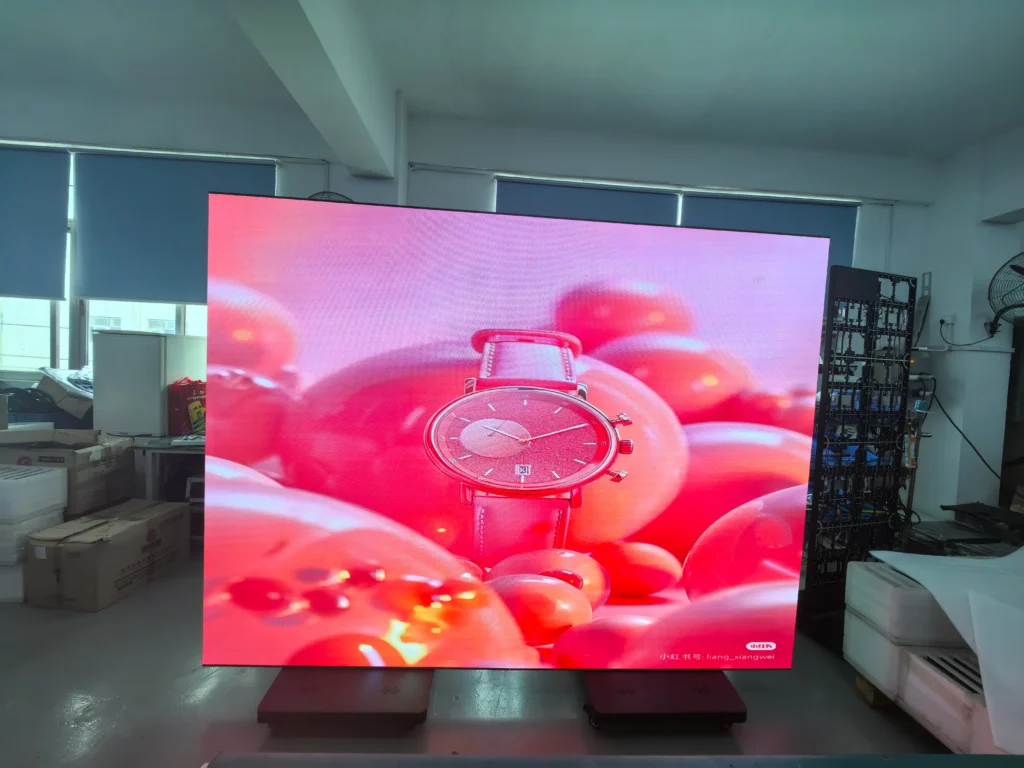
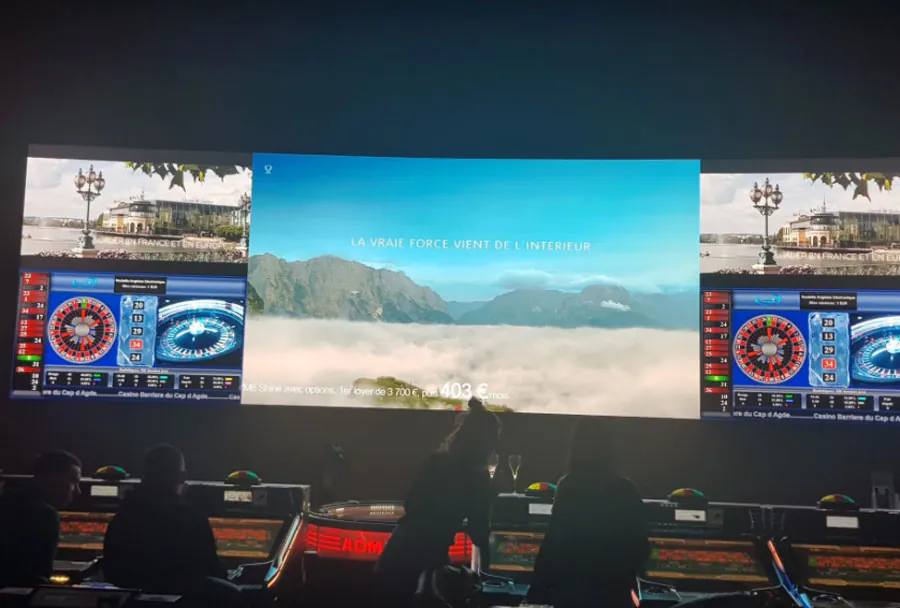
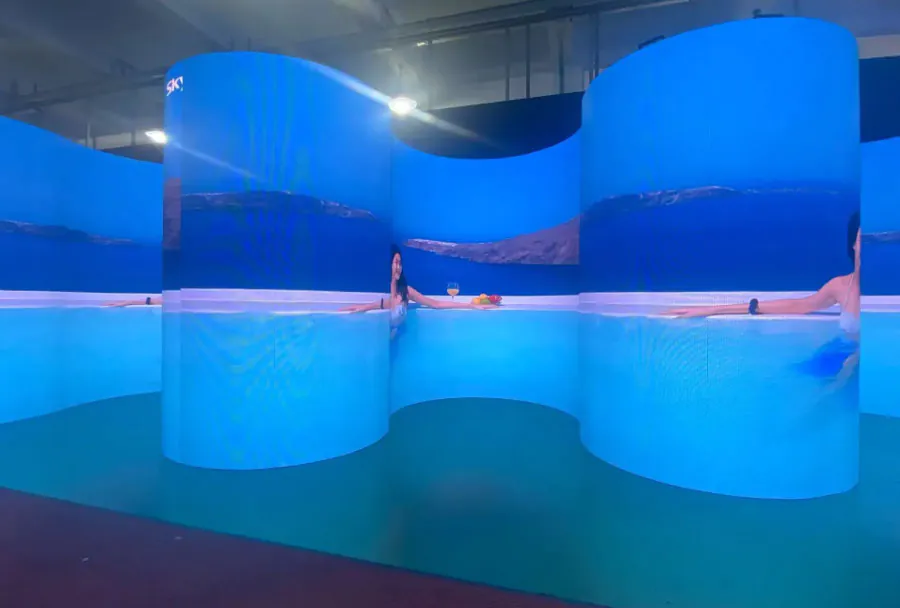
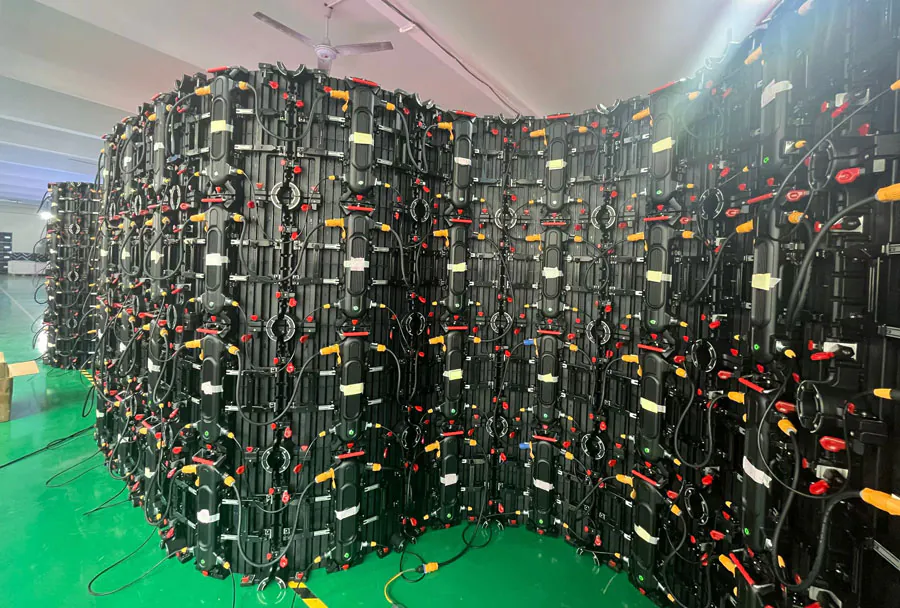
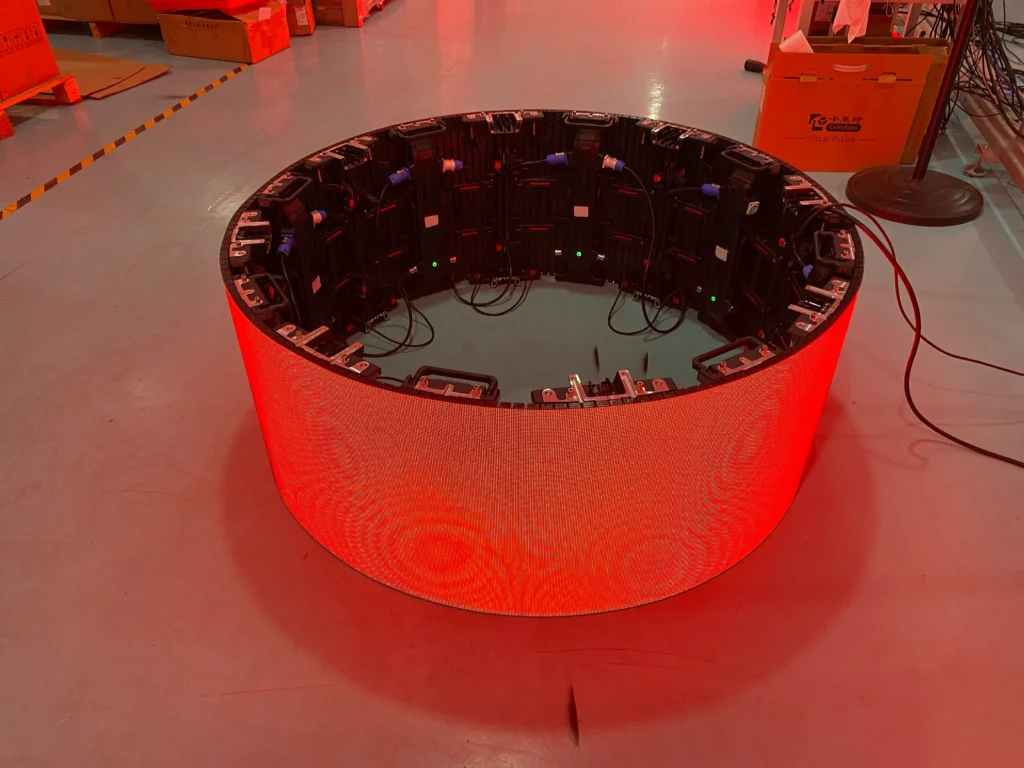
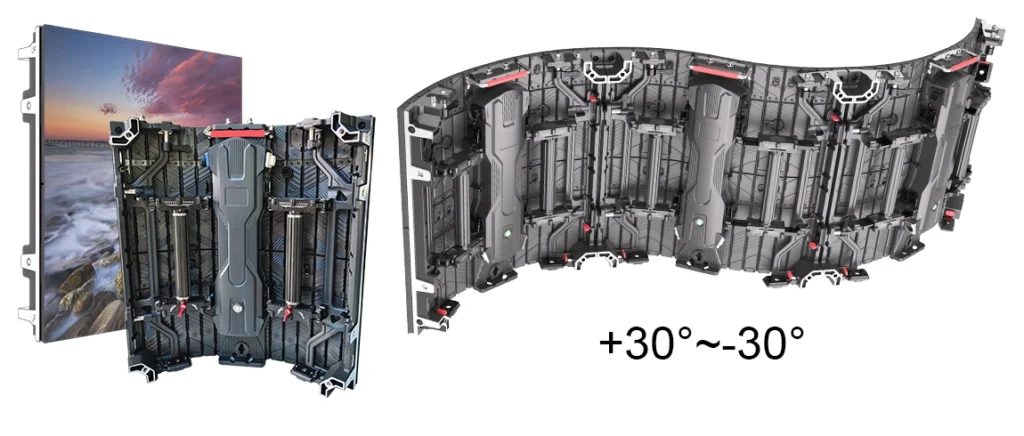
P1.9 indoor and outdoor flexbile cabinet, support P1.9, P2.6, P3.9 indoor and P2.6, P3.9 outdoor, curve degree 22.5 concave and convex. 8 panels can work as a circle.
1. Match Pixel Pitch to Viewing Distance First
Pixel pitch is the distance in millimeters between two LED clusters, and it is the single biggest driver of both image sharpness and price. A smaller pitch means more LEDs per square meter, a tighter image, and a higher bill.
The rule professionals use is simple: divide the viewing distance in meters by a factor of roughly 1 to 1.5 to estimate the pitch you need in millimeters. When selecting Flexible LED Displays for Indoor and Outdoor Projects: How to Choose, pixel pitch is your starting point.
– P2.5 to P4: indoor retail, lobbies, control rooms, and stages where viewers stand 3 to 6 meters away
– P5 to P8: indoor venues with longer sightlines, plus semi-outdoor signage
– P10 and above: large outdoor billboards and stadium screens viewed from 15 meters or more
Getting this wrong is expensive in both directions. Buy too fine a pitch for a highway billboard and you pay for resolution no one can perceive. Buy too coarse a pitch for a conference backdrop and text looks blocky on camera.
Consider a hotel lobby where the nearest sofa sits about 4 meters from the wall. A P3 panel delivers a crisp image at that range without the cost premium of P1.8, which is designed for close-up broadcast work.
Most manufacturers publish a viewing-distance chart in their datasheets. Ask for it in writing along with the actual LED lamp brand, because the same pitch from two suppliers can differ in brightness uniformity and color consistency.
How to apply this: Measure your shortest realistic viewing distance in meters, divide by 1.4, and round down to the nearest standard pitch before you request quotes. Flexible LED Displays for Indoor and Outdoor Projects: How to Choose always starts with this measurement.
2. Weigh Brightness and IP Rating for Outdoor Survival
Outdoor screens live or die by two numbers: brightness in nits and ingress protection (IP) rating. Indoor panels typically run 600 to 1,200 nits, which is plenty under controlled lighting. Direct-sun outdoor installations generally need 5,000 nits or more to stay readable at midday.
Flexible LED Displays for Indoor and Outdoor Projects: How to Choose hinges on getting these ratings right.
IP ratings follow the IEC 60529 standard, which the International Electrotechnical Commission publishes and maintains. The first digit covers solids (dust), the second covers liquids (water). For permanent outdoor use, IP65 on the front face is a common minimum, and fully sealed cabinets rated IP65 or IP66 on all sides are preferred in coastal or rainy climates.
– IP54: dusty indoor industrial spaces, covered atriums
– IP65: front-face protected outdoor signage with a rear cabinet indoors
– IP66 to IP68: fully exposed facades, poolside, and marine environments
Heat is the silent killer. An outdoor cabinet that seals water out also traps heat in, so look for active cooling or high-efficiency drivers. A screen that runs 30 percent cooler tends to last measurably longer before color shift appears.
The U.S. Department of Energy’s Building Technologies Office notes that LED systems generally deliver far longer rated lifetimes than legacy lighting, but that lifetime still depends heavily on thermal management — a useful reminder that the driver and cooling design matter as much as the diode itself.
How to apply this: Before ordering, request the IP rating for both the front and rear of the cabinet, plus the manufacturer’s rated operating temperature range, and confirm your climate stays inside it. Flexible LED Displays for Indoor and Outdoor Projects: How to Choose means verifying these numbers, not assuming them.
3. Plan Curvature and Installation Before You Buy
The whole point of a flexible panel is that it bends. But “flexible” covers a wide spectrum, and the minimum bend radius is the spec that decides whether your design is buildable. Flexible LED Displays for Indoor and Outdoor Projects: How to Choose requires understanding your structure first.
Soft modules with a magnetic or rubber backing typically flex to a radius of a few hundred millimeters. Harder rigid-flex boards bend less but hold their shape better on a permanent column wrap. If you are covering a 1-meter-diameter cylindrical pillar, you need modules rated for that tight a curve — a spec most suppliers list as “minimum bending radius.”
Installation method follows from the structure:
- Magnetic modules: fast to service, best on steel or magnetic-receptive backframes
- Rubber-masked soft modules: ideal for curved walls and temporary event builds
- Rigid-flex tiles: suited to permanent architectural features and corner wraps
Weight and service access matter too. If a module fails high on a facade, can your team reach it? Screens that are front-serviceable avoid the cost of scaffolding or a lift.
One common scenario: an events company wrapping a curved stage riser needs to tear down and rebuild weekly. Magnetic soft modules cut that labor dramatically compared with fixed tiles.
How to apply this: Measure your tightest radius and confirm the panel’s minimum bend radius is at least 20 percent smaller, giving yourself installation tolerance. Flexible LED Displays for Indoor and Outdoor Projects: How to Choose is easier once you know your geometry.
4. Choose the Right Control System and Content Pipeline
A flexible LED display is only as good as the signal feeding it. The control system determines how content reaches the screen and how easily you can change it. Flexible LED Displays for Indoor and Outdoor Projects: How to Choose also means choosing the right signal architecture.
Most installations use one of three architectures:
– Synchronous (real-time): a sending card and receiving cards mirror a computer or video source live — standard for live events and broadcast
– Asynchronous: an onboard player runs scheduled content from internal storage — ideal for signage that changes on a schedule
– Cloud-managed: content pushed over a network to many screens from one dashboard — best for multi-site retail
For remote fleets, cloud platforms let you update hundreds of screens without sending a technician. Content management tools like NoviSign and Yodeck are built for exactly this kind of scheduled, multi-screen digital signage.
Refresh rate is the spec people forget. On camera, a low refresh rate produces scan lines and banding. For any screen that will appear in video, aim for a high refresh rate — most broadcast-grade panels advertise 3,840Hz or higher.
How to apply this: Decide whether your content is live or scheduled, then confirm the control system supports that workflow and your camera frame rate before purchase. Flexible LED Displays for Indoor and Outdoor Projects: How to Choose depends on matching control to content.
5. Compare Total Cost of Ownership, Not Sticker Price
The purchase price is often less than half the real cost. Power consumption, spare parts, service labor, and lifespan all shape the true number. Flexible LED Displays for Indoor and Outdoor Projects: How to Choose is ultimately a financial decision as much as a technical one.
| Cost Factor | What It Tells You | Action to Take |
|---|---|---|
| Price per m² | Hardware only | Compare on equal specs, not raw price |
| Power draw (W/m²) | Annual electricity | Multiply by your local rate and runtime |
| Spare modules | Downtime risk | Buy 5-10% spares at order time |
| Service access | Labor cost | Prefer front-serviceable cabinets |
| Rated lifespan | Replacement timing | Check driver and lamp lifetime |
Power is the sleeper cost. An outdoor screen running high brightness for 16 hours a day draws serious current, and the gap between an efficient and inefficient panel compounds over years. Ask for the average and maximum power consumption per square meter, not just a peak figure.
Spares are cheap insurance. Because flexible panels are often custom-bent, a discontinued module can mean replacing an entire section. Ordering spare modules with the original batch keeps color and pitch matched.
How to apply this: Build a five-year cost sheet using power draw, spares, and service labor, then compare suppliers on that total rather than the initial quote. Flexible LED Displays for Indoor and Outdoor Projects: How to Choose rewards buyers who think long-term.
Frequently Asked Questions About Flexible LED Displays for Indoor and Outdoor Projects: How to Choose
Can flexible LED panels be used in freezing outdoor temperatures?
Most quality outdoor-rated panels are specified to operate well below freezing, often down to around -20°C, but you must confirm the exact rating. Cold affects the driver electronics more than the LEDs themselves. If your site sees extreme cold, ask the supplier for low-temperature test data and heated cabinet options.
Choosing Flexible LED Displays for Indoor and Outdoor Projects: How to Choose in cold climates means verifying the operating range, not just the IP rating.
Do I need a different panel for a curved wall versus a flat one?
No — flexible panels handle both, but the minimum bend radius decides the tightest curve you can achieve. On a flat wall you can often use cheaper rigid modules instead. Only pay the flexible premium where the surface actually curves. Confirm the bend radius for your tightest column or corner before assuming one panel type covers the whole wall.
Flexible LED Displays for Indoor and Outdoor Projects: How to Choose becomes simpler once you know your surface.

How do I stop a flexible screen from looking patchy after a few years?
Patchiness usually comes from uneven brightness degradation between modules or mixed production batches. Mitigate it by ordering all modules from one batch, buying spares at the same time, and using a control system with per-module calibration. Regular calibration — annually is a reasonable baseline — keeps modules matched.
Choosing Flexible LED Displays for Indoor and Outdoor Projects: How to Choose with per-module calibration support saves costly replacements later.
Can I mix indoor and outdoor flexible panels in one installation?
You can, but keep the environments separate. Indoor and outdoor panels differ in brightness, IP rating, and often pixel pitch, so placing them side by side makes the difference visible. Use outdoor-rated units for any exposed face and indoor units for sheltered areas. Document which is which so future service crews install the correct replacement module.
Flexible LED Displays for Indoor and Outdoor Projects: How to Choose means respecting these environmental boundaries.
What refresh rate do I need if the screen will be filmed?
For any screen appearing on camera, target a high refresh rate — broadcast-oriented panels commonly advertise 3,840Hz or above. A low refresh rate causes horizontal banding that is nearly impossible to fix in post. If your display sits behind a news anchor or on a live stage, treat refresh rate as a non-negotiable spec.
Choosing Flexible LED Displays for Indoor and Outdoor Projects: How to Choose on camera means prioritizing refresh rate over a marginally finer pitch.
Conclusion
Choosing the right flexible panel comes down to a handful of decisions you can make before you ever request a quote:
– Match pixel pitch to your shortest viewing distance, not the budget
– Confirm brightness and IP rating against your actual sunlight and weather exposure
– Verify the minimum bend radius covers your tightest curve with tolerance to spare
– Pick a control system that fits whether your content is live or scheduled
– Evaluate five-year total cost, including power, spares, and service access
Start by measuring your viewing distance and your tightest radius today. Those two numbers eliminate most of the wrong options before a single quote lands on your desk, and they make Flexible LED Displays for Indoor and Outdoor Projects: How to Choose far easier to specify with confidence.