Professional Service for TW VISION Flexible LED Display Installation

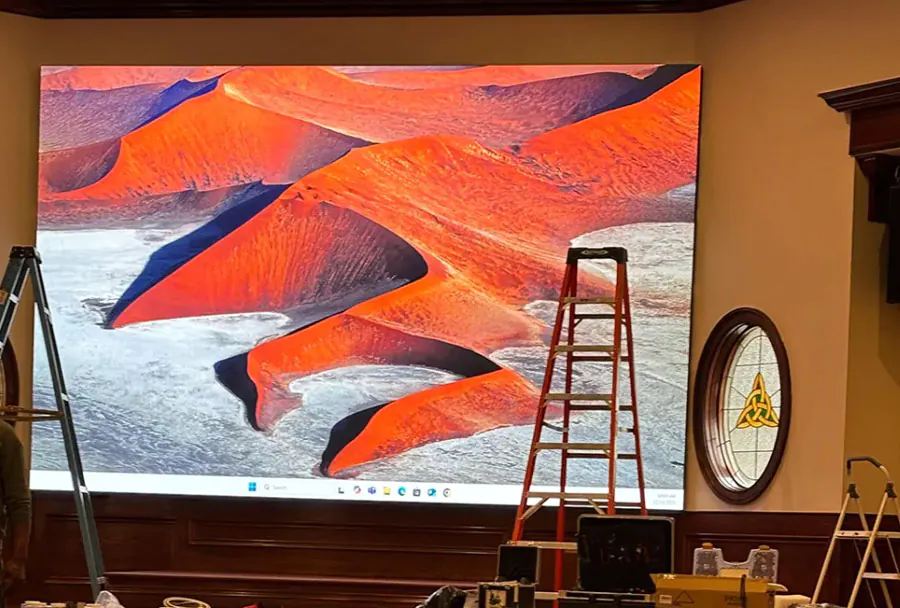
Professional Service for TW VISION flexible led display Installation: Overview and Strategic Approach
TW VISION flexible LED displays are transforming how brands, venues, and architects approach dynamic visual environments. These thin, lightweight, and bendable LED modules enable creative installations that were previously impossible with rigid panels. However, the technical subtleties of flexible LED technology make professional installation not just a convenience but a necessity. This article outlines a professional service approach for TW VISION flexible LED display installation, covering planning, site preparation, installation methodology, testing, and long-term maintenance. It also provides an analysis table to help decision-makers compare critical factors, and practical recommendations to ensure optimal performance and return on investment.
Why Professional Service Matters
Flexible LED displays present distinct challenges compared to traditional rigid displays. They can conform to curved surfaces, drape over structures, and be configured in unconventional geometries. These capabilities increase complexity in mechanical support, cable management, thermal behavior, and electronic calibration. A professional service ensures that the installation:
– Is structurally sound and meets local building codes;
– Maintains LED lifetime and color uniformity through correct ventilation and power distribution;
– Achieves seamless visual performance via precise alignment, mapping, and calibration;
– Provides safe, maintainable wiring and access for future servicing.
Skipping professional steps often leads to premature burnouts, uneven brightness, flicker, or visible seams that compromise both aesthetics and investment value.
Pre-Installation: Planning and Site Survey
A thorough site survey is the foundation of any successful TW VISION flexible LED installation. Key elements include:
– Dimensional verification: Accurate measurements of curves, radii, and mounting surfaces.
– Structural assessment: Load-bearing capacity, attachment points, and potential need for reinforcement.
– Environmental factors: Ambient light, humidity, temperature ranges, and exposure to elements.
– Power and data infrastructure: Existing capacity, distribution paths, and redundancies.
– Safety and access: Egress routes, maintenance access, and compliance with codes.
Professional services will produce a site-specific installation plan, 3D models if necessary, and a bill of materials that matches the TW VISION product specifications with real-world constraints.
Mechanical and Structural Considerations
Flexible LED modules require mounting systems designed to preserve curvature without stressing electronics. The professional approach includes:
– Custom frames and backers that match the desired contour and distribute loads evenly.
– Use of mounting adhesives or clips recommended by TW VISION to prevent slippage or undue bending.
– Vibration isolation for installations near transit or heavy machinery.
– Fire-retardant materials and pathways for emergency egress.
Proper mechanical design increases longevity and reduces the risk of module failure along stress points.
Power Distribution and Thermal Management
Power design for flexible LED displays must account for voltage drops across long runs and heat dissipation for densely packed modules. Professional service includes:
– Calculating and balancing power feeds to avoid uneven brightness.
– Sizing conductors and breakers according to TW VISION recommendations and local electrical codes.
– Designing thermal paths—ventilation, conductive backing, or active cooling—while preserving the desired aesthetic.
– Implementing surge protection and ground fault monitoring.
A well-engineered electrical system prevents hotspots and extends LED lifetime.
Signal Integrity and Content Mapping
flexible displays often require complex pixel mapping to accommodate non-planar geometries. Professional services provide:
– Signal topology planning to minimize latency and maintain refresh rates.
– Use of appropriate data transmitters, fiber runs, or repeaters as needed.
– Software-based mapping tools to warp and blend content across curved surfaces.
– Color calibration and gamma correction to ensure consistent imagery.
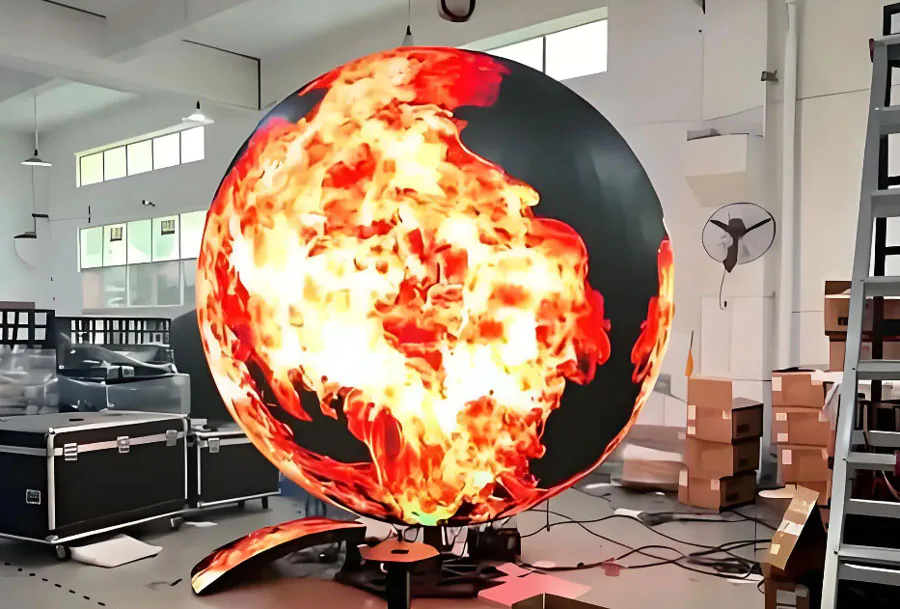
Content mapping is critical to deliver the intended visual experience on non-traditional surfaces.
Installation Workflow and Quality Assurance
A step-by-step professional installation typically follows this workflow:
1. Secure frames and mountings; verify geometry.
2. Pre-test LED modules on a bench to identify any defective units.
3. Sequentially mount LED strips/panels and perform interim electrical verifications.
4. Route and label power and data cables with redundancy where necessary.
5. Perform initial calibration and software mapping as modules are installed.
6. Conduct full-system testing including brightness uniformity, color consistency, refresh stability, and failover scenarios.
7. Final verification against acceptance criteria jointly approved by installer and client.
Quality assurance documentation should be provided, including test reports, as-built drawings, and maintenance schedules.
Testing, Commissioning, and Handover
Professional commissioning validates that the display meets performance specifications and client expectations. Tests include:
– Pixel integrity and dead-pixel counts.
– Brightness and color uniformity under real ambient conditions.
– Network and signal failover testing.
– Thermal behavior under prolonged operation.
– Compliance with safety and electrical standards.
Training for onsite staff and a structured handover package — warranty documentation, spare parts list, and emergency contacts — complete the turnover.
Maintenance and Lifecycle Support
Long-term performance depends on predictable maintenance. Services typically offer:
– Preventive maintenance schedules: cleaning, thermal checks, and firmware updates.
– Remote monitoring to detect anomalies early.
– Fast response service-level agreements (SLAs) for component replacement.
– Inventory of critical spares customized to the installation.
A proactive approach minimizes downtime and preserves ROI.
Cost-Benefit and ROI Considerations
Investing in professional installation reduces hidden costs such as rework, downtime, and shortened LED life. Initial higher installation costs often yield lower total cost of ownership and better visual outcomes, especially for flagship installations where quality impacts brand perception.
Analysis Table: Installation Factors for TW VISION Flexible LED Displays
| Aspect | Importance | TW VISION Specification | Best Practice | Estimated Time/Cost Impact |
|---|---|---|---|---|
| Structural Mounting | High | Flexible modules require secure backing and specified bend radius | Custom frames, distribute loads, follow bend radius guidelines | Medium time; moderate cost (frames/fabrication) |
| Power Distribution | High | Specified voltage/current per module; max run lengths | Balanced feeds, correct wire sizing, surge protection | Low time; variable cost (cabling, breakers) |
| Signal Integrity | Medium | Data rates and cabling recommendations from TW VISION | Use repeaters/redundant paths; shielded/fiber where needed | Medium time; modest cost (repeaters/connection hardware) |
| Thermal Management | High | Operating temp range; thermal dissipation limits | Ventilation, conductive backplanes, temperature monitoring | Medium time; variable cost (cooling/backplane materials) |
| Calibration & Mapping | High | Color profile guidance and calibration tools | Professional software mapping & color calibration routine | High time; skilled labor cost for technicians |
Common Pitfalls and How Professionals Avoid Them
– Overbending modules beyond specified radii: Professionals use jigs and templates.
– Inadequate power planning: Installers model voltage drops and place distribution nodes accordingly.
– Poor content mapping causing visual distortion: Specialists employ advanced mapping software and test patterns.
– Insufficient access for maintenance: Designers include service panels and modular mounting systems.
– Ignoring environmental protection: Professionals apply conformal coatings or protective housings for humid or outdoor sites.
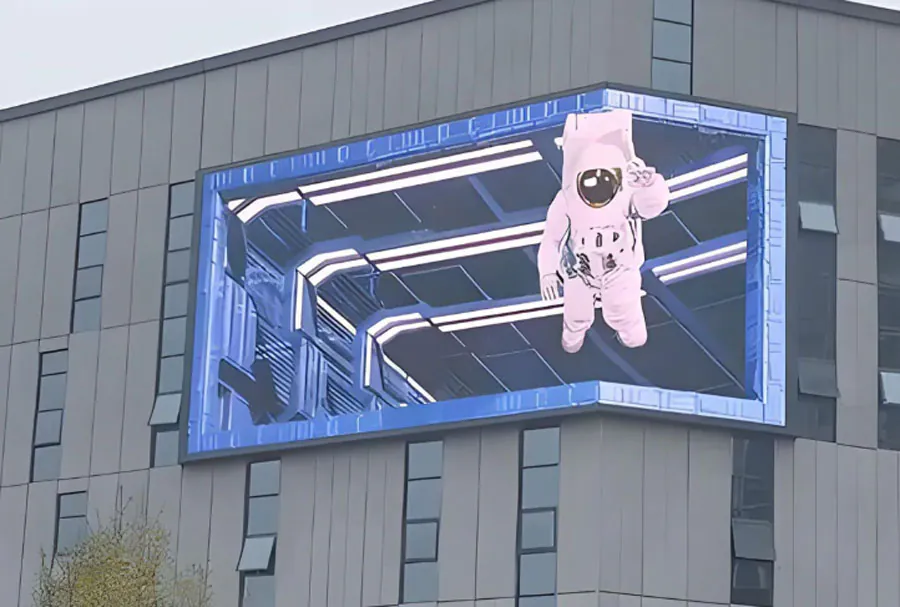
Case Example: Retail Flagship Installation
A TW VISION flexible LED installation in a flagship store combined a curved entrance fa?ade and interior chandelier feature. The professional team performed a detailed site survey, designed custom stainless-steel frames to match the architectural intent, and implemented redundant power feeds with surge suppression. Advanced content mapping enabled a seamless transition between fa?ade and interior display. The result was a high-impact visual identity with minimal maintenance downtime and measurable uplift in foot traffic and dwell time.
Choosing the Right Professional Partner
When selecting an installation partner, prioritize:
– Proven experience with TW VISION products or similar flexible LED technologies.
– Strong project management and documentation practices.
– Comprehensive electrical and structural engineering capabilities.
– Local code knowledge and certified electricians/installers.
– After-sales service, spare parts inventory, and robust SLAs.
Request references, site visit evidence, and detailed scope-of-work proposals before awarding contracts.
TW VISION flexible LED displays offer unparalleled creative opportunities, but they require a disciplined, professional approach to installation. From accurate site surveys and custom mechanical solutions to precise power engineering and advanced content mapping, each phase influences long-term performance and cost-efficiency. Engaging experienced professionals ensures the display looks exceptional, operates reliably, and delivers sustained value. For brands and venues aiming to leverage flexible LED technology as a strategic asset, investing in high-quality installation services is an essential step toward success.