How to Choose the Best Big LED Screen for Your Event

Choosing the best big LED screen for your event starts with one unglamorous question: what will people actually see on it? Event professionals consistently report that screen failures — not speaker cancellations or catering issues — create the most visible problems on site.
Table of Contents
- Step 1: Define Viewing Distance Before You Compare Any Screens
- Step 2: Match Pixel Pitch and Brightness to Your Venue Conditions
- Step 3: Calculate Power, Rigging, and Space Requirements Early
- Step 4: Vet Your LED Screen Supplier Like a Partner, Not a Vendor
- Step 5: Insist on a Pre-Event Test and a Written Contingency Plan
- What pixel pitch do I need for a screen viewed from 30 meters away?
- Is renting an LED wall always cheaper than buying one?
- Can I use an outdoor LED screen indoors?
- How far in advance should I book a large LED screen?
- What happens if a panel fails during my event?
- How Pixel Pitch Defines Big LED Screen Size vs. Resolution in Commercial Displays
- Conclusion
The stakes are real: a pixel pitch mismatch or a miscalculated brightness level can turn a keynote into a squint-fest, and rental quotes vary enormously depending on panel type, pitch, and support gear.
This guide walks you through five practical steps: defining viewing distance, matching pixel pitch and brightness to your venue, calculating power and rigging, vetting your supplier, and testing before doors open.
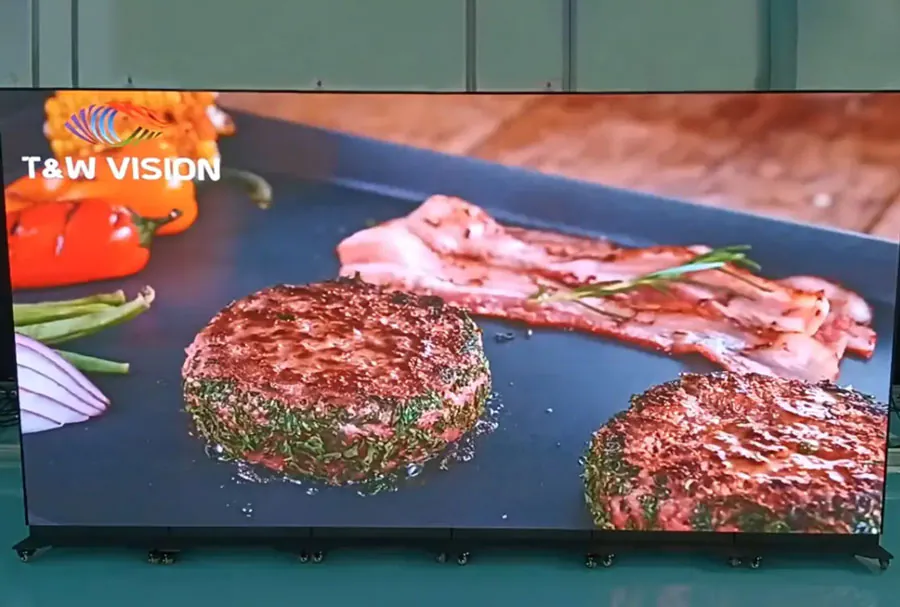
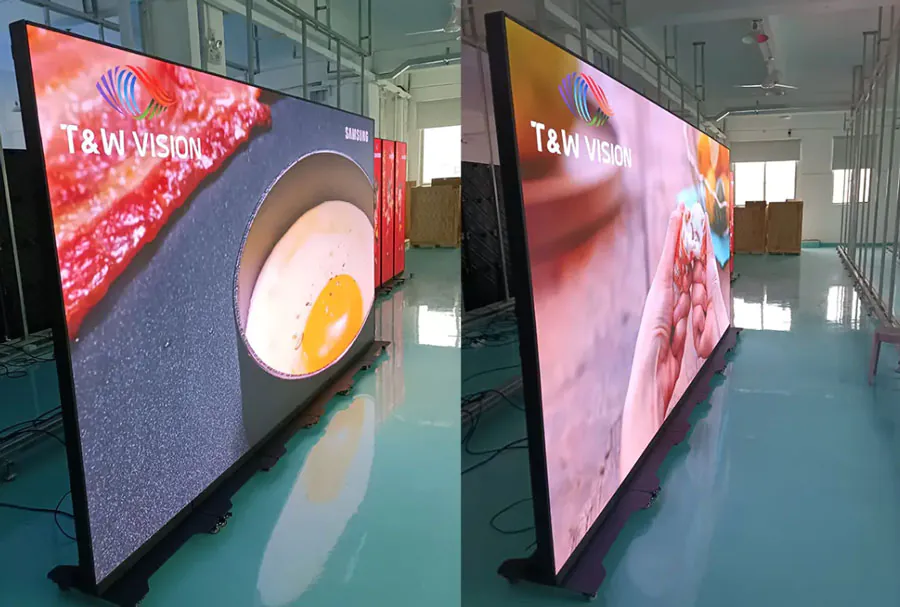
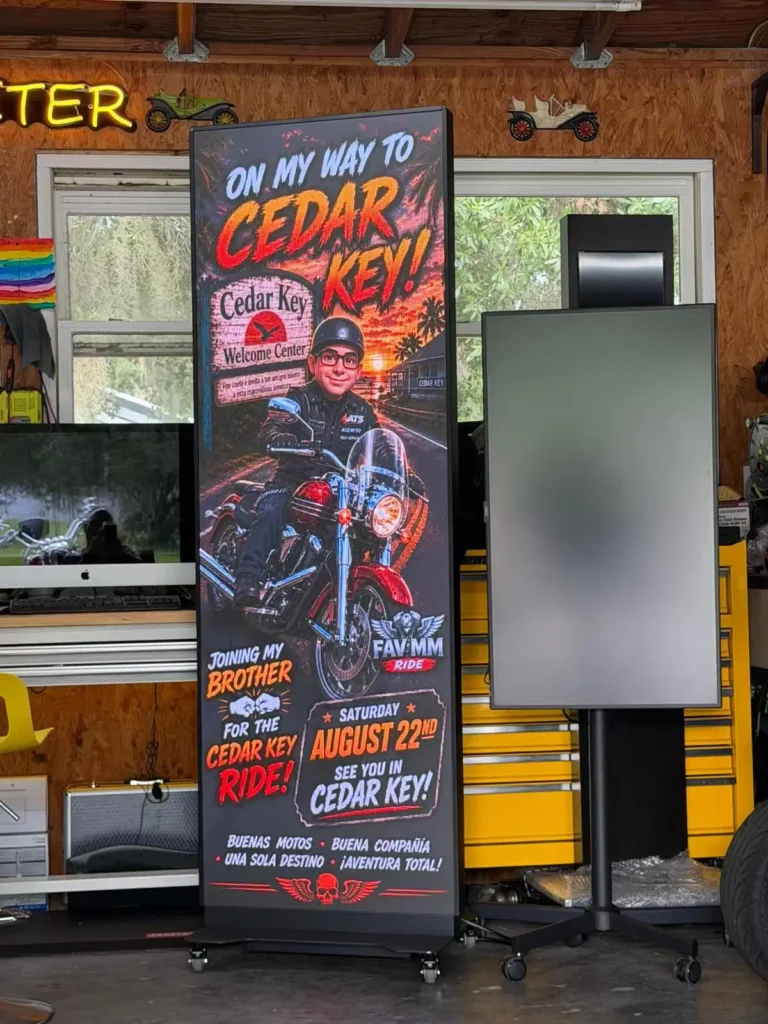
LED poster made by TW VISION, operate on cellphone.
Step 1: Define Viewing Distance Before You Compare Any Screens
How to Choose the Best Big LED Screen for Your Event begins with the single most useful number in any LED screen decision: the distance between the farthest viewer and the screen. Pixel pitch — the spacing between individual LEDs, measured in millimeters — only means something relative to that distance.
A commonly cited industry rule of thumb suggests that for comfortable viewing, the viewing distance in meters should be roughly equal to the pixel pitch in millimeters. A 3.9mm pitch panel, then, looks sharp from about 4 meters away but visibly pixelated up close.
This is why a screen that looks flawless from the back row can look blocky to front-row VIPs.
Measure your venue before you talk to any vendor:
– Find the distance from the screen to the last row (or the back of the standing area).
– Note the distance to the closest seated guest — this is your tightest constraint.
– Decide whether cameras will film the screen; broadcast viewing has stricter pitch requirements than the human eye.
Once you have both numbers, you can filter rental catalogs quickly instead of comparing dozens of irrelevant options.
How to apply this: Walk your venue with a tape measure or laser distance meter today, and write down your nearest and farthest viewer distances before requesting a single quote. This is the foundation of how to choose the best big LED screen for your event.
Step 2: Match Pixel Pitch and Brightness to Your Venue Conditions
Indoor and outdoor events demand completely different screen specifications, and brightness is where most budget mistakes happen. Understanding how to choose the best big LED screen for your event means knowing that brightness is measured in nits (candelas per square meter). For a dim indoor ballroom, panels in the several-thousand-nit range are usually adequate.
For direct sunlight, you typically need considerably higher output — outdoor-rated panels are built specifically for this. The exact figure depends on sun angle, time of day, and how much shade your stage has.
Ambient light isn’t the only factor. Camera recording adds another layer: LED walls can produce moiré and flicker on video if refresh rate is too low. Rental panels designed for broadcast usually advertise high refresh rates for exactly this reason.
Knowing how to choose the best big LED screen for your event also means understanding that over-specifying wastes money while under-specifying ruins the show.
| Factor | What it tells you | Action to take |
|---|---|---|
| Pixel pitch | Sharpness at distance | Match pitch to farthest viewer distance |
| Brightness (nits) | Visibility in ambient light | Confirm venue light levels with vendor |
| Refresh rate | Flicker on camera | Ask for broadcast-rated panels if filming |
| Panel weight | Rigging and floor load | Share venue rigging limits with vendor |
| Power draw | Electrical capacity needed | Check venue amperage before signing |
| IP rating | Outdoor weather resistance | Require IP-rated panels for open-air events |
A common scenario: an organizer books a high-brightness outdoor wall for an indoor gala and ends up with a screen so intense it washes out the stage lighting. Over-specifying wastes money; under-specifying ruins the show.
How to apply this: Send your venue’s light conditions, filming plans, and viewer distances to at least three vendors, and ask each to justify their recommended pitch and nit level in writing. This written justification is central to how to choose the best big LED screen for your event.
Step 3: Calculate Power, Rigging, and Space Requirements Early
LED walls are heavy, power-hungry, and physically deep — three facts that sink more events than image quality ever does. According to AVIXA, the audiovisual industry’s leading trade association, the most common source of event-day AV failures is inadequate advance site planning rather than equipment defects.
Start with power. A large wall can draw significant current, and older venues often have limited circuits near the stage. Ask your vendor for the wall’s maximum power draw in amps, then confirm the venue can supply it — ideally on a dedicated circuit.
Next, rigging. Large panels are typically flown from trusses or ground-stacked. Flown configurations require certified rigging points with sufficient load ratings. Ground-stacked walls need floor space, and they block sightlines unless raised. When you learn how to choose the best big LED screen for your event, these structural questions matter as much as the image itself.
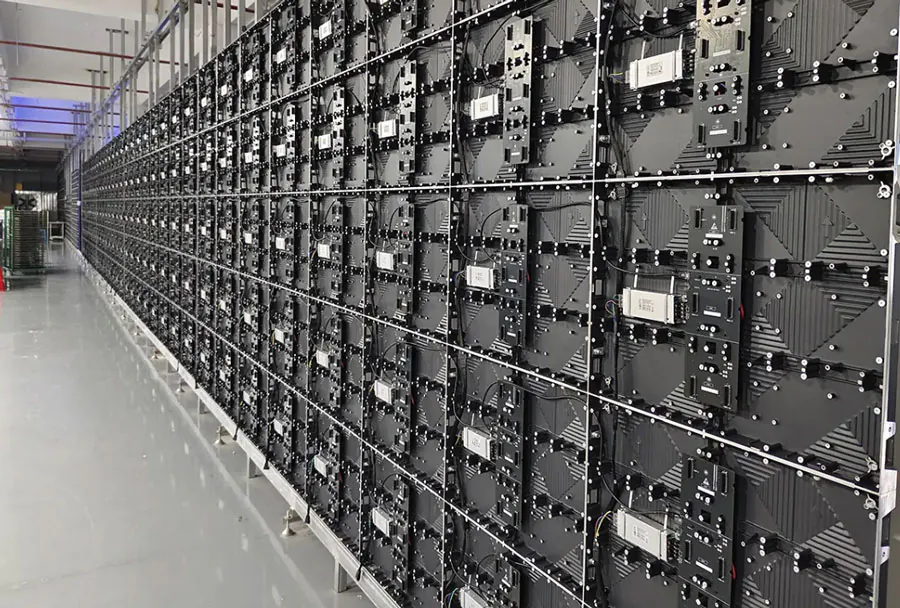
Finally, consider depth and cabling runs. Panels need space behind them for cabling and, on some builds, rear service access. Failing to plan this can push your screen forward and shrink your stage. Mastering how to choose the best big LED screen for your event means treating power, rigging, and space as a single connected calculation.
How to apply this: Request a one-page spec sheet from each vendor listing power draw, weight per panel, total weight, and rigging method, then hand it to your venue’s operations manager for approval.
Step 4: Vet Your LED Screen Supplier Like a Partner, Not a Vendor
The equipment matters, but the supplier determines whether the show runs. Two vendors offering identical panels can deliver wildly different outcomes based on spare parts, on-site technicians, and setup timelines. When you ask how to choose the best big LED screen for your event, part of the answer is always about the people behind the panels.
Ask every shortlisted supplier these questions:
- How many spare panels and power supplies will you bring on site?
- Will a technician stay for the full event, or only during setup?
- What is your typical setup and teardown window for a wall this size?
- Can you provide references from events with similar venue constraints?
- What happens if a panel fails mid-show — what’s the swap time?
Industry surveys consistently show that a meaningful share of event AV problems trace back to insufficient on-site support rather than hardware faults, which is why the technician question matters more than the brand logo on the flight case.
You can also check whether your supplier follows recognized AV standards and training frameworks promoted by organizations like AVIXA, which maintains the industry’s Certified Technology Specialist credential. A supplier who knows how to choose the best big LED screen for your event will welcome these questions rather than dodge them.
How to apply this: Add the five questions above to your request-for-quote template so every supplier answers the same support and spares questions in writing.
Step 5: Insist on a Pre-Event Test and a Written Contingency Plan
The final step happens before load-in: a full test of the exact panels, processor, and signal chain you’ll use on event day. Never accept “it’ll be fine on the day” as an answer. This is where how to choose the best big LED screen for your event shifts from planning to proof.
A proper pre-event check covers several things:
– Dead pixels and color uniformity across every panel
– Content playback at the actual resolution you’ll use
– Source switching between laptops, media players, and live cameras
– Refresh rate verified on camera if the event is being filmed
– A backup signal path in case the primary processor fails
Content resolution trips up more organizers than hardware. A screen with an unusual aspect ratio — common with custom-built walls — can letterbox or stretch standard 16:9 slides. Confirm the native resolution and prepare your graphics to match.
Planning tools help here. You can track your test checklist, vendor communications, and timeline in a project tool like Trello, and use a simple shared document for the contingency plan so your whole team can access it on site. How to choose the best big LED screen for your event ultimately comes down to testing what you’ve planned.
How to apply this: Schedule the pre-event test at least 48 hours before doors open and write a one-page fallback plan covering signal loss, panel failure, and power interruption.
Frequently Asked Questions About How to Choose the Best Big LED Screen for Your Event
What pixel pitch do I need for a screen viewed from 30 meters away?
For a farthest viewer at roughly 30 meters, pitches in the higher millimeter range are often sufficient, though the exact choice depends on content type and budget. Fine text and detailed graphics need tighter pitch than bold logos.
When learning how to choose the best big LED screen for your event, always prioritize the farthest-viewer distance over the closest — front rows can tolerate slight pixelation far better than a back row that can’t read your sponsor logos.
Is renting an LED wall always cheaper than buying one?
Renting is usually the better choice for one-off or occasional events, since purchase adds storage, maintenance, transport, and insurance costs. Buying can make sense if you produce events monthly and have secure storage plus trained staff. Run a break-even calculation over your expected event count per year before deciding.
A reputable rental partner for how to choose the best big LED screen for your event will often credit part of your rental toward a future purchase.
Can I use an outdoor LED screen indoors?
Yes, but with caveats. Outdoor-rated panels are typically heavier, brighter, and sometimes louder due to cooling fans. Running them at low brightness indoors can cause color shift on some models.
If your venue has high ceilings and generous rigging capacity, it works fine — but confirm noise levels with your vendor first, especially for intimate corporate sessions where fan hum would be audible. This is a frequently overlooked part of how to choose the best big LED screen for your event.
How far in advance should I book a large LED screen?
For peak seasons and large walls, booking several months ahead is standard practice in most markets, while smaller walls can sometimes be secured on shorter notice. Lead times stretch further for custom dimensions, outdoor builds, and events needing broadcast-grade panels.
Treat the booking date as a hard deadline in your planning timeline; late bookings often force compromises on pitch or brightness. Smart planners factor how to choose the best big LED screen for your event into their timeline from day one.
What happens if a panel fails during my event?
Well-prepared suppliers bring spare panels and can typically swap a failed module within minutes if a technician is on site. The risk multiplies when no technician stays for the show.
When you evaluate how to choose the best big LED screen for your event, treat on-site support as a specification, not a nice-to-have — and confirm the swap procedure in your contract so nobody is improvising mid-keynote.
How Pixel Pitch Defines Big LED Screen Size vs. Resolution in Commercial Displays?
In commercial LED walls, pixel pitch replaces resolution as the controlling spec, and it reshapes the Big LED Screen Size vs. Resolution: What Matters More? conversation entirely. Pixel pitch is the physical distance between individual LEDs, measured in millimeters.
A P1.9 screen packs LEDs closer together than a P4 screen, producing a denser image — but only from the right distance.
The rule of thumb used across the AV industry: minimum viewing distance in meters roughly equals pixel pitch in millimeters. A P4 display, for example, looks clean from about 4 meters away and gets visibly dotty closer than that. This is why stadium screens use pitches like P10 or P16 — nobody sits 10 meters from a jumbotron.
In the Big LED Screen Size vs. Resolution: What Matters More? debate, pitch often decides the winner.
Here’s how the trade-offs stack up:
| Spec | What it tells you | Action to take |
|---|---|---|
| Pixel pitch | LED spacing in mm | Match to closest viewer distance |
| Screen size | Total viewing area | Size for farthest viewer legibility |
| Resolution | Total pixel count | Secondary to pitch on LED walls |
| Viewing distance | Nearest and farthest seats | Primary spec to measure first |
| Content type | Text, video, or graphics | Denser text needs finer pitch |
| Brightness | Nits or cd/m² | Match to ambient light level |
The key insight: on big LED walls, resolution is a downstream number. Size and pitch determine everything a viewer actually perceives. A 20-foot wall made from P2.5 panels can outclass a smaller P1.5 wall if the audience sits farther back. That is why Big LED Screen Size vs. Resolution: What Matters More? cannot be answered without pitch data.
How to apply this: Before quoting any LED wall, list your minimum and maximum viewing distances. Then pick the coarsest pitch your closest viewer can tolerate — it’s usually the cheapest option that still looks sharp. This approach resolves most Big LED Screen Size vs. Resolution: What Matters More? disputes before they start.
Conclusion
Choosing the right screen comes down to five disciplined moves:
– Measure viewer distances before comparing any specs
– Match pixel pitch, brightness, and refresh rate to your actual venue conditions
– Confirm power, rigging, and space capacity with the venue early
– Vet suppliers on spares, technicians, and references — not just price
– Test the full signal chain and write a contingency plan
None of these steps require deep technical expertise, but skipping any one of them shifts risk onto event day, when you have the least flexibility. Start with the tape measure and the five supplier questions this week, and you’ll be ahead of most organizers who simply accept the first quote.
Knowing how to choose the best big LED screen for your event is ultimately about asking better questions earlier — so request your spec sheets and venue measurements today, and let the data make the decision for you.