

Mobile LED Display Wind Load: Outdoor Safety & Structural

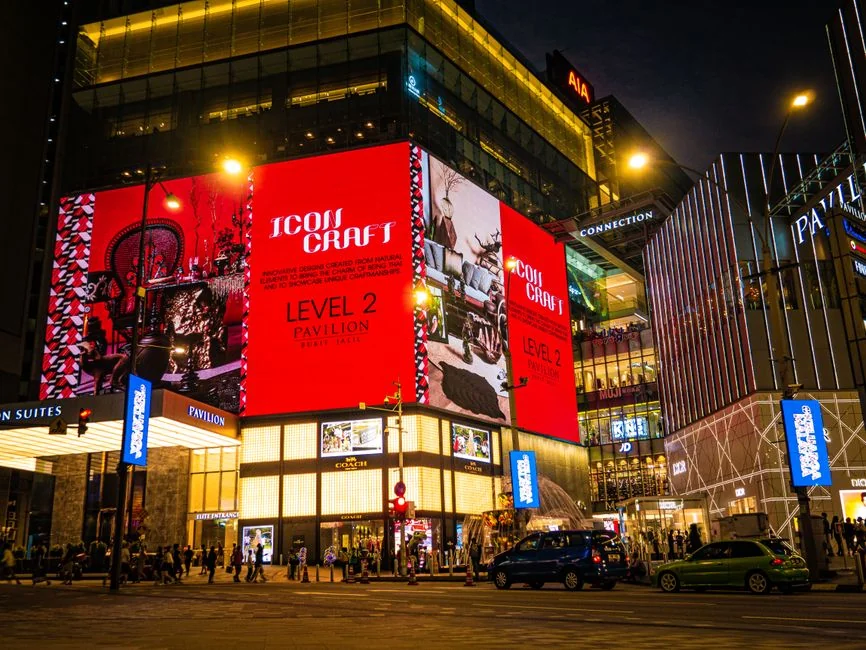
Understanding Mobile LED Display Wind Load: Outdoor Safety & Structural Requirements starts with a simple physics truth: wind does not push, it pressures. A 10-by-20-foot screen facing a 90 mph gust experiences roughly 4,000 pounds of horizontal force, equal to the weight of a compact car.
Table of Contents
- Why Wind Load Matters for Mobile LED Displays
- The Role of Exposure and Gust Factor
- Key Wind Load Calculation Basics
- Wind Pressure vs. Total Force: Do Not Confuse Them
- Structural Requirements for Outdoor Safety
- The Importance of a Safety Factor
- Anchoring and Ballasting Strategies
- One Example of Underground Anchor Use
- Compliance and Inspection Checklist
- What to Check After a Wind Event
- Comparing Wind Speed, Pressure, and Force
- How does wind direction affect load on a mobile LED screen?
- What is the difference between gust and sustained wind speed for anchoring?
- Can you use a mobile LED display in hurricane-prone areas?
- How often should I inspect anchors and structure before an event?
- What are common mistakes in wind load calculations for temporary screens?
- Conclusion
Most event organizers and AV technicians underestimate this force, then anchor a screen with sandbags rated for half that load. The result can be a tipped display, damaged equipment, or serious injury.
This article explains how Mobile LED Display Wind Load: Outdoor Safety & Structural Requirements is calculated, what structural components must resist it, and how to verify your setup before the wind does. Every anchor, ballast block, and inspection step below follows Mobile LED Display Wind Load: Outdoor Safety & Structural Requirements.
You will find practical formulas, real tools, and inspection steps you can use today.
Why Wind Load Matters for Mobile LED Displays
Mobile LED Display Wind Load: Outdoor Safety & Structural Requirements is not just an engineering niche. It is the difference between a safe event and a liability claim. Wind exerts pressure on any exposed surface, and a large LED panel acts like a sail. The larger the screen, the greater the total force even at moderate wind speeds.
Industry practice shows that temporary outdoor screens often fail at wind speeds below the screen’s listed “maximum rated” speed. This happens because the rating may assume ideal orientation, clean wind exposure, and perfect anchoring. Real event sites have gusts, turbulence from nearby buildings, and uneven ground.
The American Society of Civil Engineers (ASCE) provides the baseline standard in ASCE 7, which states that wind loads must account for gust effects, exposure category, and topographic factors. A complete Mobile LED Display Wind Load: Outdoor Safety & Structural Requirements review must include all three factors. Ignoring any one factor can lead to a significant underestimation.
A common scenario: a screen rated for 60 mph is set up on an open field with only two guy lines per side. A 45 mph gust combined with a 15 mph thermal local wind creates an effective pressure on the panel that exceeds the anchor holding force. The screen tips backward or slides.
This is why many rental companies now require a wind action plan that specifically addresses Mobile LED Display Wind Load: Outdoor Safety & Structural Requirements before any outdoor deployment.
How to apply this: Before your next outdoor event, write down the screen’s total surface area and the maximum expected gust speed for the location. Compare that number against the anchor supplier’s holding force rating.
The Role of Exposure and Gust Factor
Wind speed changes with height and surrounding terrain. A screen placed in a parking lot surrounded by low buildings experiences different loading than one in an open field. ASCE 7 defines exposure categories B, C, and D to account for surface roughness.
For Mobile LED Display Wind Load: Outdoor Safety & Structural Requirements, exposure category is often the most overlooked input. Gust factors typically range from 0.85 to 1.3 for rigid structures, depending on exposure. Many field calculations ignore this and use a flat 1.0, which can understate load by 15 to 25 percent in open terrain.
Key Wind Load Calculation Basics
To design for Mobile LED Display Wind Load: Outdoor Safety & Structural Requirements, you need the basic pressure equation from ASCE 7. The velocity pressure \(q_z\) in pounds per square foot (psf) is calculated as:
\(q_z = 0.00256 \times K_z \times K_{zt} \times K_d \times K_e \times V^2 \times I\)
Where \(V\) is the basic wind speed in mph for the site, \(K_z\) is the velocity pressure exposure coefficient, \(K_{zt}\) is the topographic factor, \(K_d\) is the wind directionality factor (typically 0.85 for temporary structures), \(K_e\) is the ground elevation factor, and \(I\) is the importance factor.
For a quick field estimate, you can simplify this to \(q_z ≈ 0.00256 \times V^2\), which gives the pressure for a flat surface in standard conditions.
Using this simplified formula, a 60 mph wind produces about 9.2 psf. A 90 mph wind produces 20.7 psf. A 120 mph wind produces 36.9 psf. Multiply that pressure by the projected area of the screen to get the total horizontal force. A 200 square foot screen at 90 mph therefore sees about 4,140 pounds of force.
You do not need to calculate by hand every time. Tools like SkyCiv Wind Load Calculator let you input the screen dimensions, location, and exposure to get a full wind pressure calculation. Another option is MecaWind Software, which specializes in wind load analysis for non-building structures and can model temporary screen setups.
Both tools reference ASCE 7 and produce calculations that support Mobile LED Display Wind Load: Outdoor Safety & Structural Requirements documentation for your permit or safety file.
How to apply this: Take 10 minutes to enter your screen’s dimensions and site zip code into a wind load calculator. Save the output as a PDF documenting your Mobile LED Display Wind Load: Outdoor Safety & Structural Requirements calculation to keep on-site during installation.
Wind Pressure vs. Total Force: Do Not Confuse Them
A common mistake is to treat pressure as the only number you need. Pressure is per square foot. Total force equals pressure times area. A 20 psf pressure on a 100 square foot screen is 2,000 pounds, but on a 300 square foot screen it is 6,000 pounds.
In any Mobile LED Display Wind Load: Outdoor Safety & Structural Requirements review, pressure and total force are separate checks. Anchor and counterweight ratings are in pounds of holding force, so always convert pressure to total force before selecting equipment.
Structural Requirements for Outdoor Safety
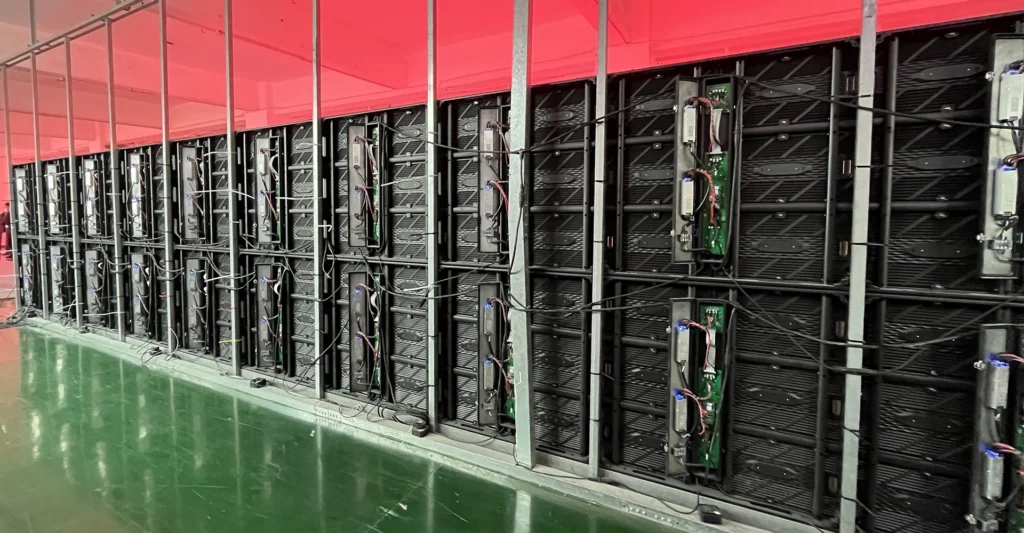
Meeting Mobile LED Display Wind Load: Outdoor Safety & Structural Requirements means the screen’s frame, mast, base, and anchors must all resist the calculated total force. The weakest link determines whether the system stands or falls. A heavy-duty frame bolted to a lightweight trailer with small outriggers is still at risk.
The frame and mast must handle the bending moment created by wind force acting at the screen’s center of pressure. For a screen mounted 10 feet above ground, a 4,000 pound horizontal force creates a 40,000 foot-pound overturning moment at the base. The base or trailer must resist that moment with enough counterweight or stabilizer spread.
This is why many mobile LED trailer manufacturers specify a maximum wind speed for operation and a lower maximum for setup or teardown.
Ballast and anchors are the second line of defense. Sandbags alone are often insufficient for large screens because they rely on friction, not mechanical connection. Ground anchors, such as earth screws or concrete ballast blocks, provide a more reliable hold.
The required holding force per anchor for Mobile LED Display Wind Load: Outdoor Safety & Structural Requirements equals the total horizontal force divided by the number of anchors, multiplied by a safety factor of at least 1.5.
How to apply this: Review your mobile LED trailer’s wind speed rating plate. If it does not have one, ask the manufacturer for the maximum operating wind speed and the maximum setup wind speed before your next deployment.
The Importance of a Safety Factor
A safety factor accounts for unknowns like uneven soil, degraded anchors, and off-axis wind direction. A safety factor is the practical heart of Mobile LED Display Wind Load: Outdoor Safety & Structural Requirements. For temporary outdoor displays, many structural engineers recommend a safety factor of 1.5 to 2.0 on the overturning moment.
This means if you calculate a need for 10,000 foot-pounds of resisting moment, you should provide 15,000 to 20,000 foot-pounds of capacity. Using a smaller factor may save weight but increases the risk of failure under a gust slightly above the design speed.
Anchoring and Ballasting Strategies
Proper Mobile LED Display Wind Load: Outdoor Safety & Structural Requirements execution depends on choosing the right anchoring method for the site. There is no single best anchor for all conditions. Sandy soil, asphalt, concrete, and grass each require a different approach.
For grass or soil, screw-in earth anchors rated for the total force per anchor work well. They must be installed at the correct angle and depth to achieve the published holding capacity. For asphalt or concrete, wedge anchors or drop-in anchors can be used, but you must verify the substrate thickness and condition.
For paved surfaces where drilling is not allowed, large concrete ballast blocks or water-filled barriers provide a non-invasive option. However, ballast weight alone often requires several thousand pounds per screen to resist high winds, which may not be practical for a mobile setup.
Guy wires and tension straps add redundancy. A typical configuration uses four guy lines per side, each attached to a ground anchor and tensioned to prevent the screen from translating or rotating. Line angle is an often-forgotten part of Mobile LED Display Wind Load: Outdoor Safety & Structural Requirements.
The angle of the guy line matters: a line at 45 degrees from horizontal provides roughly equal horizontal and vertical resistance. Lines installed too steeply lose horizontal holding capacity.
How to apply this: Create an anchor plan for each site type you encounter. Draw the anchor locations, specify the anchor type and rated capacity, and list the required torque or installation depth for earth screws.
One Example of Underground Anchor Use
Consider an event on a grass field where the soil is soft from recent rain. A crew uses four 30-inch screw-in earth anchors per side, each rated for 2,000 pounds in good soil. The total horizontal capacity is 8,000 pounds, but the screen needs 12,000 pounds for the site’s 100 mph design gust. The anchors pull out during a gust.
Installing six anchors per side and driving them 36 inches deep raises capacity to 18,000 pounds, meeting the required load. This example shows why Mobile LED Display Wind Load: Outdoor Safety & Structural Requirements must be verified with actual soil conditions.
Compliance and Inspection Checklist
Compliance with Mobile LED Display Wind Load: Outdoor Safety & Structural Requirements is not optional when a permit or insurance policy is involved. Many municipalities require a stamped structural calculation or a manufacturer’s wind load certificate before allowing a large temporary screen in a public space.
Event insurance policies often have clauses that exclude coverage if the setup did not follow the manufacturer’s wind speed limits.
The ASCE 7 Hazard Tool provides official basic wind speed values for any US address. Using this tool gives you the design wind speed to enter into your calculation. It is the recognized source for building code wind speeds and is often accepted by permit reviewers. Save a screenshot of the result for your records.
Your inspection checklist for Mobile LED Display Wind Load: Outdoor Safety & Structural Requirements should include: verifying all bolts are tight, outriggers fully extended, anchors installed to full depth, guy lines tensioned, and the screen raised no higher than the manufacturer’s maximum height for the wind speed.
If wind exceeds the operating limit, lower the screen to the ground immediately and remove tension from any fabric or banner material.
How to apply this: Print a one-page pre-event inspection form that includes the site’s design wind speed, the screen’s total force at that speed, and the rated capacity of every anchor. Sign it before the screen is raised.
What to Check After a Wind Event
After any wind gust near the design limit, lower the screen and inspect all anchors and structural members for deformation or loosening. Pay special attention to weld joints on the mast and base plate, as fatigue cracking can start after repeated wind cycles. A documented post-event review is part of Mobile LED Display Wind Load: Outdoor Safety & Structural Requirements.
Document any damage and remove the display from service until repairs are made.
Comparing Wind Speed, Pressure, and Force
Understanding Mobile LED Display Wind Load: Outdoor Safety & Structural Requirements means recognizing that wind pressure scales with the square of speed. For quick field decisions, use it as part of Mobile LED Display Wind Load: Outdoor Safety & Structural Requirements verification.
The table below shows how wind speed scales into pressure and total force for a typical 10-by-20-foot screen (200 square feet of projected area). It uses the simplified ASCE 7 formula \(q = 0.00256 \times V^2\). No safety factor is applied.
| Wind Speed (mph) | Pressure (psf) | Total Force (lbs) | Action to Take |
|---|---|---|---|
| 60 | 9.2 | 1,840 | Normal ballast + 4 anchors |
| 80 | 16.4 | 3,280 | Heavy ballast + 6 anchors |
| 90 | 20.7 | 4,140 | Lower screen or add guy lines |
| 100 | 25.6 | 5,120 | Suspend operation |
| 120 | 36.9 | 7,380 | Do not deploy outdoors |
| 140 | 50.2 | 10,040 | Structural failure risk |
Use this table as a quick reference, not a replacement for a site-specific calculation. Local exposure and topographic factors can increase these forces by 20 to 40 percent, so a site-specific Mobile LED Display Wind Load: Outdoor Safety & Structural Requirements calculation is still essential.
Frequently Asked Questions About Mobile LED Display Wind Load: Outdoor Safety & Structural Requirements
How does wind direction affect load on a mobile LED screen?
Wind direction changes the projected area and the location of the center of pressure. A head-on wind produces maximum force on the full screen face. A quartering wind from 30 to 45 degrees can create twisting or torsional loads that a straight-line calculation misses. Mobile LED Display Wind Load: Outdoor Safety & Structural Requirements must consider wind from multiple directions.
In practice, you should anchor for the worst-case direction, not just the prevailing wind.
What is the difference between gust and sustained wind speed for anchoring?
Sustained wind speed is the average over one minute or longer, while gust is a short-duration peak that can be 30 to 50 percent higher. The distinction between gust and sustained wind is central to Mobile LED Display Wind Load: Outdoor Safety & Structural Requirements. Anchors and structure must resist the gust speed, not the sustained speed.
Many temporary screen failures happen because operators anchor for the forecast sustained wind of 25 mph, but a 40 mph gust arrives for 3 seconds. Your design wind speed should always be the maximum expected 3-second gust for Mobile LED Display Wind Load: Outdoor Safety & Structural Requirements.
Can you use a mobile LED display in hurricane-prone areas?
Yes, but only if you design for the ASCE 7 basic wind speed for that location, which can exceed 150 mph in coastal hurricane zones. Most standard mobile LED trailers are rated for 60 to 80 mph operational wind, so they cannot remain deployed during a hurricane warning.
The practical rule is to fully lower and evacuate the trailer before tropical-storm-force winds arrive. Portable anchoring cannot satisfy Mobile LED Display Wind Load: Outdoor Safety & Structural Requirements in a hurricane zone without a custom design. For permanent outdoor installation of a mobile-style screen in these zones, you need a custom structural design with deep foundations, not portable anchoring.
How often should I inspect anchors and structure before an event?
You should perform a full inspection before every single deployment, not just annually. Check earth anchors for corrosion, bending, or stripped threads. Inspect the mast and outrigger weld joints after every 10 uses.
For long-term outdoor installations, inspect monthly and after any wind event above 50 mph. Mobile LED Display Wind Load: Outdoor Safety & Structural Requirements is a continuous obligation. Keep a logbook of inspections, including date, wind speed experienced, and any repairs made.
What are common mistakes in wind load calculations for temporary screens?
The most common mistake is using the screen’s weight instead of its wind load. A screen may weigh 2,000 pounds but see a 4,000 pound wind force. Another mistake is ignoring the height of the screen above ground, which increases the overturning moment.
A third mistake is using the sustained wind speed from a weather app instead of the ASCE 7 gust speed for the site. Each of these errors can change the required anchor capacity by a factor of two or more for Mobile LED Display Wind Load: Outdoor Safety & Structural Requirements.
Conclusion
Mobile LED Display Wind Load: Outdoor Safety & Structural Requirements is a discipline that combines physics, site awareness, and hardware selection. The key takeaways are:
– Wind force on a screen scales with the square of wind speed, so a small increase in gust speed creates a large increase in load.
– Total force, not pressure alone, determines anchor and ballast requirements. Always multiply pressure by projected area.
– A safety factor of 1.5 to 2.0 on overturning moment is standard for temporary displays.
– Use ASCE 7 tools and wind load calculators to get site-specific design speeds and document your compliance.
Your next step is to calculate the wind load for your own mobile LED display using the ASCE 7 simplified formula or a tool like SkyCiv Wind Load Calculator. Print the result, compare it to your anchor capacity, and add a safety factor. That is the practical essence of Mobile LED Display Wind Load: Outdoor Safety & Structural Requirements.
Do this before the next outdoor event, and you will know exactly where your setup stands.
Related Articles
- Commercial LED Display: 10 Best for Modern Business Growth
- mobile led screen rental: 5 Best for Events and Promotions
- led screen rental tampa: 9 Best for Events and Promotions
