

Rental LED Screens Supplied to Tampa — Factory Direct

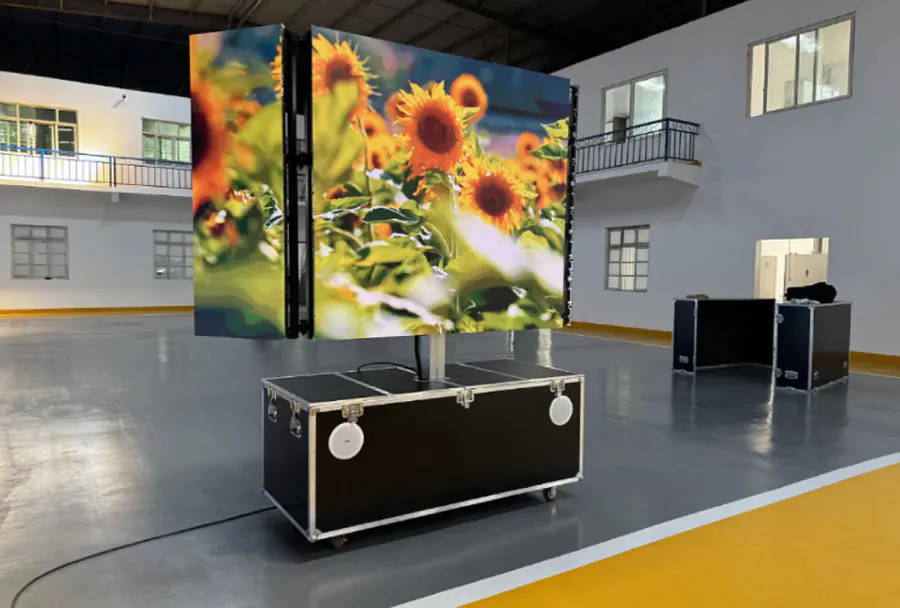
Rental LED screens Tampa covers two very different purchases, and the contract differs before the hardware does.
Tampa adds its own constraints. Afternoon sun, summer thunderstorms, hurricane season from June 1 to November 30, salt air near the bay and Gulf beaches, and venues that enforce tight load-in windows. The screen that works is the one specified for those conditions, not the one with the best headline pitch.
TW VISION manufactures rental-grade LED displays and keeps stock in our Atlanta warehouse — PQ, LP-H and CT series — with delivery into Tampa in one to two days once a stock order is loaded. This guide covers what to define before quoting, how factory supply compares with a supported rental, how to vet a Tampa rental company, what the site demands, and what belongs in the contract.
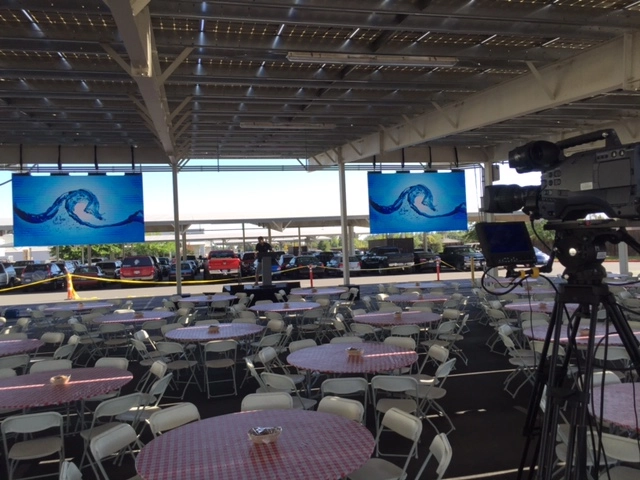
Table of Contents
- 1. Define the Screen Around the Audience and Venue
- 2. What Factory Supply Includes in Tampa
- 3. Compare Factory Supply With a Supported Rental
- 4. How to Choose a Rental Company in Tampa
- 5. Prepare for Tampa Weather, Access and Safety
- 6. Verify Processing, Resolution and Content
- 7. Put Responsibility, Contingencies and Costs in Writing
- 8. Delivery From Atlanta to Tampa
- FAQ
- Conclusion
1. Define the Screen Around the Audience and Venue
The right screen is set by viewing conditions, audience distance, content and installation method — not by a preferred size. Start with a site and content brief, then let the specification follow.
Match pixel pitch to viewing conditions
Pixel pitch is the centre-to-centre distance between adjacent pixels, in millimetres. Smaller pitch means more LEDs per square metre, more detail at close range and a higher price.
The density maths is simple: (1,000 ÷ pitch)². A P3.9 layout carries roughly 65,700 pixel positions per square metre; a P2.6 layout carries about 147,900. That is why one step finer changes cost so sharply.
Use the manufacturer’s native cabinet resolution rather than estimating quality from pitch alone. A wall 5,000 mm wide at P3.9 would theoretically place about 1,282 pixels across, but the actual number depends on cabinet dimensions and how the wall divides.
A working rule for Tampa events: P2.6–P2.9 for indoor sessions where the front row is within 20 feet, P2.9–P3.9 for ballrooms and mid-size outdoor stages, and P4.8–P6.7 once the nearest viewer is beyond 80 feet.
Define brightness and placement
Outdoor screens have to compete with daylight, but a high brightness number alone does not guarantee visibility. Screen orientation, afternoon sun, shade, content contrast and automatic brightness control all matter.
Load-In and Compliance
Ask for the calibrated operating brightness, not the panel maximum. Indoor cabinets typically run 800–1,500 nits; a Tampa outdoor build needs 5,000 nits or more, and 6,000–8,000 nits where the face is in direct sun.
Build a brief covering:
- Indoor, covered outdoor or open air
- Nearest and farthest viewer
- Audience layout and sightlines
- Screen orientation through the event window
- Live video, slides, advertising or mixed content
- Ground-supported, flown or trailer-mounted installation
Ask every bidder to name the panel model, native resolution, brightness, IP rating and processor. Labels such as “high resolution” are not specifications.
How to apply it: measure the viewing area, record the nearest seat, and send every bidder the same site diagram and content list.
Rental LED screens Tampa buyers either need a wall for one weekend or a fleet that earns across a season.
Most Rental LED screens Tampa quotes blur those two cases, which is where the price gap starts.
2. What Factory Supply Includes in Tampa
Factory-direct is not an abstract discount. It means the cabinets, spares and configuration files come from the manufacturer, and the buyer takes responsibility for crews, structure and storage. Three lines are stocked in Atlanta, ready to ship rather than to produce.
| Series | Stock | Pitch | Cabinet | Best for |
|---|---|---|---|---|
| PQ series | Atlanta | Indoor P1.9 / P2.6 / P2.9 / P3.9; outdoor P2.6 / P2.9 / P3.9 | 500×500 / 500×1000 mm | Rental walls, stage builds, indoor and outdoor events |
| LP-H series | Atlanta | P1.86 | 640×1920 mm folding poster | Lobbies, retail, hotel and sales-centre displays |
| CT series | Atlanta | P2.5 | 640×480 mm soft connection | Indoor fixed installation, menu boards, church walls |
| PN / PH / PI | Factory order | P2.976 – P6.67 | 500×500 / 500×1000 mm | Large builds where the required pitch or IP rating is not stocked |
What ships with an order: cabinets matched to one production batch, spare modules, receiving cards and power supplies, the processor and control components, flight cases, and the configuration files that let your technician rebuild the wall without starting from zero.
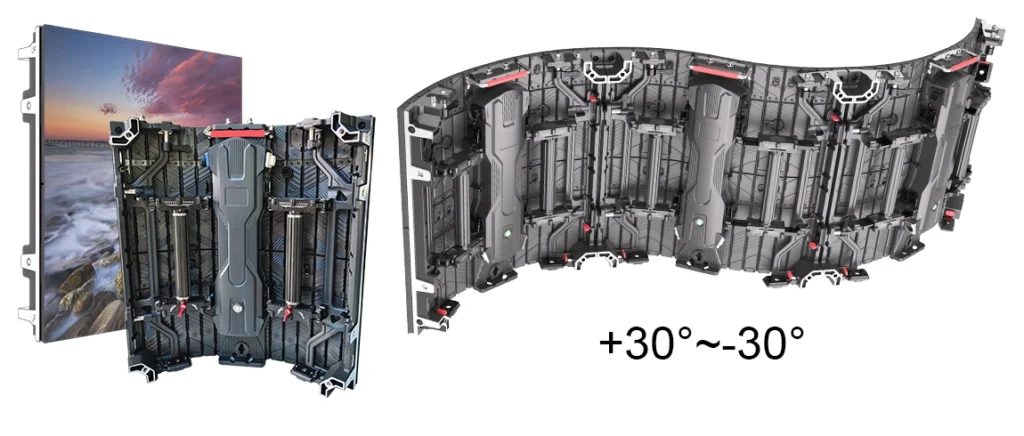
The PQ series covers straight walls, 90-degree corners, curves from −10° to +15°, flexible sections to ±22.5° and 45-degree beveled cabinets, with rear cabinet maintenance and front-service modules. One inventory pool therefore serves several room types.
What sits behind the factory claim. Our facility covers 8,000㎡ and runs 8 independent SMT lines, so placement, PCB assembly, module production and calibration stay in-house. A 500㎡ module aging area screens weak modules before they become cabinets, and roughly 2,000㎡ of cabinet aging runs each batch for 24 hours at operating conditions. Rental cabinets are handled far more often than installed ones, so we apply automated glue dispensing around module edges and automated screw fastening with torque control.
Practical Considerations
Where a size is not stocked, PQ production is listed at 15 days before freight. Stock moves, so confirm the exact pitch and cabinet format at quotation.
How to apply it: send cabinet size, pitch, quantity, indoor or outdoor use, and whether curved locks, cases or transport are needed; ask which items ship from Atlanta and which require production.
3. Compare Factory Supply With a Supported Rental
Factory pricing and event-ready rental pricing describe different scopes. Compare total delivered responsibility, not equipment price.
| Quote element | Factory supply | Supported rental | What to check |
|---|---|---|---|
| LED cabinets | Included | Included | Exact model and batch |
| Structure | Usually separate | Often available | Engineering and wind rating |
| Processor | Optional | Usually included | Inputs, scaling, backup |
| Labor | Buyer arranged | Quoted locally | Crew hours and overtime |
| Spares | Purchased | Provider inventory | Quantity on site |
| Support | Remote or limited | Event technician | Response terms |
A factory order makes sense when you already have trained technicians, compatible rigging, dry storage and enough bookings to keep the fleet working. A supported rental makes sense when the wall is needed for one weekend and the crew is the hard part.
Normalise every proposal. Convert each quote into the same scope: freight, drayage, lift equipment, power distribution, setup time, rehearsal, operator hours, teardown, tax and potential overtime. A common Tampa scenario is a low equipment quote that excludes the processor and ground support; once those are added, the advantage disappears.
Request a line-item scope and mark each item included, excluded or supplied by another contractor. The proposal should also say who accepts responsibility for signal testing and failed components.
How to apply it: copy every proposal into one comparison sheet and calculate the delivered, installed, operated and removed cost.
For Rental LED screens Tampa installations, humidity and salt set the cabinet treatment before brightness does.
Rental LED screens Tampa pricing separates cabinets, structure, labour and permits.
4. How to Choose a Rental Company in Tampa
If the crew, structure and show-day support are part of what you are buying, the company matters as much as the panel. Five questions separate a production company from a broker.
- Specifications in writing. Pitch, calibrated nits, refresh rate, IP rating and the exact cabinet and processor model.
- Crew credentials. Rigging certifications, stamped engineering for flown builds, and coordination with staging, lighting and audio.
- Redundancy. Backup media server, duplicate signal path, and spare modules, receiving cards and power supplies on site rather than in a warehouse.
- Inventory depth. Enough panels in the exact pitch, plus the ability to add a second screen or replace a batch at short notice.
- Insurance and contract terms. General liability, equipment coverage, additional-insured status for the venue, and a weather clause that names the shutdown trigger and who decides.
Local knowledge matters in Tampa. Hillsborough County and City of Tampa permit requirements differ from beach communities, venues enforce their own load-in windows through marshalling areas, and some require union or in-house labor for rigging and electrical work. A company that has run the same venue in the same month is better evidence than a star rating.
Our guide to outdoor LED screen rental companies in Florida covers provider types, day-rate bands and vetting in more detail.
How to apply it: send the same five questions to three companies and compare the written answers, not the verbal ones.
5. Prepare for Tampa Weather, Access and Safety
Plan for weather and wind
The National Weather Service publishes the forecasts, watches and warnings production teams track. Hurricane season runs from June 1 to November 30, but thunderstorms and strong wind affect Tampa events outside that window too.
An outdoor panel’s IP rating is not permission to operate through every storm. The structure, ballast, connectors, processors, generators and crew procedures each have their own limits. The plan should name:
- The person monitoring official alerts
- The person authorised to stop the show
- The shutdown sequence
- The wind limit set by the engineer or manufacturer
- The evacuation and screen-lowering procedure
For elevated or flown installations, wind loading should be engineered for the site against a recognised temporary-structure standard such as ANSI E1.21, not copied from a typical installation drawing.
Protect access and electrical routes
The 2010 ADA Standards for Accessible Design state that the minimum clear width of walking surfaces is 36 inches, subject to listed exceptions. Barricades, cable ramps, ballast and control stations should not narrow an accessible route.
Satellite imagery helps with vehicle approach, but it cannot show temporary barriers, current construction, surface condition or venue restrictions. Walk the site.
Confirm grounding, power capacity, wet-location protection and inspection requirements with qualified professionals, and confirm the IP rating under IEC 60529 before specifying hardware for an uncovered site.
How to apply it: walk the site with the venue, screen provider, electrician and production lead, then document access, power, ballast, weather authority and shutdown steps.
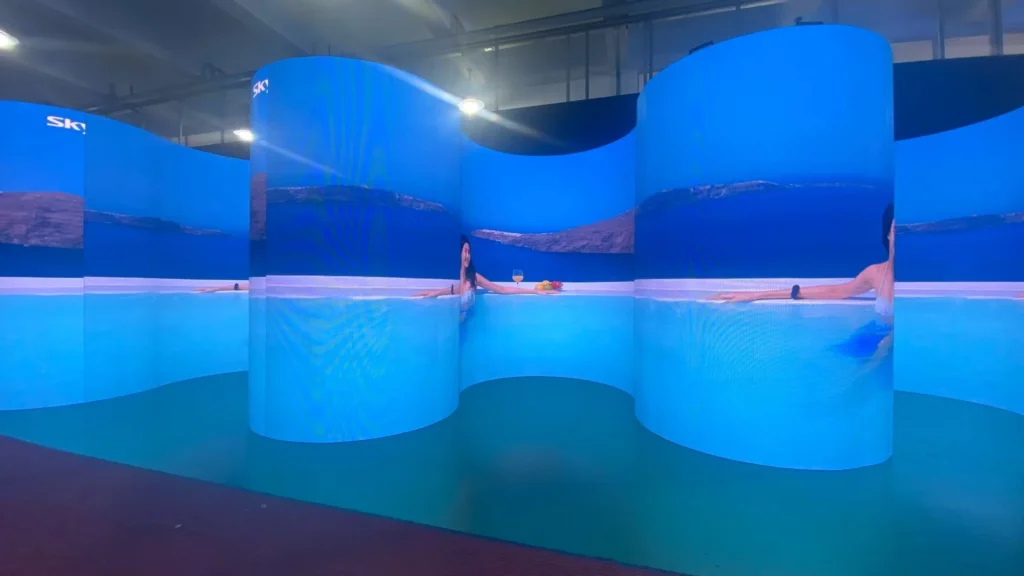
State whether you are hiring for a date or buying for a calendar, and the Rental LED screens Tampa answer changes.
6. Verify Processing, Resolution and Content
A wall has to display every planned source at the correct aspect ratio, frame rate, colour level and resolution. Cabinets alone do not deliver that.
Calculate the native canvas
Take one cabinet’s pixel dimensions and multiply by the number of cabinets across and high. A cabinet 128 pixels wide, used ten across, gives a native width of 1,280 pixels. Compare that with the content you intend to run: a 4K file on a 1,280-pixel wall is being scaled, and fine text will not survive.
Ask which processor receives the signal, how scaling is handled, and whether a backup input can be switched without rebuilding the screen configuration.
Test real event files
Produce media at the wall’s native canvas wherever possible. Standard presentation files otherwise get cropped, letterboxed or stretched unevenly. A sponsor reel with small legal text near the bottom edge often looks fine on a laptop and disappears from the audience.
Run a test that includes the final playback computer, the planned cable path, the switcher or processor, the backup signal, a live camera feed if applicable, and representative video and presentation files. VLC media player is useful for inspecting and playing files during content checks, but it does not replace the processor, media server or a full signal-chain rehearsal.
Ask for a native-resolution map and a supported-input list before the content deadline, not after.
How to apply it: export one representative file at the confirmed native canvas and run it through the complete signal chain before event day.
7. Put Responsibility, Contingencies and Costs in Writing
The contract should define the screen, the services, the operating conditions, the failure response, cancellation terms and who pays for what.
Specify what will arrive
List cabinet model, wall dimensions, native resolution, processor, mounting system, power distribution, cables, spare components, crew, operator coverage and setup schedule. Replace “complete LED package” with itemised descriptions.
State whether the supplier provides engineering documents, certificates of insurance, permit support and equipment substitutions. If substitutions are allowed, require equivalent or better specification and written approval.
Define failure and weather procedures
Set a communication chain for missing freight, damaged cabinets, processor failure, delayed access, unsafe weather or a venue power problem. The document should say who can pause the show and whether standby labor or replacement equipment creates extra charges.
One gap appears repeatedly: a contract promises a replacement module but says nothing about the technician who installs it. Usable inventory sits in a case while the screen stays dark.
Review these terms carefully: deposit and payment schedule, cancellation and postponement rules, freight and redelivery charges, labor minimums and overtime triggers, damage responsibility, weather-related costs, and taxes. Florida’s state sales tax rate is 6%, plus any county discretionary surtax; confirm the treatment of your order with the vendor or a tax adviser.
Confirm which legal entity signs and which provides support — a manufacturer, reseller, production company and installation contractor can be four different businesses.
How to apply it: attach a written scope exhibit and assign one responsible party to every equipment, labor, safety and contingency item.
8. Delivery From Atlanta to Tampa
We quote and book transport from the Atlanta warehouse to your Tampa address, so stock arrives on a confirmed appointment instead of an open pickup notice.
Transit. One to two days once a stock order is loaded; confirm the schedule at quotation.
Options. Standard LTL to a commercial dock; liftgate where there is no dock or forklift; inside delivery to a ground-floor room on request; direct venue delivery inside an agreed window for event dates. Buyers with their own freight account can collect.
Venue rules. Tampa venues set delivery windows through marshalling areas, may charge drayage for materials handled on site, and often require advance vehicle booking and escorted back-of-house access. Confirm before the truck is booked.
Unloading. A 500×1000 mm cabinet on a pallet is not a two-person lift. Without a dock, specify liftgate and confirm who moves pallets from the tailgate to the room.
Peak dates. Convention weeks, holiday weekends, spring break and festival season tighten both equipment and freight capacity. Order and book transport together.
How to apply it: include the receiving address, dock or liftgate status, delivery window and contact in the purchase order.
Rental LED Screens Tampa — FAQ
What does factory-direct mean for a Tampa buyer?
You buy cabinets, spares, processing and configuration files from the manufacturer rather than renting them per event. You arrange or contract the crew, structure, power and storage. It lowers long-term cost when the same configuration is used repeatedly, and removes the rental margin when it is not.
How fast can stock reach Tampa?
One to two days in transit once a stock order leaves Atlanta. Confirm at quotation; pitches that are not stocked require production, and PQ production alone is listed at 15 days before freight.
Can I buy cabinets and hire a local crew?
Yes, and it is the usual arrangement. The purchase covers hardware and technical support for the equipment; a Tampa production partner surveys the site, supplies structure, rigging, power and operators. Put the crew scope in writing so responsibility is not split by assumption.
Do I need IP65 in Tampa?
For any uncovered site, yes. Tampa’s summer storms and salt air punish unsealed cabinets, and the second digit of the IP rating — the water digit — is the one that matters outdoors. Indoor panels used outdoors will also look washed out in daylight.
How much does a Tampa LED wall cost?
Practical Considerations
As a working range, a small trailer screen for a weekend runs $2,000–$8,000 all-in; a mid-size modular wall of 200–400 square feet for one day runs $6,000–$20,000; a stadium-scale build with full production starts around $25,000. Purchase prices for 16-foot-class walls start near $18,699 and rise with pitch. For a detailed breakdown, see our Florida outdoor LED cost guide.
Can a screen stay installed overnight between event days?
Only when the venue, supplier, engineer, insurer and security plan all allow it. Overnight exposure adds unauthorised access, changing weather, condensation, theft and generator shutdown to the risk list. The agreement should name security staffing, power-down steps, covers, morning inspection and who owns damage found before reopening.
What if a few pixels fail during the show?
Notify the assigned technician and do not touch powered modules unless trained and authorised. The response may be processor diagnostics, cable checks, calibration, module replacement or switching to a spare cabinet. A small isolated defect may not justify interrupting a live program; a failed receiving card affecting a large section usually does.
Conclusion
Choosing an LED wall for Tampa requires more than dimensions and the lowest equipment price. The screen has to suit the audience, survive the site, display content correctly and have accountable technical support.
- Define the application first: viewing distance, placement, content, brightness and mounting method.
- Compare complete scopes: structure, processing, freight, labor, power, testing and removal.
- Plan for local conditions: weather authority, accessible routes, electrical safety and shutdown procedures.
- Protect the event contractually: equipment, responsible parties, substitutions, support and contingency costs.
Send us your cabinet size, pitch, quantity, indoor or outdoor use and Tampa delivery address. We will tell you what is on the Atlanta floor, what has to be produced, and which parts of the job belong to your local crew.
For specification and viewing-distance decisions, see the Florida outdoor LED buyer’s guide. Want the wider state picture, see rental LED screens supplied to Florida. For the equipment rate itself, see LED screen panel price.
Buyers comparing Rental LED screens Tampa options should ask for the cabinet count, the spare ratio and the processor model in writing.
