

Mobile LED Display Setup: Installation, Transport & Support Guide

A thorough Mobile LED Display Buying Guide: Setup, Transport & Support plan does more than help you compare pixel pitch; it prevents expensive downtime from cracked cabinets and dead modules.
Table of Contents
- 1. Match the Panel Format to Your Actual Setup Crew
- Rent Before You Commit
- 2. Verify Towing Weight and Road Rules Before You Buy
- Check Width and Height, Not Just Weight
- 3. Inspect Setup Hardware Before You Pay for Extras
- 4. Lock Down Support and Warranty Terms in Writing
- 5. Build a Spare-Part and Transport Kit Before Your First Job
- Does a standard cargo insurance policy cover LED screen damage during transport?
- What should I do if my mobile LED trailer exceeds my state’s legal width?
- Can I set up a mobile LED display on a slope or uneven ground?
- How do I find field service technicians near an event site?
- Is a foldable LED panel more fragile than a fixed frame?
- Conclusion
A surprising fact many buyers miss is that many mobile LED trailer rigs cross the 26,001-pound GVWR threshold, which means towing them legally often requires a commercial driver’s license and proper cargo securement.
The core problem is simple: you can choose the right panel for your event, but if you ignore how the screen will be transported, set up, and serviced, you may void the warranty or lose revenue.
This guide covers five decisions that matter most before you buy, from trailer format to support contracts, and gives you a checklist you can act on today. A focused Mobile LED Display Buying Guide: Setup、Transport & Support helps you ask the right questions before money changes hands.
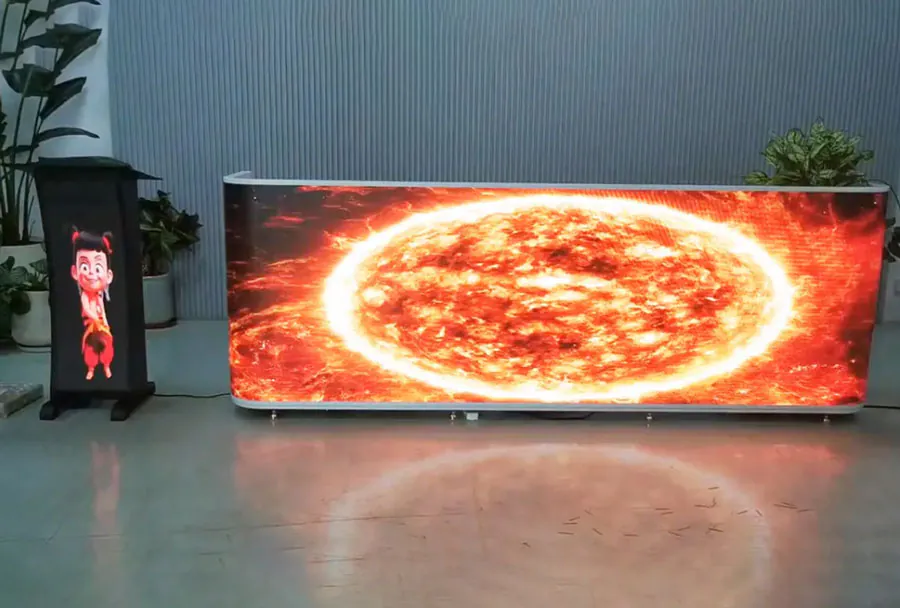
P1.9 indoor Led display for rental usage, flexbile cabinet support -22.5~22.5 degree, made by TW VISION-PD series.
1. Match the Panel Format to Your Actual Setup Crew
Start by choosing between a hydraulic trailer, a ground-stacked modular wall, or a vehicle-side screen, because each changes labor and transport differently. A practical Mobile LED Display Buying Guide: Setup、Transport & Support starts with the number of people who will actually set up the display on event day.
Outdoor mobile panels commonly use pixel pitches between 2.9 mm and 10 mm; tighter pitch suits closer viewing but demands more careful alignment. Hydraulic trailer systems often need one trained operator, while ground-stacked walls may require a small crew to lift and level each cabinet. That labor difference affects which venues you can service profitably.
A realistic Mobile LED Display Buying Guide: Setup、Transport & Support also weighs how often your crew can rehearse the same sequence under time pressure.
Comparative Setup Analysis
Below is an analysis table comparing typical setup stages, average time per stage, recommended crew composition, essential tools, and the most common support actions needed during that stage.
| Setup Stage | Avg. Time | Crew Required | Essential Tools/Kit | Common Support Actions |
|---|---|---|---|---|
| Unloading & Staging | 30–90 mins | 2–4 | Lift equipment, road cases, inventory list | Verify inventory, re-stage missing items, coordinate logistics |
| Structural Assembly | 45–150 mins | 3–6 (rigging lead) | Rigging hardware, torque tools, safety gear | Confirm anchor points, adjust rigging tolerances, conduct safety inspections |
| Power Distribution | 30–90 mins | 1–2 (power tech) | PDUs, load calculators, cable testers | Balance loads, fix tripped circuits, replace faulty PSUs |
| Signal & Data Routing | 30–120 mins | 1–3 (signal tech) | Cable patching, scalers, fiber testers | Resolve sync issues, re-route faulty links, update firmware |
| Calibration & Testing | 30–90 mins | 1–2 (calibration tech) | Colorimeter, test patterns, media player | Adjust uniformity, map pixels, confirm final QA |
Rent Before You Commit
A common scenario: a buyer specs a high-resolution screen for a music festival but forgets that the local crew only has two people. The screen sits unused because setup takes too long. Rent the same format for one job before you buy.
This rental test is one of the lowest-cost steps in a Mobile LED Display Buying Guide: Setup、Transport & Support. That rental day is exactly the kind of evidence a Mobile LED Display Buying Guide: Setup、Transport & Support should require.
How to apply this: list your typical crew size and the longest setup window you can tolerate, then shortlist formats that fit both.
2. Verify Towing Weight and Road Rules Before You Buy
The single biggest surprise in any Mobile LED Display Buying Guide: Setup、Transport & Support is that a screen’s road weight can change who is allowed to drive it. Many mobile LED trailers and tow vehicle combinations exceed the 26,001-pound gross vehicle weight rating threshold, which generally means the driver needs a commercial driver’s license under U.S. DOT rules.
This is the part of a Mobile LED Display Buying Guide: Setup、Transport & Support that many states enforce through roadside inspections.
The Federal Motor Carrier Safety Administration cargo securement rules state that cargo must be firmly immobilized or secured by structures of adequate strength, dunnage, shoring bars, tiedowns, or a combination. In other words, the screen is cargo, and a loose LED cart can shift during braking.
A Mobile LED Display Buying Guide: Setup、Transport & Support must treat road legality as a purchase criterion, not an afterthought.
Check Width and Height, Not Just Weight
Trailer width matters too. Many states require oversize permits once a load exceeds 8 feet 6 inches. A mobile screen that folds to legal width may still need a permit if outriggers or mounting brackets extend the envelope.
As part of the same Mobile LED Display Buying Guide: Setup、Transport & Support review, measure folded height so low bridges and site gates don’t stop you.
How to apply this: ask the seller for a certified weight certificate and the folded transport dimensions, then run both through your state DOT’s permit portal before a purchase.
3. Inspect Setup Hardware Before You Pay for Extras
The LED modules get the spotlight, but setup reliability comes from the lift frame, leveling jacks, and locking pins. Your Mobile LED Display Buying Guide: Setup、Transport & Support review has to include these mechanical parts, because a failed hydraulic hose can sideline a perfectly good panel.
Manufacturers publish wind-load ratings for raised outdoor screens. Ask for the maximum wind speed the screen can handle when raised, and check the frame’s lift mechanism for hydraulic cylinder guards, safety pins, and outrigger pads. Galvanized or powder-coated steel resists road salt and event-site mud longer than untreated mild steel.
One reason a Mobile LED Display Buying Guide: Setup、Transport & Support should cover the lift frame is that these parts often fail without warning.
| Component | What to inspect | Action to take |
|---|---|---|
| Hydraulic fittings | Leaks, corrosion, hose wear | Replace hoses on a scheduled interval |
| Locking pins | Bent pins or loose holes | Keep spare pins in the road kit |
| Outrigger pads | Cracks or missing anti-slip surface | Test on soft ground before selling |
| Cabinet alignment | Uneven gaps between modules | Re-level frame before powering on |
That compact table can be printed as a startup checklist. A printed startup checklist turns this section of a Mobile LED Display Buying Guide: Setup、Transport & Support into a daily habit. Keep this table with your Mobile LED Display Buying Guide: Setup、Transport & Support documents for quick training.
How to apply this: request the manufacturer’s daily setup checklist and compare it to your own pre-event inspection, then add any missing hydraulic or pin checks.
4. Lock Down Support and Warranty Terms in Writing
Support means more than a tech support phone line. For this Mobile LED Display Buying Guide: Setup、Transport & Support step, verify the response time for onsite service, the availability of spare receiving cards, and whether the warranty covers the labor to swap a failed module.
Many standard warranties on LED modules exclude physical damage from transit, so cargo insurance is a separate decision.
Tools such as Novastar video processing software can help you diagnose signal faults and calibrate modules before you file a support ticket. If you plan to map content across unusual screen shapes, Resolume is a real media server used by staging professionals for LED wall playback.
When you document every fault, your Mobile LED Display Buying Guide: Setup、Transport & Support records become negotiation power for faster service.
Ask the seller to put the response-time promise in writing. A two-year warranty on modules means little if the nearest spare part sits in a warehouse overseas. Without a written service plan, a Mobile LED Display Buying Guide: Setup、Transport & Support leaves you guessing after the first warranty claim.
A solid Mobile LED Display Buying Guide: Setup、Transport & Support always separates parts coverage from freight and labor coverage.
How to apply this: before payment, request a written support agreement that states maximum response time, spare-part location, and which labor costs are included.
5. Build a Spare-Part and Transport Kit Before Your First Job
The final decision in this Mobile LED Display Buying Guide: Setup、Transport & Support is the road kit you build before the screen arrives. Modular LED tiles are usually hot-swappable, so replacing a failed tile can take minutes if you already carry spare modules, power cables, and receiving cards.
Without spares and road cases designed for vibration, a small failure turns into a lost event.
Rental companies often carry a small percentage of spare modules on every job; ask the manufacturer for a recommended spare count based on wall size and pixel pitch. Keep those spares in a padded, wheeled case with silica gel packs to control humidity. Label every cable so a local crew can troubleshoot without a specialist on site.
Every Mobile LED Display Buying Guide: Setup、Transport & Support should treat transport cases as essential equipment, not optional packing. This part of a Mobile LED Display Buying Guide: Setup、Transport & Support is often where a modest spare inventory pays for itself.
How to apply this: create a pre-departure packing list that includes spare modules, signal and power cables, spare pins, tie-down straps, and a torque wrench for mounting bolts. A complete Mobile LED Display Buying Guide: Setup、Transport & Support road kit checklist should be tested before the first paid job.
Frequently Asked Questions About Mobile LED Display Buying Guide: Setup、Transport & Support
Does a standard cargo insurance policy cover LED screen damage during transport?
Most do not. Standard cargo policies may cover overturn or collision, but many exclude damage from vibration or improper padding. A named-equipment policy or inland marine rider is often required. If you rely on this Mobile LED Display Buying Guide: Setup、Transport & Support, confirm coverage for each loaded panel before the first trip.
What should I do if my mobile LED trailer exceeds my state’s legal width?
Oversize permits are usually needed for trailers wider than 8 feet 6 inches. Apply through your state DOT before travel, and confirm route restrictions. Even if the screen folds, an extended outrigger can trigger a permit. Use this Mobile LED Display Buying Guide: Setup、Transport & Support to check width and height months before an event.
Can I set up a mobile LED display on a slope or uneven ground?
Yes, but only with adjustable leveling jacks and outrigger pads. Exceeding the frame’s slope tolerance can bind hydraulic lifts or stress cabinet locks. Build a level base with plywood or aluminum plates. A careful Mobile LED Display Buying Guide: Setup、Transport & Support review covers the maximum slope rating and ground bearing pressure before you drive on site.
How do I find field service technicians near an event site?
Ask the manufacturer for a list of certified service partners or rent from a dealer with local depots. Major suppliers sometimes maintain regional rental staging hubs. Confirm response time in writing. Use this Mobile LED Display Buying Guide: Setup、Transport & Support to document the nearest support office and whether they stock spare modules for your specific panel model.
Is a foldable LED panel more fragile than a fixed frame?
Not necessarily. Foldable panels reduce trailer length, but their hinges and alignment pins need more frequent inspection. Fixed frames tolerate highway vibration better when they are properly cased. The right choice depends on your setup crew and storage space. This Mobile LED Display Buying Guide: Setup、Transport & Support recommends comparing hinge maintenance hours, not just panel weight.
Conclusion
A Mobile LED Display Buying Guide: Setup、Transport & Support is only as strong as the transport and service plan behind it. If the trailer cannot be towed legally or the nearest spare module is overseas, the screen’s price tag does not matter.
– Match the panel format to your actual crew size and viewing distance.
– Confirm towing weight, width, and cargo securement before you sign.
– Demand written support terms and a local spare-parts plan.
– Build a road kit and pre-event inspection checklist from day one.
Now compare at least two suppliers on folded dimensions, warranty exclusions, and maximum response time. Download the manufacturer’s setup and service checklists today, and walk through them at a demo or rental before you commit. Use this Mobile LED Display Buying Guide: Setup、Transport & Support as a live document, not a one-time read.
Refer back to this Mobile LED Display Buying Guide: Setup、Transport & Support whenever you change vehicles, storage, or service providers.
