Outdoor LED Screen Price in Florida 2026: Cost Guide

Outdoor LED screen price Florida buyers ask about is usually the wrong question, because the answer depends on four things most planners settle late: the visible area, the pixel pitch, the brightness the site demands and the cabinet count.
Published 2026 package rates for Florida run from roughly $600 a day for a small community screen to $45,000 a day for a festival-scale billboard, and the gap is rarely the panels alone. It is rigging, crew, generators, permits and the weather contingency that Florida events cannot skip.
This guide breaks the outdoor LED screen price in Florida into its components, puts buying and renting on the same basis, and lists the state-specific costs that usually arrive after the deposit. For specification and viewing-distance decisions, see the Florida outdoor LED buyer’s guide.
Table of Contents
- 1. What Outdoor LED Rental Costs in Florida
- 2. The Line Items in Every Quote
- 3. What It Costs to Buy an Outdoor LED Screen
- 4. When Buying Beats Renting
- 5. Florida Costs People Forget
- 6. Taxes, Permits and Contract Terms
- 7. How to Compare Two Quotes
- FAQ
- Conclusion
1. What Outdoor LED Rental Costs in Florida
Florida rental listings for 2026 cluster into five tiers. The figures below are published package ranges per show day, before tax, before multi-day discounts, and before extraordinary logistics such as road closures or crane permits.
| Package tier | Screen size | Pitch | Estimated day rate | Usually included |
|---|---|---|---|---|
| Community / basic | 8 × 6 ft | 6 – 10 mm | $600 – $1,200 | Local delivery, basic setup, minimal technician time |
| Event standard | 14 × 8 ft | 4 – 6 mm | $1,800 – $3,500 | Delivery, setup, operator, basic processor, short transport |
| Premium concert / stadium | 30 × 16 ft | 3 – 4 mm | $6,500 – $15,000 | Full rigging, crew, video switching, production support |
| Corporate fine-detail | 20 × 10 ft | 2.5 – 3 mm | $8,000 – $18,000 | High-resolution panels, calibration, content prep, operator |
| Festival / XXL billboard | 50 × 20 ft | 4 – 6 mm | $18,000 – $45,000 | Cranes, multiple technicians, structural engineering, production package |
Read those ranges as equipment plus standard service, not as an event budget. A single-day community festival using the 14 × 8 tier commonly lands near $4,000 all-in once delivery, two technicians, a generator and permit fees are added. A beachfront weekend with main and side screens can pass $200,000 for three days, because cranes, structural sign-off, generators and public-safety costs scale faster than the screen does.
What a complete quote should include
What Sits Outside the Headline Figure
Ask every supplier to mark each line as included or extra, in writing.
| Included in a turnkey outdoor rental | Usually billed separately |
|---|---|
| LED cabinets, spare modules, receiving cards | Florida sales tax, plus county surtax where it applies |
| Processor, switching and signal distribution | Generators, distro boxes and cable runs |
| Ground support, ballast or flown rigging | Engineered structural sign-off and wind calculations |
| Delivery inside the vendor’s service radius | Permits, road closures and off-duty police details |
| Installation, focus and strike | Overtime, night work and holiday labor |
| On-site technician during show hours | Hurricane standby crew, covers and monitoring |
| Basic rain plan and spare panels | Damage waiver and panel replacement liability |
What Sits Outside the Headline Figure
A common Florida scenario: a municipal event receives a $1,900 screen quote, then discovers that the generator, two technicians, ballast and permit bring the total to $4,600. The fix is to request one all-in event total against a fixed brief.
How to apply it: send every vendor the same dimensions, dates, venue address, load-in window, power access, audience distance and weather plan. Quotes built on different briefs cannot be compared.
An outdoor LED screen price Florida band that omits structure is not comparable with a delivered package.
Outdoor LED screen price Florida ranges move with brightness class before pitch, because daylight sets the ceiling.
2. The Line Items in Every Quote
Almost every outdoor LED quote is built as area × rate per square metre, then adjusted. A quote that bundles the components below into one number is hard to compare with anything.
| Line item | Typical share of a project | Notes |
|---|---|---|
| LED cabinets and modules | 50 – 65% | Depends mainly on pitch, brightness and area |
| Power supplies and receiving cards | 5 – 10% | Sometimes bundled invisibly into the cabinet price |
| Processing and playback | 5 – 12% | Processor, switcher, cabling; scale with resolution and surface count |
| Structure, rigging or mounting | 8 – 20% | Wind-rated ground support costs more than a hung wall |
| Transport, crew and installation | 8 – 18% | Rises sharply with venue access restrictions and night work |
| Power and generator | 3 – 10% | Field and beach sites rarely have usable house power |
| Spares | 2 – 5% | The line most often cut, and the one that protects the event |
Percentages shift with project type. A stage build pushes structure and labor up; a lobby poster pushes everything except the screen down. The practical test is whether the two quotes you are comparing contain the same seven lines at all.
3. What It Costs to Buy an Outdoor LED Screen
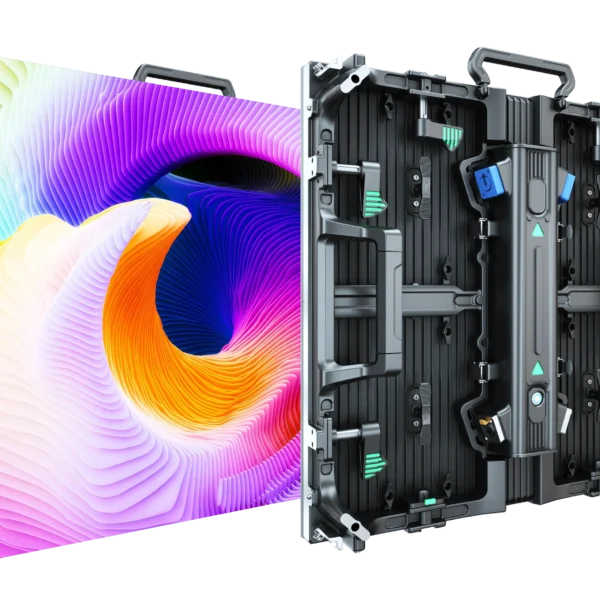
Purchase prices depend on the same variables, plus one that rental quotes hide: the structure. Current US listings for 16-foot-class walls start at $18,699 for P4.81 and reach $40,999 for P1.95, and a packaged Full HD system with controller, cables, spare modules and mounts is listed from $41,995 MSRP.
| Published system | Price | What the listing covers |
|---|---|---|
| 16.4 × 9.8 ft, P4.81 turnkey | $18,699 | Event-grade wall; confirm spares and structure in the bill of materials |
| 16.4 × 9.8 ft, P2.97 turnkey | $26,799 | Same footprint at a finer pitch, which is the whole price difference |
| 16 × 9 ft, P1.95 turnkey | $40,999 | 30 panels, processor and fly bars |
| Full HD packaged system | from $41,995 MSRP | Cabinets, controller, cables, spare modules and wall mounts |
The first three figures are published by LED Nation USA and The Penn Group; the packaged system price is from Planar’s MGP Complete brochure. Treat them as indoor baselines. An outdoor cabinet at the same pitch costs more, because it needs IP65 sealing, 5,500–8,000-nit modules, stronger power supplies and corrosion protection.
Why outdoor purchase prices vary
- Pixel pitch: halving the pitch roughly quadruples the LEDs and driver channels per square metre.
- Brightness: a daylight-readable outdoor module costs more than an indoor module of the same size.
- Sealing: IP65 or IP67 cabinets, sealed connectors and conformal coating add production steps.
- Corrosion protection: three-proof treatment on the PCB and power supply is essential near the coast and cannot be added later.
- Structure: fly bars are not a wind-rated ground-support system, and engineering is a separate line.
- Spares and warranty: replacement modules, receiving cards and domestic support decide how long a failure costs you.
What Sits Outside the Headline Figure
An $18,699 wall still needs installation engineering, electrical work, freight, flight cases and operator training. Ask for a bill of materials that names every component before comparing totals. For what is available on short lead time, see the factory-direct rental LED screens for Florida page.
For outdoor LED screen price Florida comparisons, ask for ballast, labour and permit fees as separate lines.
Outdoor LED screen price Florida quotes that ignore generator sizing tend to grow after the site visit.
4. When Buying Beats Renting
Renting is the right answer for a single event. Buying becomes the right answer when the same capability is needed repeatedly. Put both numbers on the same basis first.
Step 1 — purchase total. Area in square metres × quoted rate, plus structure, processing, transport, spares, installation and tax.
Step 2 — effective rental cost per use. Day rate × days per booking, plus delivery, crew, generator, permits and any damage waiver.
Step 3 — divide. Purchase total ÷ effective cost per use = the number of uses before ownership breaks even.
An illustrative example with round figures: a 30 m² P4.81 outdoor wall purchased with wind-rated ground support, processing, spares and installation at $58,000; the comparable Florida rental at $7,500 per day including crew and rigging. Break-even is about eight show days. At two events a year that is four years, so renting wins; at monthly use it is under a year, so buying wins.
Practical Considerations
The arithmetic above excludes storage, maintenance, insurance and financing, which is why the purchase total must include them before the comparison is honest.
| Cost factor | Rent | Buy | Action to take |
|---|---|---|---|
| Equipment | Per event | Upfront | Compare equal pitch, brightness and IP rating |
| Labor | Usually included | Recurring | Price every load-in and strike |
| Weather risk | Vendor carries spares | Owner carries spares | Budget spare modules and a standby plan |
| Storage | Not required | Required | Quote dry, secure, humidity-controlled space |
| Corrosion | Vendor maintains | Owner maintains | Plan annual inspection and cleaning |
| Upgrades | Easy to change | Full replacement | Assume a five-year useful life |
Use annualized cost, not sticker price
Model the decision over at least three years, including crew costs even when you own the wall. A venue, church or promoter running the same configuration monthly in the same location usually justifies buying; an organization with two or three events a year in different cities gains more flexibility by renting, because it can change size and pitch per event.
Two factors the arithmetic misses. Availability is one: Florida’s peak season and hurricane windows tighten inventory. Control is the other: ownership means your own batch, spares and maintenance schedule, which matters for a rental business and rarely for a one-off buyer.
How to apply it: build low, expected and high usage scenarios, and include a downside case with fewer events than planned.
5. Florida Costs People Forget
Salt air. Coastal sites corrode fixings, connectors and power supplies long before the LEDs age. Three-proof coating, stainless hardware and a cleaning schedule are purchase-stage decisions with a real cost, not maintenance afterthoughts.
Humidity storage. Panels stored in a humid warehouse degrade quietly. Dry storage, desiccant and a periodic power-on cycle are an ongoing budget line for any owner in the state.
Hurricane season. The Atlantic season runs from June 1 to November 30, and outdoor builds need ballast, covers, a monitored stand-down trigger and a crew authorized to act on it. The National Hurricane Center and the Florida Division of Emergency Management publish the forecasts a written plan should reference. Expect standby labor or a contingency fee to appear in the quote.
Generators and fuel. Field sites rarely have adequate power. A generator, distro, fuel and cable runs are separate line items that scale with screen area.
Permits and public safety. Municipal requirements vary across the state, and coastal jurisdictions can add environmental review. Large builds commonly need six to ten weeks of lead time.
Content. A new screen usually needs new content. Reusing a 16:9 deck on a 3:1 stage wall produces letterboxing or stretched graphics, and fixing it after load-in costs more than designing for the aspect ratio.
Overtime and access. Night load-ins, road closures, escorted access and venue-exclusive labor all add cost that a warehouse delivery does not.
Fix the site and the operating hours first, and the outdoor LED screen price Florida figure stops moving.
6. Taxes, Permits and Contract Terms
Florida’s state sales tax rate is 6%. Counties may add a discretionary surtax, so the combined rate depends on the delivery location; the Florida Department of Revenue publishes the current discretionary sales surtax table. Confirm whether your rental or purchase is taxable, and at which county rate, with the vendor or a tax adviser.
Event permits are municipal, not statewide. Application windows, insurance limits and structural review differ between a city park, a beach venue and a private resort. Start the conversation with the venue and the local permitting office at the same time, and send both the proposed dimensions, weight, power draw, support method and load-in schedule.
Contract terms matter more outdoors than indoors. Confirm who has authority to lower or shut down the wall, what wind speed triggers that decision, whether postponement and relocation are covered, and how damaged panels are valued. A weather clause that only addresses rain is not a storm plan.
How to apply it: add tax, permits, insurance, generator and weather contingency to the quoted equipment price before comparing suppliers.
7. How to Compare Two Quotes
Put both quotes on one page and confirm that each line exists in both:
- Visible area in square metres, and cabinet footprint
- Pitch, measured brightness in nits, and refresh rate
- IP rating and corrosion treatment
- Panel model, processor model and control software
- Structure type, ballast, and whether engineering is included
- Power: generator, distro, cable runs and who supplies them
- Delivery, load-in window and who unloads
- Spares shipped with the order
- Weather terms, cancellation policy and warranty exclusions
A quote missing four of these nine is not cheaper. It is incomplete, and the missing items will reappear as change orders or, worse, as a dark screen during the show. For the vetting questions that apply to the supplier rather than the quote, see our guide to outdoor LED screen rental companies in Florida.
Outdoor LED Screen Price Florida — FAQ
How much does an outdoor LED screen rental cost in Florida?
Published 2026 package rates run from about $600 a day for a small community screen to $45,000 a day for a festival-scale billboard. A typical 14 × 8-foot event screen with delivery, crew and a processor lands near $1,800–$3,500 before tax, generator and permits.
Is it cheaper to buy or rent?
Renting is cheaper for occasional use and includes crew, spares and weather contingency. Buying usually wins when the same configuration is used monthly or more, and when storage and maintenance are already available. Break-even is purchase total divided by the effective cost per rental day.
What does the cheapest quote usually leave out?
Generators and distro, engineered structure, permits, spares on site, and the weather clause. Those four or five lines are where a $1,900 quote becomes a $4,600 event, and they are the first things to check before comparing totals.
How much should be budgeted for permits and insurance?
It varies by municipality and venue, and public sites usually require a certificate of insurance naming the venue. Budget a contingency rather than a fixed number, and confirm requirements with the venue and permitting office at the same time.
How long does an outdoor LED screen take to deliver?
Domestic stock can move in days; a factory production run plus freight is typically several weeks, and PQ-series production alone is listed at 15 days. Large builds needing permits and engineering commonly need six to ten weeks.
Does hurricane season change the price?
Yes. Standby crew, ballast, covers, monitoring and contingency fees appear in quotes between June and November, and postponement or cancellation terms become part of the cost of the booking.
Conclusion
The outdoor LED screen price in Florida is a function of pitch, area, brightness, sealing, structure and scope, not a single market rate. Get all six onto one page, run rent and buy through the same three-step calculation, and compare quotes by line item rather than by total.
- Renting reduces upfront risk and usually includes crew, spares and weather contingency.
- Buying lowers long-term cost when the same configuration is used monthly in the same location.
- Brightness and IP rating matter as much as pitch in Florida daylight and storm season.
- Tax, permits, generators and hurricane planning belong in the total budget.
Document your screen size, audience distance, venue, event frequency, power access and weather requirements. Then request at least three itemized rental quotes and two complete purchase proposals, and use those figures to calculate three-year cost per event.
For the specification side of the decision, see our Florida outdoor LED buyer’s guide. Need purchase options and US stock, see the factory-direct supply page. For the equipment rate itself, see LED screen panel price.
Buyers comparing outdoor LED screen price Florida options should ask for the cabinet count, the spare ratio and the processor model in writing.