LED Screen Rental Prices in Toronto — What Every Line on the Quote Means

LED rental prices Toronto buyers compare vary by more than 100% for what looks like the same wall, and the gap is rarely the panel.
This page breaks a Toronto quote into its lines, gives indicative CAD bands by screen type, and explains which variables move the number and which are padding. The figures are market benchmarks for a locally supplied rental; they are not our factory price, and they are not a substitute for a written scope.

Table of Contents
- 1. How a Toronto Quote Is Built
- 2. Rate Bands by Screen Type
- 3. What Moves the Price Most
- 4. Per-Event, Weekly, Monthly or Full Service
- 5. The Lines That Appear Later
- 6. Seasonal Pricing in the GTA
- 7. Cut Cost Without Cutting Quality
- 8. When Buying Beats Renting
- FAQ
1. How a Toronto Quote Is Built
A defensible quote for LED screen rental prices in Toronto contains the same eight lines, whether it arrives as a package or an itemised sheet.
Base rental. Screen area multiplied by pitch class and duration. This is the line everyone compares and the one that matters least on its own.
Delivery. Roughly CAD 100–500 for a short GTA run, 500–1,500 for a long haul or a multi-stop tour. Downtown windows, liftgates and after-hours access add to it.
Setup and strike. Crew hours at both ends, including the venue’s load-in limits and any union minimums.
Technician hours. Show-day cover, rehearsal and standby — the most commonly under-quoted line in the document.
Power. Distribution, cabling and, on outdoor sites, a generator plus fuel passed through at 50–300 per day.
Permits and road use. Frequently 100–1,500 depending on footprint, with city lead time attached.
Content and playback. Ingest, re-encoding, media server or processor, and a backup device.
Insurance and tax. Event insurance add-ons of 150–600, and HST at 13% on everything above.
A quote missing any of the eight is not cheaper; it is incomplete. Ask for the missing line before comparing totals.
LED rental prices Toronto quotes diverge because each supplier assumes a different cabinet count and a different structure.
LED rental prices Toronto bands move with pitch before size, since one step finer doubles cost per square metre.
2. Rate Bands by Screen Type
The table below reflects indicative LED screen rental prices in Toronto for a locally supplied screen, before HST. Use it to test whether a bid is in range, not to settle on a number in isolation.
| Screen type | Typical size | Pitch | Indicative rate |
|---|---|---|---|
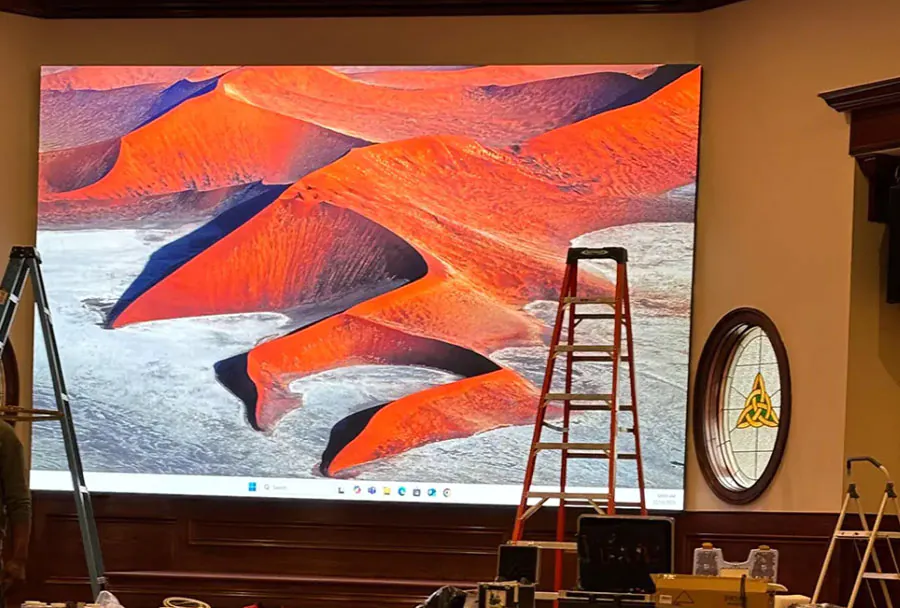
| Indoor boardroom or breakout | 3 × 2 m | P2.6 – P3.9 | CAD 700–1,500 per day |
| Ballroom or conference stage | 6 × 3 m | P2.9 – P3.9 | CAD 1,200–3,000 per day |
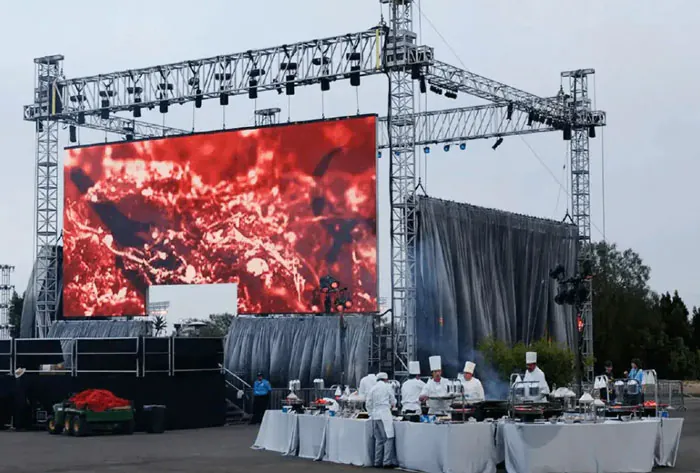
| Trailer-mounted, outdoor | 10 × 6 ft | P6 – P8 | CAD 900–2,000 per day |
| Festival backdrop | 12 × 6 m | P8 – P12 | CAD 8,000–20,000 per day with installation |
| Stadium-grade wall | 20 m+ | P6 – P10 | CAD 25,000–60,000 per day |
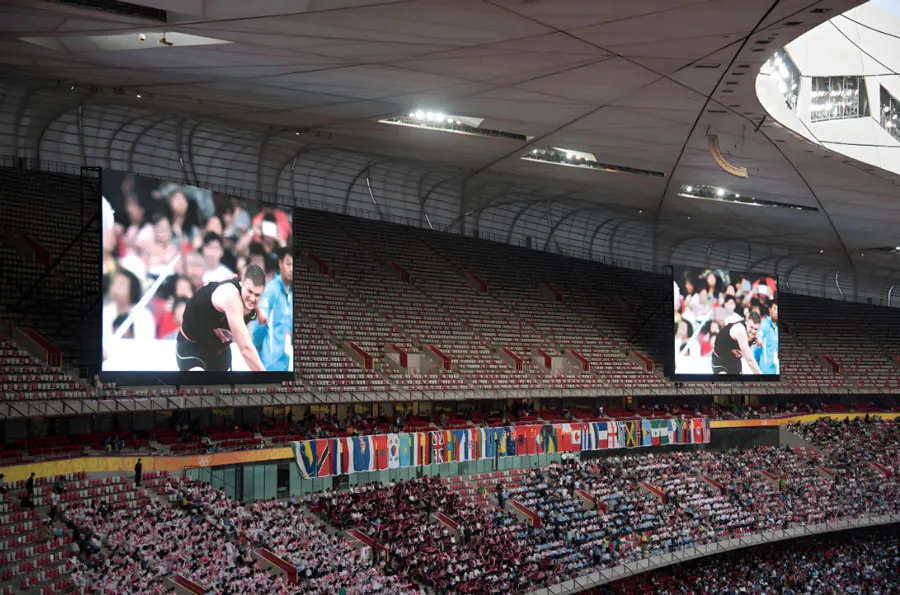
Two cautions. The indoor bands assume a normal load-in window and a house supply; a heritage theatre with a narrow door and a four-hour window can double the labour while the equipment line stays flat. And the outdoor bands assume a build that fits the site — a wall needing engineered ballast and a stamped design carries a cost the panel price never shows.
3. What Moves the Price Most
Five variables explain most of the spread between two bids for the same room.
Pitch. One step finer is the largest single jump, because panel count, processing and calibration rise together. For an audience seated twenty metres back, that step buys nothing visible.
Area. Cost scales with square metres, but so does structure, cable and crew time. A 20% larger wall is rarely 20% more expensive.
Duration. Multi-day bookings price extra days well below the first, because transport and setup are already paid. A four-day festival is not four times a one-day rate.
Indoor or outdoor. Sealing, brightness headroom, ballast and weather contingency add cost outdoors, and so does the strike plan.
Venue. Union calls, dock schedules, freight lift limits and curfews change labour hours more than any technical choice. Two identical walls in different Toronto buildings can differ by 40% on labour alone.
Everything else — brand, processor model, case quality — matters to reliability but moves the total far less. If a bid sits well above the band, ask which of the five is driving it.
For LED rental prices Toronto comparisons, ask which items sit outside the headline number.
LED rental prices Toronto packages that include labour are not comparable with equipment-only quotes.
4. Per-Event, Weekly, Monthly or Full Service
Four commercial models appear in this market, and they suit different buyers.
Per event. One price for one show, usually including delivery, setup and show-day cover. Simple to budget, expensive per day, and right for a first or one-off event.
Weekly. Multi-day activations, conferences and festivals. The equipment line drops per day, and technician standby is usually priced as a day rate rather than hourly.
Monthly or seasonal. Campaigns, retail installations and residencies. Expect a reduced monthly rate with a minimum term and a separate maintenance allowance.
Full service. Equipment, crew, content ingestion, permit support and insurance coordination in one number. Convenient, but the only way to judge it is to compare the eight lines from section 1 row by row.
À la carte pricing puts the screen first and adds every service separately, which is where budgets slip. Bundled pricing hides the same services, which is where comparisons fail. Either way, ask for the itemised version before signing.
5. The Lines That Appear Later
Most overruns on LED screen rental prices in Toronto come from six items that were never in the original quote.
- Overtime. Crew hours beyond the quoted window at premium rates, usually triggered by a late venue handover.
- Union minimums. A four-hour call billed for a two-hour job, plus meal penalties.
- Generator fuel. Passed through daily on self-powered trailers.
- Permit and traffic control. Rarely included, and priced by the city rather than the vendor.
- Structural review. An engineer’s stamp for a large modular wall or elevated platform.
- Content changes. Re-editing or re-encoding after the agreed deadline.
Ask one question at proposal stage: “What would cause this number to increase on site, and by how much?” A vendor who answers precisely has priced the job; one who says “it won’t” has not thought about it.
Damage and loss terms belong in the same conversation. A reasonable agreement caps exposure at module level rather than cabinet, and states who inspects the wall at strike.
Send the room and the content format, and the LED rental prices Toronto range narrows to a defensible number.
6. Seasonal Pricing in the GTA
LED screen rental prices in Toronto follow the event calendar more than the weather.
May to October. Outdoor season. Trailers, outdoor cabinets and rigging crews are booked first, and short-notice bookings carry a premium. Here availability, not price, decides the outcome.
September to November. Conference and gala season. Indoor inventory tightens and downtown venues book up weeks ahead.
December. Holiday parties and year-end events compressed into three weeks. Weekend rates rise; weekday availability improves after mid-month.
January to March. The quietest stretch, and the best window to negotiate a multi-event or seasonal agreement for the year ahead.
Two practical consequences. Booking a summer date in March usually costs less than booking it in June. And a weekday event in February is the cheapest indoor slot on the calendar — worth knowing if the date is flexible.
7. Cut Cost Without Cutting Quality
Cutting LED screen rental prices in Toronto without cutting quality is possible when the saving comes from scope rather than from the wall.
- Match pitch to the farthest useful seat. A step coarser where nobody sits close is the largest honest saving available.
- Book the shoulder day. Moving a Tuesday event to Wednesday rarely changes attendance and often changes the rate.
- Reduce build complexity. Ground-supported straight walls cost less than flown, curved or multi-surface designs.
- Bundle transport and crew. Vendors discount when delivery, setup and technician hours sit on one order.
- Reuse content. Re-encoding and re-editing are billable; a native-resolution master from the last event is not.
- Take the older-but-functional unit when the show is a one-off and the audit trail is not the point.
What not to cut: spares on site, show-day technician hours, and insurance. Those three separate a cheaper event from a cancelled one.
8. When Buying Beats Renting
Once LED screen rental prices in Toronto are compared with ownership, the decision becomes arithmetic rather than preference.
Add the purchase total — cabinets, structure, processing, freight, clearance, HST treatment, spares and cases. Divide it by the effective cost of renting the same configuration per event, including crew, permits and delivery.
An illustration: a 30 m² P3.9 indoor fleet at roughly CAD 75,000 landed, against CAD 4,500 per event to rent an equivalent wall with crew and delivery. At eight bookings a year, renting costs about CAD 36,000 annually, so ownership pays back in a little over two years, before resale and before counting the bookings a fleet of your own makes possible.
Below four bookings a year, renting usually wins. Between four and eight it depends on storage, technicians and how much of the crew cost you already carry. Above eight, the arithmetic is rarely close.
LED Rental Prices Toronto — FAQ
Is HST included in LED screen rental prices in Toronto?
Usually not. Ontario HST is 13% and should appear as a separate line. A quote without it is not comparable to one that includes it.
Why is one bid half the price of another for the same screen size?
Almost always scope: crew hours, technician cover, permits, insurance or transport are missing from one side. Compare the eight lines, not the totals.
Do multi-day events cost less per day?
Yes. Transport and setup are paid once, so additional days price below the first. Ask for the day-two rate explicitly.
What deposit is normal?
A deposit to hold equipment with the balance before load-in is standard. What matters is the reschedule and cancellation terms, not the percentage.
Can I supply my own crew and just rent the screen?
Often yes, and it lowers the price — provided your crew is certified for the rigging and the venue accepts them. Confirm insurance and union rules before assuming it.
Cross-border shipments are cleared under CBSA documentation rules. See www.cbsa-asfc.gc.ca for the current rules.
Ontario tax and business requirements are published provincially. See www.ontario.ca for the current rules.
Conclusion
LED screen rental prices in Toronto make sense once eight lines sit on the table: base, delivery, setup, technicians, power, permits, content, insurance and tax. Compare those, match pitch to the seat, and buy when the booking count justifies it.
For the wider buying decision, see LED screen rental Toronto. For supplier selection, see top rated mobile LED screen rental companies in Toronto.
Buyers comparing LED rental prices Toronto options should ask for the cabinet count, the spare ratio and the processor model in writing.