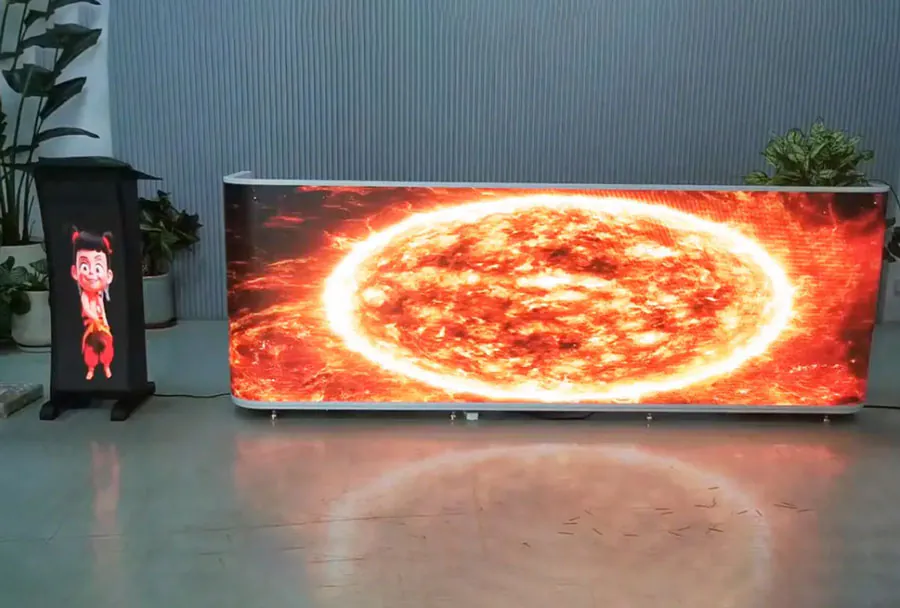
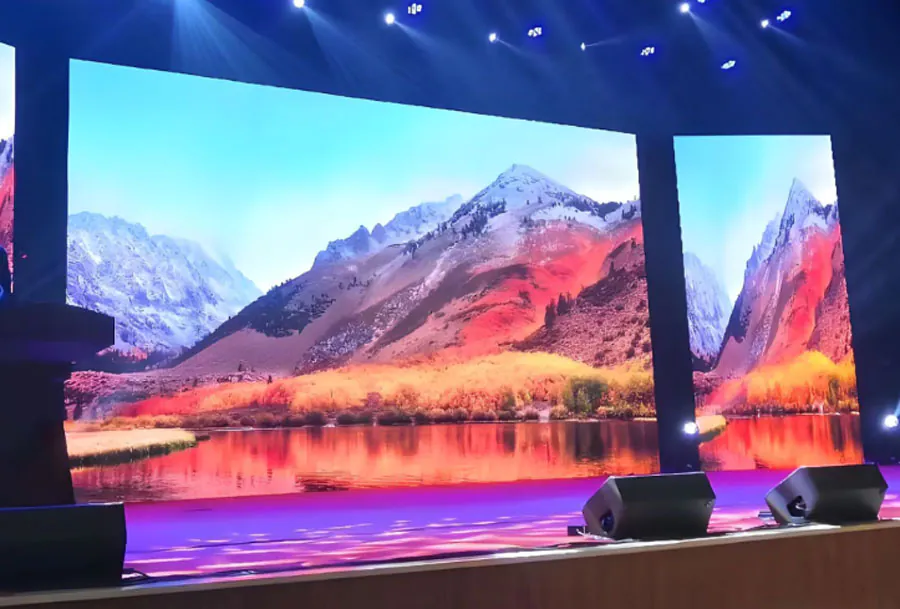
LED Screen Rental Las Vegas — Factory Supply for Resort and Convention Work

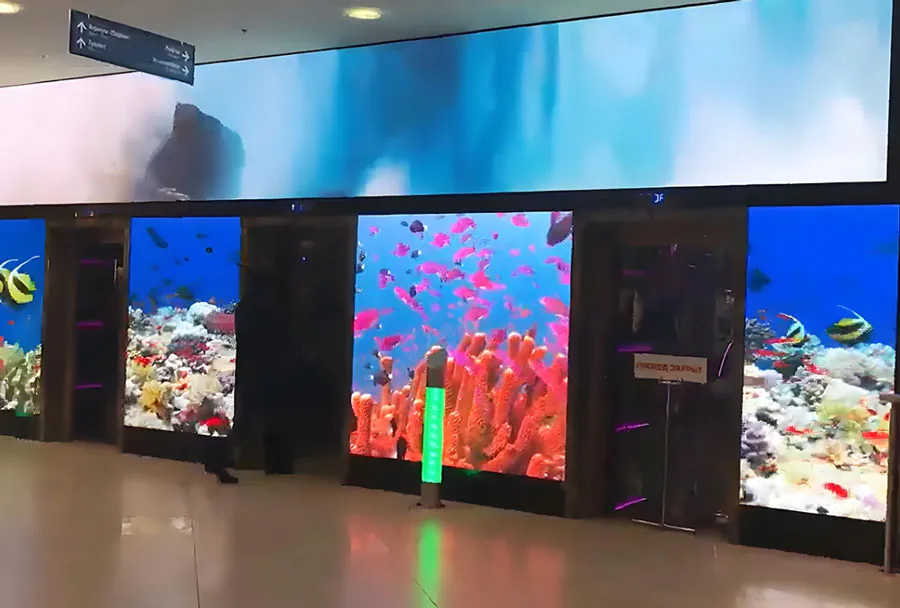
The building shapes LED wall rental in Las Vegas more than the panel does. For example, a resort ballroom that forbids rigging to its ceiling, a convention hall that gives you six hours on a dock, and an outdoor plaza at 44°C in July all take the same cabinets and demand three different builds. The specification that survives all three is the one worth buying.
TW VISION manufactures rental-grade LED cabinets and holds standard stock in our Atlanta warehouse, with delivery into southern Nevada in four to six business days once loaded. We do not rent screens in Las Vegas and we do not run a Nevada depot. This page is written for the rental houses, AV companies, production suppliers, venues and exhibitors that do.
What Las Vegas changes. Three conditions dominate. Resort properties restrict rigging and schedule docks by the hour, so ground support and ballast are normal rather than exceptional. Because the convention calendar — CES, NAB, InfoComm, PACK EXPO — compresses build and strike into windows measured in hours, union calls come attached. And the desert does the rest: dry heat that derates brightness, fine dust that finds every fan, and monsoon gusts that arrive with twenty minutes of warning.
Table of Contents
- 1. What Las Vegas Changes About the Purchase
- 2. Read the Room, Not the Brochure
- 3. Resort Ballrooms and Rigging Restrictions
- 4. Convention Halls and the Build Window
- 5. Heat, Dust and Monsoon Wind
- 6. What Las Vegas Buyers Order for LED Wall Rental
- 7. What LED Wall Rental Costs in Las Vegas
- 8. Permits, Fire Safety and Union Calls
- 9. Crew, Turnarounds and Show Day
- 10. Sports, Concerts and Fast Turnarounds
- 11. Event Planning, Reliability and Corporate Work
- 12. Factory Supply Compared With a Supported Rental
- 13. When a Vegas Fleet Buys Instead of Renting
- 14. Delivery From Atlanta to Las Vegas
- 15. Ordering, Tax and Resale Paperwork
- 16. FAQ
- 17. Conclusion
1. What Las Vegas Changes About the Purchase
Four conditions separate a Las Vegas order from one placed for a Dallas or Atlanta venue.
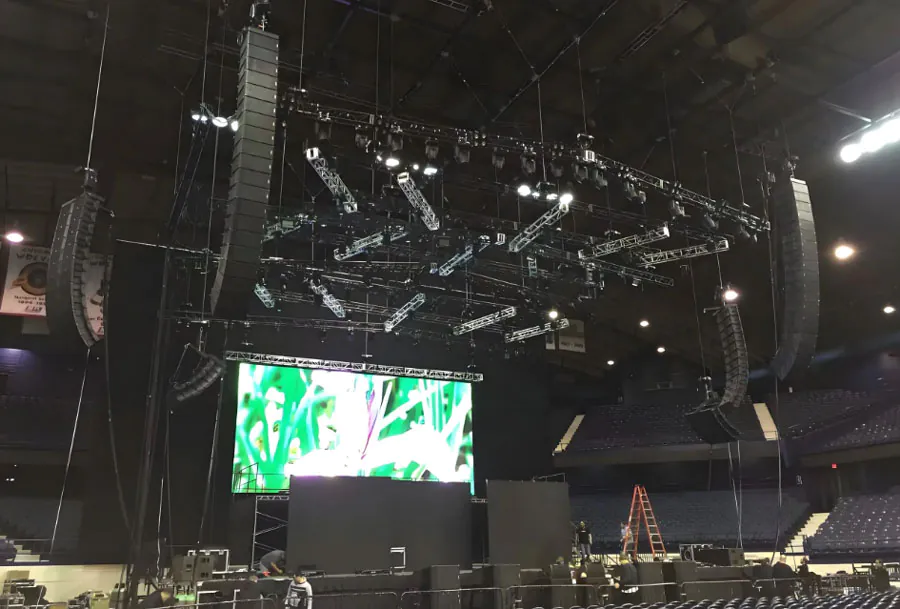
Rigging is often forbidden. In practice, many resort ballrooms have no structural points a vendor may use, or require the property’s own rigging contractor. A fleet built around flown walls arrives unable to fly, so ground support, ballast and low-profile bases belong in the specification rather than in the afterthought.
The clock is the constraint. Convention work follows windows: a six-hour install, a four-hour strike, a ballroom turned overnight. Crew size and cabinet format follow the speed of assembly, which is why 500×500 mm cabinets dominate here.
The building is a business. Docks run on reservations, service corridors are shared, and a late truck can lose its slot. Delivery follows the property’s loading calendar, not the vendor’s.
The desert sets the operating envelope. Meanwhile, summer highs run past 40°C, humidity sits in single digits, dust is constant and monsoon gusts arrive fast. Cabinets, filters and cleaning intervals all follow from that.
None of this changes what a good cabinet is. It changes what has to be specified, and which parts of the build belong to a local partner.
2. Read the Room, Not the Brochure
Screen size and pitch for LED wall rental in Las Vegas come from three numbers: the closest viewer, the content people must read, and the light on the wall. In this market the third number is unusually large indoors, because ballrooms are lit for cameras and general sessions often run with house lights up.
Pixel pitch is the centre-to-centre distance between LEDs in millimetres, and density scales with the square of pitch: (1,000 ÷ pitch)². P2.6 carries roughly 147,900 pixels per square metre, P3.9 about 65,700 and P4.8 about 43,400. One step finer is where most of the cost sits.
Working split for the jobs venue teams book most often: P1.9–P2.6 where the front row sits inside four metres, P2.9–P3.9 for ballrooms, general sessions and mid-size stages, P4.8–P6.7 for outdoor plazas and festival stages once the nearest viewer passes 25 metres, and P8–P10 for roadside and arena-distance work.
Ask for calibrated operating brightness, not the panel maximum. Indoor ballrooms run 1,200–2,500 nits because the room is brighter than a theatre; outdoor walls need 5,000 or more, and 6,000–8,000 where the face takes direct afternoon sun.
As a result, a wall sized from room area rather than sightlines is usually wrong in one direction or the other. Send a photograph of the space at the event hour alongside the content list, and the pitch question answers itself.
3. Resort Ballrooms and Rigging Restrictions
The single most expensive mistake on an LED wall rental job in Las Vegas is assuming a ballroom can be flown.
In practice, resort properties vary widely. Some allow a certified rigging contractor to use designated points; others prohibit ceiling attachment entirely and require ground-supported structures; a few restrict what can be attached to walls or columns. The rule is property-specific and it lives in the technical packet, not in the sales conversation.
Practical consequences for a fleet:
- Ground support is standard. Base plates, ballast and vertical truss should come from stock, not from per-show fabrication.
- Cabinet weight matters. A lighter cabinet reduces ballast and crew, which is why 500×500 mm formats and aluminium frames earn their place here.
- Ceiling height sets the design. Ballroom clear heights commonly run 16–24 feet, so a 12-foot wall plus header may not fit under the air wall track.
- Floor protection is required. Carpet protection, cable ramps and a clean strike are conditions of the property’s approval.
- Air walls and rigging conflict. A wall placed against a movable partition cannot carry load, and the partition’s track decides the maximum height.
Before pricing, run two checks. Ask for the room’s technical packet, and ask which contractor the property requires for anything attached overhead. Those two answers change crew size, equipment list and cost more than pitch does.
4. Convention Halls and the Build Window
Las Vegas convention work runs on a different logic from a ballroom: the hall is enormous, the window is short, and the floor is shared with hundreds of other exhibitors.
In this market, three venues dominate. The Las Vegas Convention Center spreads across halls with scheduled dock slots and freight routes; the Venetian Expo sits beside the resort with its own loading sequence; Caesars Forum adds a newer hall with tight exhibitor scheduling. Each publishes an exhibitor manual that governs height limits, hanging signs, floor loading, electrical ordering and rigging approval.
What that means for an LED wall rental:
- Booth builds fit a window. Most exhibitor installs run in hours, not days, so the wall suits two to four technicians and a known assembly sequence.
- Height limits apply. A hung header or a tall wall may need marshalling approval and a stamped drawing before it goes up.
- Floor loading counts. Ballast for a ground-supported wall has to sit inside the booth’s load allowance and inside its footprint.
- Electrical is ordered from the hall. Distribution, tie-ins and labour come through the venue’s contractor, on the venue’s schedule and price list.
- Strike is as scheduled as build. A wall that comes down slowly holds the aisle and the truck.
For booth geometry, exhibitor manual clauses and six-hour builds in detail, see our trade show LED screen rental in Las Vegas guide.
5. Heat, Dust and Monsoon Wind
The desert is a specification input, not a maintenance topic.
Heat. Summer afternoons run above 40°C, and a cabinet rated at 6,000 nits will not hold that output once its internal temperature climbs. Leave ventilation clearance behind the wall, shade the rear where possible, avoid enclosing a ground-supported build, and schedule content testing for the hour the sun hits the face. Ask for the derating curve, not the peak figure.
Dust. Because fine material enters through cable entries and fan paths, it settles on drivers and reduces cooling over months. Filtered airflow, sealed connectors and a defined cleaning interval belong in the purchase. A fleet that never opens its cabinets will lose brightness to dust before it loses it to age.
Monsoon season. From July into September, gust fronts can arrive with little warning. Outdoor builds need a stated wind rating, engineered ballast and a written strike trigger — who decides, at what wind speed, and by when. Rain itself is brief and heavy; drainage behind the wall matters more than the rating on the face.
Temperature swing. A 20°C drop after sunset is normal. Check cabinets for condensation only when they move between environments, not simply because the air cooled.
6. What Las Vegas Buyers Order for LED Wall Rental
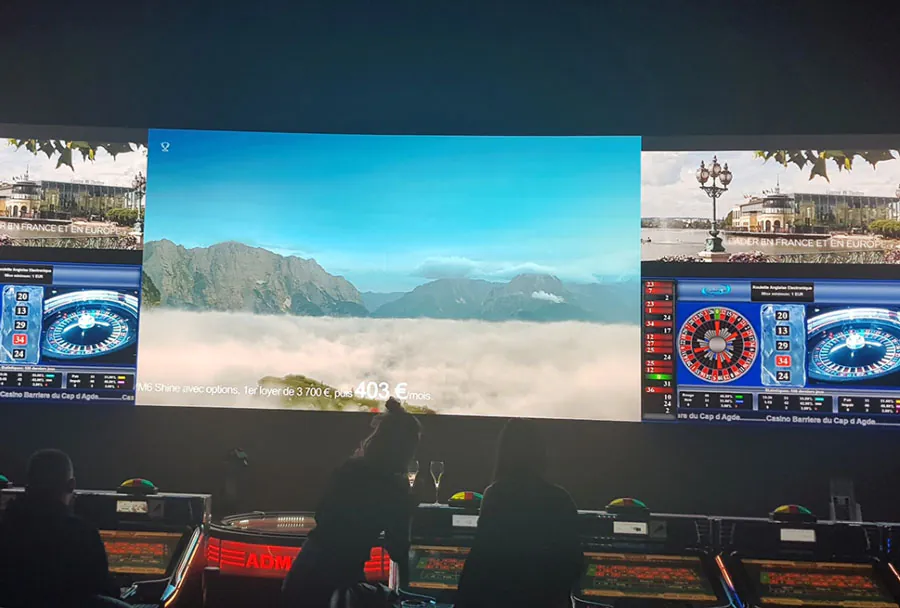
Orders for LED wall rental in southern Nevada fall into four groups: standard rental cabinets, fine-pitch indoor cabinets, IP-rated outdoor cabinets, and folding posters for lobbies and showrooms.
Standard rental cabinets
P2.976 and P3.91 in 500×500 mm and 500×1000 mm formats carry most of the work: general sessions, exhibition booths, awards nights and ballroom stages, with front or rear service access and optional curved locks.
Fine-pitch indoor cabinets
P1.953 and P2.604 suit boardrooms, broadcast sets and stages where the front row sits inside four metres, which includes most product launches and executive presentations on the Strip.
Outdoor cabinets
P3.91 and P4.81 with IP-rated sealing and brightness headroom for plaza and festival work. Sealing, drainage and ballast planning matter as much as nits in this climate.
| Series | Stock | Pixel pitch | Cabinet | Typical Las Vegas use |
|---|---|---|---|---|
| PQ P2.6 | Atlanta stock | P2.6 | 500×500 / 500×1000 mm | Ballrooms, general sessions, booth walls |
| LP-H | Atlanta stock | P1.86 | 640×1920 mm folding poster | Lobbies, showrooms, retail |
| IP-CT | Atlanta stock | P2.5 | 640×480 mm soft connection | Fixed indoor walls, menu boards |
| Other pitches (PN / PH / PI) | Factory order | P1.953 – P6.67 | 500×500 / 500×1000 mm | 15–20 days production plus freight |
Therefore, orders ship from a single production batch with matched spare modules, receiving cards, power supplies, processors, flight cases and configuration files. For a fleet working overnight turnarounds, batch matching keeps a swapped module invisible on camera the next morning.
7. What LED Wall Rental Costs in Las Vegas
The figures below are indicative market rates for LED wall rental in Las Vegas in US dollars, useful for benchmarking a bid rather than as a factory price.
| Use case | Typical size | Pitch | Indicative rate |
|---|---|---|---|
| Exhibitor booth wall | 1.8 × 2.4 m | P1.9 – P2.9 | $700–$1,500 per day |
| Ballroom general session | 6 × 3 m | P2.6 – P3.9 | $2,000–$6,000 per day |
| Outdoor plaza or festival | 6 × 3.6 m | P4.8 – P6.7 | $4,000–$10,000 per day |
| Arena or stadium wall | 20 m+ | P6 – P10 | $25,000+ per day |
| Lobby or showroom display | 1.2 × 1.8 m | P2.5 – P3.9 | $400–$900 per day |
Finally, three local multipliers apply. Labour carries union minimums, so a short install can cost more than the screen day rate implies. Docks work on reservations, so a missed window becomes a rescheduled delivery. And convention weeks compress supply across the valley, which is when availability, not price, decides the booking.
Affordable LED screen rental in Las Vegas usually means a coarser pitch matched to the sightline, a ground-supported build instead of a flown one, and a weekday window — not a cheaper panel. A 20–30 m² P3.9 indoor wall with crew, calibration and one day of technician cover typically lands between $3,000 and $10,000 here; materially less usually means labour, power distribution or spares are missing.
For buyers who purchase to own, the arithmetic is a per-square-metre cabinet price plus freight and your own crew hours. Count bookings per year before comparing the two quotes.
8. Permits, Fire Safety and Union Calls
Approvals and labour rules are the two items nobody can fix on the day.
Temporary structures and assemblies. Clark County reviews temporary structures and assembly occupancy, and the fire authority reviews egress, occupancy and materials. Large ground-supported walls and elevated platforms generally need design by a licensed engineer.
Outdoor events. Plaza and street events add special-event permits, road occupancy and sometimes a traffic control plan. Screen placement, footprint and duration feed the application.
Union calls. Much of the Strip and the convention halls operate with collective agreements, and rigging and stagehand work typically runs through IATSE Local 720. Minimum calls, overtime and meal penalties are real costs and belong in the labour schedule.
Insurance. Properties commonly require a certificate naming them as additional insured, with limits set by the venue. Confirm both the vendor’s policy and the event’s policy before load-in.
Electrical. Licensed contractors, often the venue’s own, handle tie-ins and temporary distribution on the venue’s schedule. Confirm who files and who pays.
9. Crew, Turnarounds and Show Day
Build time on an LED wall rental answers to a window, not an ideal.
- Booth wall, 3 × 2 m: 2–4 hours with two technicians.
- Ballroom general session, 6 × 3 m on ground support: 4–8 hours with four to six.
- Large convention feature, 8 × 4.5 m with header: 6–10 hours inside a marshalling window.
- Outdoor plaza or festival wall, 10 × 5 m: 10–24 hours including ballast, safety checks and camera alignment.
Because overnight turnarounds are normal here, the plan changes in three ways. Crews work in shifts rather than hours, spares travel with the wall instead of sitting in a warehouse, and the configuration file for each room is saved so the next build starts from a known state.
Show-day sequence should stay fixed: confirm power, power the wall and test it, switch sources, check calibration, then run a ten-minute loop at show brightness so the client can sign off. Test with the actual camera shutter when the event is filmed; a wall that looks clean to the eye can band on a broadcast feed.
10. Sports, Concerts and Fast Turnarounds
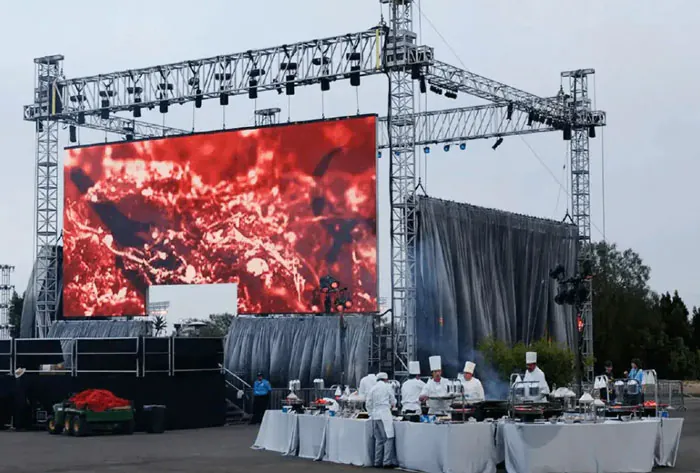
Three scenarios account for much of the volume in this valley, and each sets a different priority.
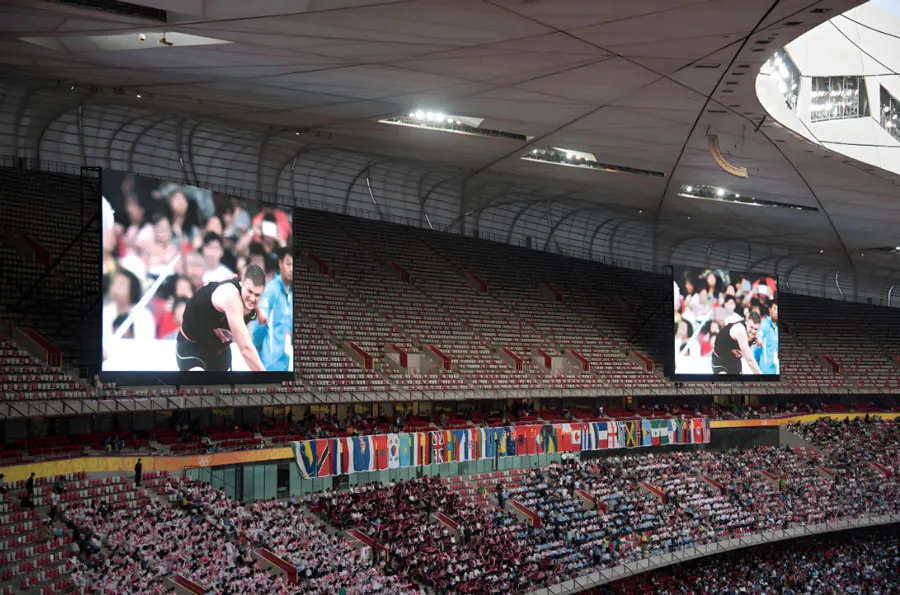
Sports events. LED screen rental for Las Vegas sports events rewards distance and frame rate more than fine pitch: a bowl viewed from forty metres needs P6–P10 at high brightness, genlock so the wall matches broadcast cameras, and a structure that clears the seating sightlines. Replay and scoreboard feeds arrive through the venue, so the crew confirms input compatibility before the build, not during it.
Concerts and mega concerts. Buyers choose concert LED screens for impact: large arrays, 5,000 nits or more outdoors, 3,840 Hz refresh for IMAG, and media servers driving multi-zone playback. The screen is part of a stage design, so cabinet format and curved locks follow the set, and the spares kit travels with the tour.
Fast installation and fast turnaround. A room turned overnight is the local norm, and fast installation is a design requirement rather than a promise. Cabinets with quick locks, pre-addressed receiving cards and a saved configuration file per room make a four-hour rebuild realistic; crew size and case packing decide the rest.
Nevertheless, if a single LED wall rental fleet has to cover all three, the practical mix is P3.9 for indoor sport and corporate, P2.6 for ballrooms and close camera work, and P4.8–P6.7 for outdoor stages. One batch across the range keeps colour and calibration consistent when a cabinet moves between jobs.
11. Event Planning, Reliability and Corporate Work
Most bookings in this market move through the same sequence: a brief, a site survey, a proposal with drawings, permits, install, calibration, live support, strike. A reliable LED screen rental supplier documents each stage, because the failure that ruins a show is almost never the panel — it is a permit filed late, a dock slot lost or a spare left in a warehouse.
For corporate and conference work, the specification follows the room. General sessions want P2.6–P3.9 with a camera-safe refresh, breakout rooms want a smaller wall at a finer pitch, and exhibition booths want front-service cabinets the crew can reach from the aisle. Every one of those is an event LED screen rental decision made at quoting time, not on site.
High definition displays are the default expectation here rather than a premium: content arrives at 1080p or 4K and is judged at two metres. Confirm the wall’s native pixel count before promising it, because a wall that downscales still says “high definition” on the quote and shows it on the screen.
Reliability, in practice, is three things: spares that travel with the wall, a processor configuration saved per room, and a named person reachable at 7 pm. Those three cover more failures than a finer pitch ever will.
12. Factory Supply Compared With a Supported Rental
Factory pricing and event-ready rental pricing describe different scopes. Compare total delivered responsibility, not equipment price.
| Quote element | Factory supply | Supported rental | What to check |
|---|---|---|---|
| Cabinets | Included | Included | Model, batch and spare count |
| Ground support | Usually separate | Often available | Ballast and engineer’s approval |
| Processor | Optional | Usually included | Inputs, scaling, backup |
| Labor | Buyer arranged | Quoted locally | Union minimums and turnaround |
| Spares | Purchased | Provider inventory | Quantity held on site |
| Support | Remote or limited | Event technician | Response terms overnight |
A factory order suits a company with trained technicians, its own ground support, dry storage and enough bookings to keep the fleet working. A supported rental suits a one-weekend event where the crew, the permits and the union call are the hard part.
Normalise every proposal into the same scope: freight, drayage, lift equipment, power, structure, setup, rehearsal, operator hours, strike and tax. A common pattern in this market is a low equipment quote that excludes ground support and the union call; add both and the gap closes.
Behind the factory claim. An 8,000㎡ facility with 8 independent SMT lines keeps placement, PCB assembly, module production and calibration in-house. A 500㎡ module aging area screens weak modules, and roughly 2,000㎡ of cabinet aging runs each batch for 24 hours at operating conditions. We glue modules at the edges and drive cabinet screws to a set torque. For a Las Vegas fleet the useful consequence is a wall that survives nightly rebuilds: the same cabinet is handled, trucked and re-hung several times a week, and the failure points are the module edge and the screw, not the LED.
13. When a Vegas Fleet Buys Instead of Renting
Owning beats renting when the same configuration sees repeated use and the supporting costs are already paid for. Here that threshold arrives sooner than in most US markets, because turnaround work rewards owning the batch.
Add the purchase total: cabinets, ground support, processing, freight, spares and cases. Add the effective cost of renting the same configuration per event, including crew and transport. Divide the first by the second.
An illustration: a 30 m² P3.9 fleet at roughly $60,000 landed, against $3,500 per event to rent an equivalent wall with crew and delivery. At ten bookings a year, renting costs about $35,000 annually, so ownership pays back in under two years — before counting the extra bookings a fleet of your own makes possible.
However, two local factors sit outside the arithmetic. Convention weeks and the winter event calendar tighten availability across the valley, and a broker’s truck from Los Angeles may not arrive inside a dock reservation. And control matters: owning the batch means the configuration file, the spares and the maintenance history belong to you when a room turns overnight.
Build low, expected and high cases, and include a year with fewer events than planned.
14. Delivery From Atlanta to Las Vegas
You do not have to arrange freight yourself. We quote and book transport from our Atlanta warehouse to your address or venue, so the order arrives on a confirmed appointment rather than an open pickup notice.
Transit. Stock orders typically reach southern Nevada in four to six business days by LTL once loaded. Expedited and partial-truck options carry a separate quote when a show date is tight.
Options. Standard LTL to a commercial address with a dock; liftgate where there is no dock or forklift; inside delivery to a ground-floor room on request; delivery to a venue inside an agreed window. Buyers with their own truck or freight account can collect.
Resort and hall access. Strip properties schedule docks and service corridors, and convention halls assign freight routes. Give us the property and the reservation window at ordering so the delivery can be planned against it rather than discovered at the gate.
Unloading. A pallet of 500×1000 mm cabinets is not a two-person lift. Without a dock, specify liftgate and confirm who moves pallets from the tailgate to the room.
Event dates. State the required arrival date at quotation. A wall that lands the afternoon before load-in is a wall nobody can test.
15. Ordering, Tax and Resale Paperwork
Quotation. Send cabinet size, pitch, quantity, indoor or outdoor use, and whether ground support, curved locks, flight cases or transport are needed. The quote is per square metre with configuration and delivery scope stated, so it compares row by row.
Sales tax. Nevada levies state and local sales tax, and the combined rate in Clark County is among the higher ones in the state; the Nevada Department of Taxation publishes the current figure. Rental companies and resellers can normally supply a resale certificate so qualifying purchases avoid retail tax.
Vendor setup. W-9 and onboarding documents are available for buyers who need to be registered in a purchasing system before the first order.
Payment and terms. Standard orders are prepaid or paid on shipment; repeat buyers can discuss terms once an order history exists.
16. FAQ
Do you rent LED screens in Las Vegas?
No. We manufacture and sell rental-grade cabinets. For a single event, a Las Vegas rental company is the right call; this page covers buying cabinets to build or extend a fleet.
Can the wall be flown in a resort ballroom?
Often not. Many properties prohibit ceiling attachment or require their own rigging contractor. Assume ground support with ballast until the technical packet says otherwise.
How fast can an LED wall rental reach Las Vegas?
Stock lines ship from Atlanta and usually reach southern Nevada in four to six business days by LTL. Factory-order pitches take 15–20 days plus freight.
Does the desert heat affect brightness?
Yes. A cabinet rated at 6,000 nits will not deliver that output at high internal temperature. Ask for the derating curve and leave ventilation clearance behind the wall.
Is high-frame-rate and 4K content supported?
Refresh at 3,840 Hz or higher comes as standard for camera work, and native mapping is quoted with the design so 4K masters avoid silent rescaling. Our guide to 4K, Ultra HD and HDR explains what the processor has to do.
Do you supply LED wall rental for fleets rather than a single wall?
Yes. Our LED display solutions for rental companies page covers fleet sizing, spare ratios and batch matching for multi-wall inventories.
17. Conclusion
LED wall rental in Las Vegas is won on logistics: a wall that can be ground-supported because the ceiling is off limits, rebuilt overnight because the room turns, and cleaned because the air is full of dust. The panel decides the picture; the specification decides whether the build happens.
Start with the rental LED screen range to confirm cabinet format and pitch, check what is in stock at our Atlanta warehouse before planning a fleet expansion, or read the 2026 Las Vegas event trends report for what buyers are specifying this year.