Flexible LED Display: Complete Guide for Creative Installations

A flexible LED display changes how designers, architects and event producers think about visual media, because the screen no longer has to be a flat rectangle on a wall. TW VISION’s flexible panels bring that shift into focus with lightweight, bendable, high-resolution modules that follow curved facades, cylindrical columns, stage backdrops and sculptural forms. This guide covers the technical foundations, design practices, installation methods, content strategy and lifecycle costs behind a reliable installation.
Understanding product capabilities and practical constraints is what separates a striking build from an expensive repair. Whether you are planning a curved retail facade, a wraparound stage backdrop or an interior art piece, pixel pitch, bending radius, transparency, weight and control options will shape every decision that follows.
In this guide
- What is a flexible LED display
- Key features and advantages
- Technical specifications that shape design
- Design considerations for creative installations
- Installation methods and best practices
- Content strategy for curved screens
- Foldable displays: components, setup speed and portability
- Foldable specifications, applications and care
- Creative applications and case studies
- Maintenance, reliability and lifecycle
- Cost considerations and ROI
- Choosing the right product
- Conclusion and recommendations
What Is a Flexible LED Display?
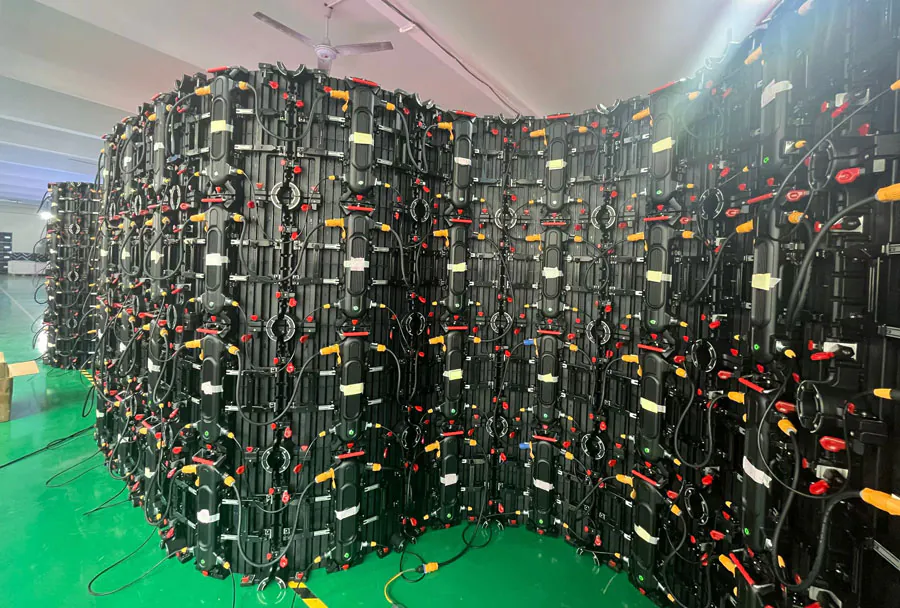
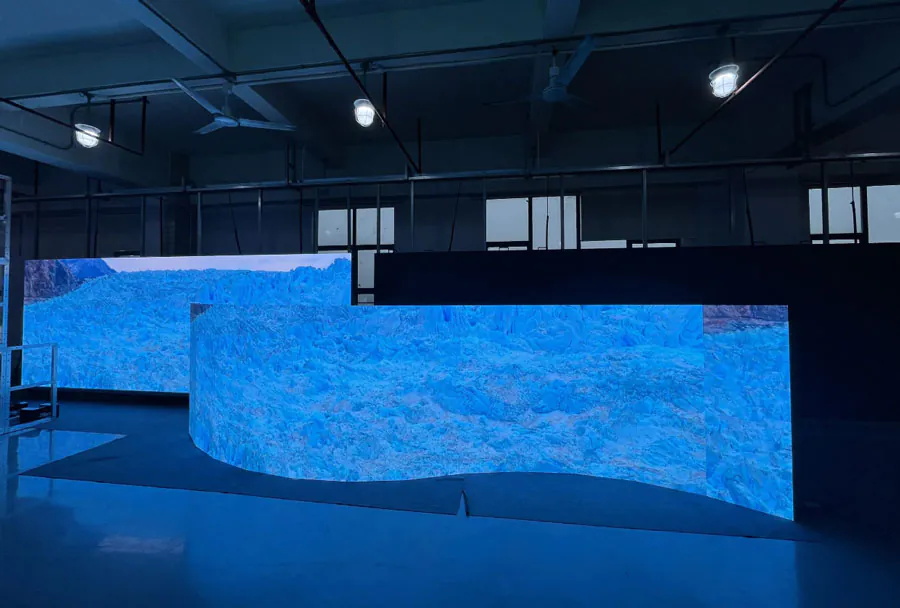
A flexible LED display is a modular screen engineered to bend, roll or drape without breaking pixel integrity. Instead of rigid cabinets, it uses soft PCBs or segmented modules that allow curvature in both horizontal and vertical directions, which is why the same product family can wrap a column, curve around a corner or hang as a soft backdrop.
TW VISION builds these panels across a range of pixel pitches, including P1.2, P1.5, P1.9, P2.5 and P3.9, with brightness classes for indoor and outdoor work. The range matters because pitch sets viewing distance while brightness sets the environment, and the two decisions are usually made together.
Core Components
- Flexible LED modules. The front pixel matrix, mounted on a bendable substrate.
- Flexible power and signal distribution. Cables or flexible backplanes designed to move with the screen.
- Controller and receiving cards. The electronics that map and drive every pixel.
- Mounting framework. Custom or semi-standard structures that hold the bending radius and protect the electronics.
Buyers usually choose a flexible LED display for aesthetic adaptability: the ability to create fluid forms while keeping strong color fidelity, refresh rate and brightness control. That combination is what makes the format useful in architecture and retail, not just on stage.
Key Features and Advantages
Before comparing suppliers, it helps to know which strengths actually matter in a built project:
- Flexibility and form factor. Panels can curve, wrap or hang, enabling 3D shapes, cylindrical columns and draped backdrops.
- Lightweight construction. Lower structural load and simpler rigging than conventional cabinets.
- High pixel density options. Small pitches deliver crisp imagery for close-view indoor installations.
- High brightness and contrast. Usable in dim interiors as well as brighter retail and outdoor contexts, depending on the variant.
- Transparency variants. Preserve daylight and sightlines for facades and indoor overlays.
- Seamless visual flow. Minimal bezels and careful module alignment reduce visible seams on curves.
- Modular repairability. A defective module can be replaced without dismantling the cabinet.
- Energy efficiency. Modern flexible LEDs can be optimized for lower power per square meter than older large-format displays.
Constraints to Design Around
Flexibility also introduces limits: minimum bending radii, cable strain relief and environmental sealing. Respecting those three constraints early is what keeps a curved installation looking intentional a year later, when thermal cycling has already moved every joint once.
Technical Specifications That Shape Design
The table below reflects typical TW VISION flexible ranges and how each parameter changes the design brief. Always confirm the exact datasheet for the model you plan to specify.
| Parameter | Typical specification | Impact on design | Recommended use | Notes |
|---|---|---|---|---|
| Pixel pitch | P1.2 – P3.9 | Determines viewing distance and image clarity | Indoor close-view: P1.2–P1.9; longer distance: P2.5–P3.9 | Choose the smallest pitch affordable for the target viewing distance |
| Minimum bending radius | Flat to about 150 mm, product-dependent | Limits curvature tightness and structural design | Gentle curves and cylinders with a planned radius | Confirm against the datasheet for each model |
| Brightness | 600–6,000 nits across indoor and outdoor variants | Affects visibility in ambient light | Indoor 600–1,200 nits; outdoor 3,000–6,000 nits | Higher brightness raises power draw and heat |
| Transparency | 0%–60% | Controls light transmission and sight-through | Facades, shopfronts, atria | Higher transparency can reduce pixel density |
| Ingress protection | IP20–IP67, model-specific | Sets indoor or outdoor suitability | Outdoor and wet areas need IP65 or better | Curved outdoor seams may need extra sealing |
| Weight per m² | 5–20 kg/m² | Drives structure and mounting design | Lightweight builds reduce structural cost | Always factor dynamic loads for hanging screens |
Design Considerations for Creative Installations
Successful design of a flexible LED display reconciles creative ambition with physical limits. Eight considerations decide most outcomes:
- Bending radius and panel orientation. Never force modules beyond the datasheet limit; both vertical and horizontal bends may be possible, but directional restrictions must be verified.
- Structuring and backing. Draped or suspended screens need a supportive but discreet frame; lightweight aluminium formers hold shape while allowing service access.
- Seam planning. Overlap and interlock strategies hide joints, and module seams should follow natural design lines or be masked with content.
- Thermal management. High brightness generates heat, so plan airflow; enclosed installations need ventilation or active cooling.
- Power distribution. Distributed power points shorten runs; map drops to avoid voltage drop and add redundancy for critical installs.
- Signal integrity. High-resolution content needs robust distribution, usually fiber or quality CAT6/7 with extenders, plus early pixel mapping for complex shapes.
- Structural load and safety. Calculate static and dynamic loads with safety factors, and involve structural engineers for large facades or overhead work.
- Environmental protection. Outdoor and semi-outdoor builds need IP-rated modules, sealed seams and UV-resistant materials.
Installation Methods and Best Practices
Installation discipline decides whether a flexible LED display reaches its designed appearance or drifts out of alignment within months:
- Pre-install planning. Produce drawings for cable runs, power locations and service access, and validate curvature with a mockup or small prototype.
- Surface preparation. The substrate must be smooth, stable and able to carry the load; adhesive mounting requires confirmed compatibility and cure times.
- Mounting technique. Use purpose-built brackets, hook-and-loop systems or custom tracks, with segmented rings for cylinders. Avoid sharp bends and provide strain relief on every connection.
- Grounding and bonding. Bond metal frames and keep grounding consistent across modules to reduce electrical noise and improve safety.
- Service access. Design in access panels, hinge points or removable sections before the frame is closed.
- Calibration and color matching. Calibrate every module after installation so uniformity is measured, not assumed.
- Testing and commissioning. Run burn-in tests, verify refresh rate, pixel mapping, brightness uniformity and shutdown systems, and validate content on the actual curved surface.
Content Strategy for Curved Screens
Content carries a flexible LED display installation. Curves add distortion, varying viewing distances and seam visibility, so the media has to be designed for the geometry rather than cropped into it.
- Content mapping. Use the controller’s mapping tools to align pixels with the physical surface, and apply mesh warping or projection-mapping tools for irregular shapes.
- Design for curvature. Avoid thin type and tight graphics that wrap awkwardly; larger weights and spatial composition flow with the form.
- Viewing distance and resolution. Match detail to the closest expected viewer, with higher density and simpler high-contrast imagery for interactive installations.
- Motion and transitions. Motion masks seams and builds immersion, but fast horizontal movement can blur against LED seams at close range.
- Brightness and night modes. Dynamic brightness profiles follow ambient light, extending component life and improving viewer comfort.
- Interactivity. Sensors, touch overlays and camera-based interaction need planned latency, durability and maintenance access.
Foldable Displays: Components, Setup Speed and Portability
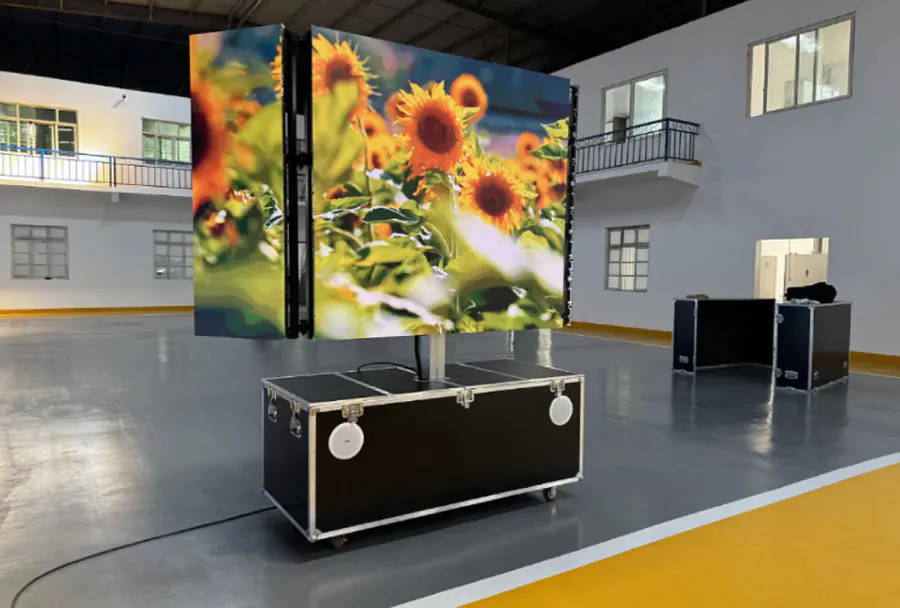
A foldable LED display shares the flexible family’s modular logic but optimizes for transport rather than curvature. Each system combines LED cabinets, a hinged support frame, power supplies, receiving cards, a media processor and a road case, so the screen packs down between events and rebuilds in a different venue.
What a Foldable System Includes
Most professional systems ship with LED panels in CNC or die-cast aluminium cabinets, a foldable frame, power supplies, receiving cards, a control system and a road case. Practical extras separate a durable unit from a fragile one: edge-protection frames, a fast-lock system, an HDMI port for cascade use, GOB or COB surface protection, and wheels on the base.
How Fast Foldable Screens Really Set Up
Speed is measurable. In a factory test, a P1.86 foldable screen measuring 1,920 × 3,840 mm (1,032 × 2,064 pixels) reached a working image about 12 minutes after leaving its case. That build time changes labor planning for trade shows, launches, roadshows and corporate events, because a small crew finishes without overtime. A recorded setup and programming example is available on YouTube.
How It Differs From a Fixed Wall
A conventional LED wall is heavier, more rigid and usually dependent on truss or permanent mounting. A folding display prioritizes mobility: it can sit on wheels, collapse into a compact footprint and move between venues without a dedicated truck. The trade-off is tighter hinge and cabinet tolerances, which is why two screens with identical pixel pitch can differ sharply in alignment after repeated folding.
Foldable Specifications, Applications and Care
Pitch bands follow the same logic as any LED purchase: P1.5–P2.5 for close indoor viewing, P2.6–P3.9 for general indoor events, and P4 and above for longer distances or outdoor work. Indoor units typically run 800–1,500 nits, while outdoor-rated panels need 3,000 nits or more.
Folding formats suit trade shows, retail promotions, corporate events, stage and worship productions, education, hotel venues and city-to-city roadshows. Check hinge strength, seam alignment after repeated cycles, front service access, control compatibility including cascade support, and transport protection such as reinforced edges and corner guards.
Never force the unfolding mechanism, keep connectors dry and store cabinets in their cases; the maintenance section below covers the rest of the routine. Before ordering, ask six questions: expected lifespan, front or rear service access, cascade limits, supported control software, training, and spare-parts support. Get the answers in writing, because they predict service quality better than any brochure.
Hinge, Registration and Service Design
Mechanical quality is what separates a screen that survives a season from one that drifts out of alignment in a month. Look for hinge architectures with replaceable bushings, so wear is serviced at the joint rather than written off across the cabinet.
Once unfolded, the screen must behave as one flat surface. Precision alignment pins, quick-lock clamps and micro-adjustments hold registration across modules, while reinforced frames and integrated data and power routing reduce the number of exposed connections at every load-in. Front or rear service access, modular spare parts and clear diagnostics keep downtime measured in minutes instead of days.
Four dimensions describe a reliable system:
- Mechanical robustness. Hinges, locks and frames that maintain alignment through repeated cycles.
- Electrical consistency. Stable power distribution, connector integrity and thermal management.
- Predictable serviceability. Replaceable modules, diagnostics and fast repairs.
- Consistent imaging. Color calibration, refresh rate and brightness that stay uniform between shows.
Broadcast-Grade Imaging, Power and Control
Event and broadcast buyers judge a screen on camera, not only in the room. Aluminium alloy frames paired with reinforced polymer components keep weight down without sacrificing rigidity, and standard module sizes let you build a range of native aspect ratios from one inventory.
Imaging quality comes from high-brightness LEDs, precise gamma calibration and fine pixel pitch, while broadcast-level refresh rates remove scan lines and flicker during high-speed capture. On the electrical side, redundant power distribution and disciplined signal routing let the wall join existing AV workflows instead of demanding a new one.
Deployment Checklist Before You Ship
Workflow planning is cheaper than rework. Document each use case with its people, content, location, setup time and required connections, then turn that map into repeatable procedures:
- Build a use-case matrix so one configuration serves recurring jobs.
- Create content templates and an approval step instead of one-off files.
- Standardize inputs and presets, and plan what happens when a source fails.
- Write a deployment checklist that names who owns load-in, content and strike.
- Store the folded screen in its case, dry, with connectors capped.
- Track setup minutes, downtime and repeat bookings rather than vanity metrics.
Creative Applications and Case Studies
Flexible LED display projects already appear across several demanding contexts:
- Retail facades. Curved, semi-transparent LED curtains that blend display with daylight.
- Museums and galleries. Sculptural media walls that respond to visitor movement.
- Stages and theatrical sets. Draped backdrops and wraparound surfaces that reconfigure quickly between shows.
- Hospitality and lobbies. LED columns and flowing walls that change mood and support wayfinding.
- Outdoor public art. Weather-sealed cylinders and wrapped architectural details that animate plazas and transit hubs.
Each flexible LED display case benefits from early collaboration with technical teams or certified integrators, because creative intent and practical constraints are easier to reconcile on paper than on site.
Maintenance, Reliability and Lifecycle
Uptime for a flexible LED display depends on a plan rather than on luck:
- Routine cleaning. Use recommended solvents and soft cloths, never abrasives on delicate pixel surfaces.
- Firmware updates. Keep controllers and receiving cards current for compatibility and security.
- Spare parts. Stock modules, power supplies and connectors, especially for large or critical installations.
- Environmental monitoring. Track temperature and humidity in enclosed builds to avoid premature failures.
- Expected lifespan. LEDs commonly deliver 50,000–100,000 hours, but power supplies and electronics may need replacement sooner.
- Warranty and support. Understand the warranty terms and hold a service contract for high-value or high-traffic sites.
Cost Considerations and ROI
Cost for a flexible LED display varies widely with pixel pitch, brightness, installation complexity and supporting infrastructure, so compare quotes on identical assumptions:
- Capital expenditure. Price per square meter is driven by pitch and brightness class; smaller pitch and higher brightness cost more.
- Installation. Custom frameworks, structural engineering, mounting systems and labor can exceed product cost on complex shapes.
- Operating costs. Power depends on brightness and duty cycle; add energy and cooling for high-brightness indoor work.
- Content and software. Content creation, mapping and licensing are ongoing costs that shape perceived value.
- Revenue and value. In retail and experiential settings, dwell time, conversion and sponsorship can justify the spend; public venues measure branding and engagement.
A KPI-driven approach, defining outcomes such as foot-traffic uplift or ticket sales before the build, makes the investment defensible to finance teams.
Choosing the Right Product
Evaluate six factors before specifying a flexible LED display model:
- Intended viewing distance and environment, indoor or outdoor.
- Desired curvature and installation geometry.
- Transparency needs and whether daylight or sightlines must survive.
- Brightness required by ambient lighting.
- Mounting constraints and service access.
- Budget and total cost of ownership, including installation and content.
Engage TW VISION representatives or authorized integrators early. Datasheets, mechanical drawings, sample modules and simulation tools let you validate a concept before steel is ordered, which is far cheaper than correcting a radius on site.
Conclusion and Recommendations
A flexible LED display unlocks forms that rigid panels cannot match, letting designers sculpt light into architecture, retail space, stages and public art. Realizing those forms still requires discipline: respecting bending radii, planning power and signal distribution, and designing content that follows the geometry.
Five recommendations hold across projects:
- Start with a prototype or mockup to validate curvature, seams and content before full production.
- Specify pixel pitch from the closest viewing distance, not from the budget line.
- Build serviceability into the mechanical design from day one.
- Use calibrated color management and post-install commissioning to guarantee uniformity.
- Plan for long-term maintenance, spare parts and firmware updates.
Planned well, a flexible LED display delivers an experience audiences remember. For complex or large-scale work, partner with experienced integrators who can align creative ambition with a system that stays maintainable for years.