Commercial LED Screen Rental Houston — Fine-Pitch Displays for Indoor Business Events

Commercial LED screen rental in Houston usually starts with a room problem rather than a product problem: a ballroom with a 40-foot sightline, a boardroom that has to show legible spreadsheets, or a launch stage that must stay clean on a broadcast feed. We supply the cabinets that solve those problems, and we build them in our own factory before they ship from our Atlanta warehouse.
Table of Contents
- What Commercial Buyers Actually Ask For
- Matching Pixel Pitch to the Room
- Launch and Keynote Stages
- Hotel Ballrooms and Breakout Rooms
- Medical, Energy and Industrial Programmes
- Trade Booths and Exhibit Halls
- Commercial LED Screen Rental for Camera and Streaming
- Power, Rigging and Venue Rules
- Humidity, Heat and Indoor-to-Outdoor Moves
- What Ships From Stock
- Lead Times and Delivery to Houston
- Budget Bands for Commercial Work
- Specimen Configurations
- FAQ
What Commercial Buyers Actually Ask For
Most commercial LED screen rental enquiries we receive from Houston fall into three shapes. The first is a one-day event where the screen has to look flawless for ninety minutes and then disappear before the next booking. The second is a recurring programme, such as a quarterly analyst briefing, where the same wall is rebuilt in the same room four times a year. The third is a fleet order from an AV company that already owns trucks and crews and needs cabinets that survive a hundred load-ins.
Each shape changes the cabinet, not just the quantity. One-day work rewards light cabinets and a fast locking system. Recurring work rewards identical batches, so a replacement panel matches the wall four quarters later. Fleet work rewards edge protection, road-case dimensions and a spare ratio written into the purchase order.
We answer all three the same way: with the pitch, brightness and cabinet size stated in writing before anything is quoted. Read the venue floor plan first, then the content, then the budget.
Matching Pixel Pitch to the Room
Pixel pitch is the distance between two LEDs, measured in millimetres. Divide 1,000 by the pitch and square the result to get pixels per square metre, which is the number that actually predicts whether text stays sharp.
| Pitch | Pixels per m² | Working sightline | Typical Houston use |
|---|---|---|---|
| P1.86 | ~289,000 | 2–5 m | Boardroom, podium backdrop, press wall |
| P2.5 | 160,000 | 3–7 m | Breakout room, hotel ballroom front rows |
| P2.6 | ~147,900 | 4–8 m | General session, exhibit hall feature wall |
| P2.9 | ~118,900 | 5–9 m | Large ballroom, arena concourse |
| P3.9 | ~65,700 | 7–14 m | Arena bowl, outdoor marquee, long halls |
A common mistake in commercial LED screen rental quotes is overspecifying the pitch because the client asked for “high definition”. High definition describes the viewing experience, not a fixed number. A P3.9 wall read from 60 feet looks identical to a P1.9 wall at the same distance, and it costs less to buy, truck and rig.
Launch and Keynote Stages
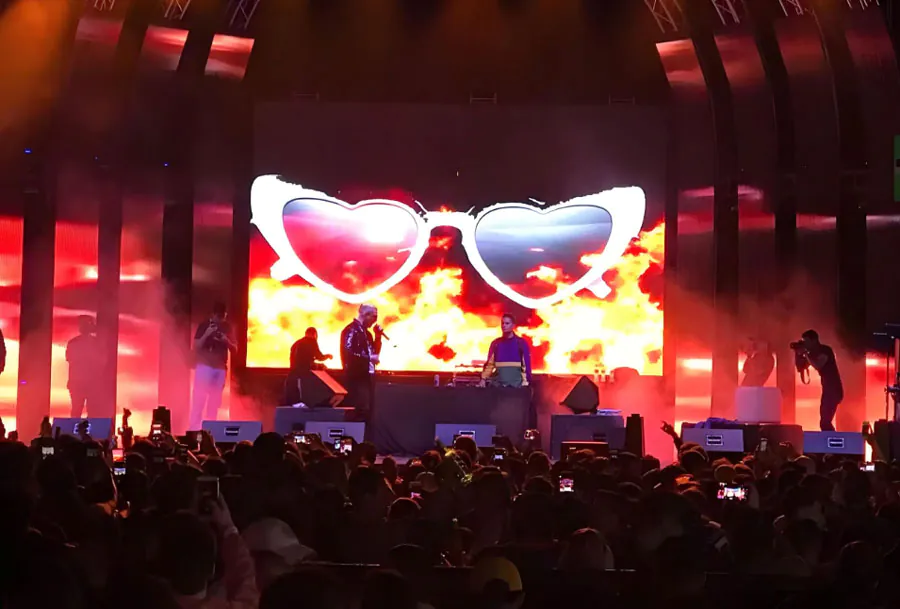
Product launches reward contrast and clean edges. A P2.5 or P2.6 wall behind a keynote speaker gives a smooth gradient with no visible module seams at the ten-foot camera crop, which is the framing most Houston launch streams use.
Ask for two things that rarely appear on a basic quote: a processor with enough inputs for a live laptop, a backup laptop and a playback machine, and a cabinet count that lets the wall be rebuilt two metres wider if the set changes during rehearsal. The NovaStar VX400, VX600 and VX1000 Pro we keep in stock cover the first requirement; the second is a purchasing decision made at order stage.
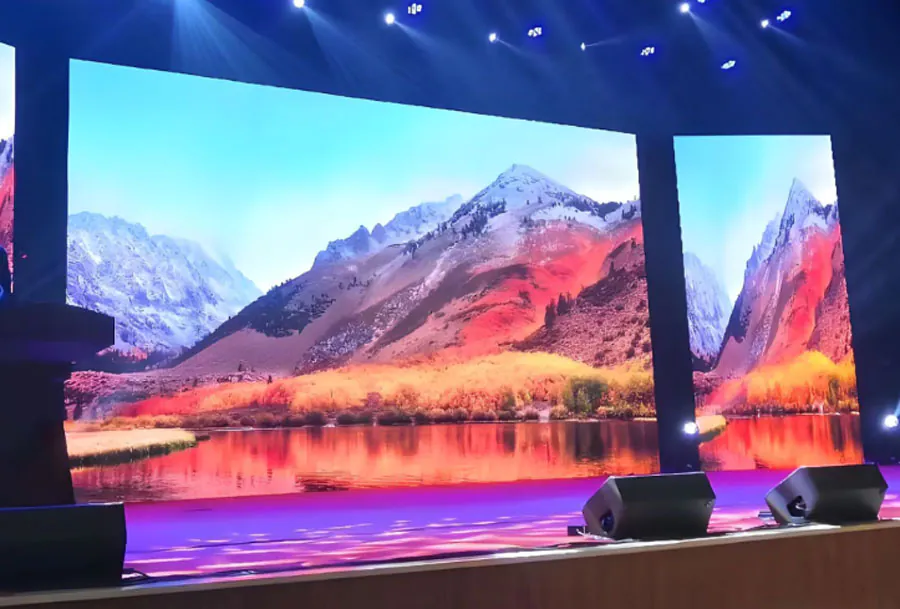
Brightness for a controlled indoor room sits between 800 and 1,200 nits. Pushing to 2,500 nits indoors does not improve the picture; it raises power draw and heat behind the wall, and it can wash out skin tones on camera.
Hotel Ballrooms and Breakout Rooms
Houston hotel ballrooms carry two constraints that shape a commercial LED screen rental order: ceiling height with rigging points already spoken for, and carpet-level power that is rarely where the screen ends up.
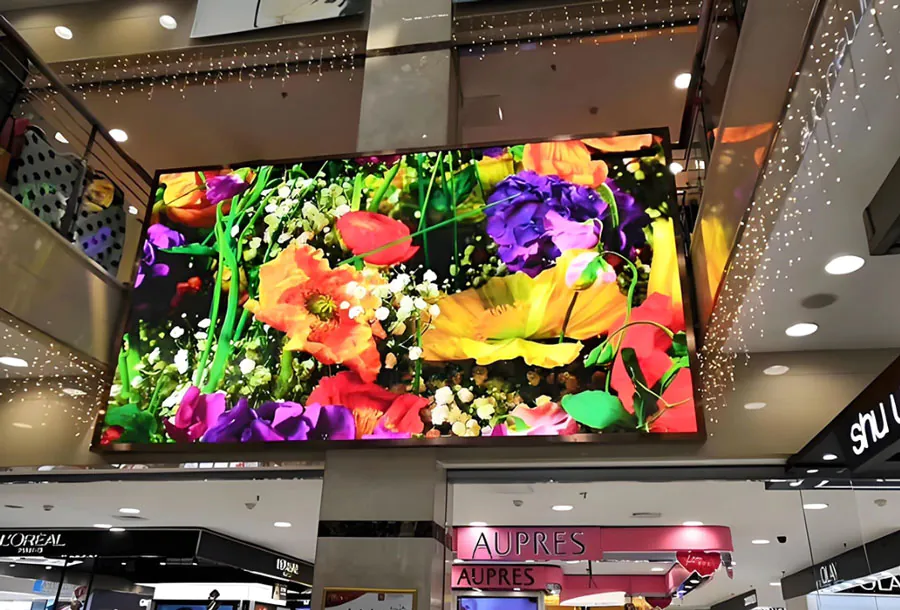
For a typical 1,200-seat general session, a 16:9 wall around 9 m wide by 5 m high in P2.6 covers the room without pushing the front-row sightline under three metres. Breakout rooms usually need a 4 m by 2.25 m wall in P2.5, mounted on ground support so no ceiling steel is used.
Ground support also solves the hotel’s floor-protection clause. Ask the venue for the ballroom’s point-load limit and the service elevator dimensions before the order is confirmed, because a 500 mm cabinet that fits the freight lift may not fit a passenger lift, and a wall that arrives on the wrong floor costs a full re-load.
For a full venue-by-venue breakdown of load-in routes and rigging limits, see our Houston LED screen rental hub.
Medical, Energy and Industrial Programmes
Houston’s medical center and energy corridor run a steady calendar of symposia, safety briefings and investor days. These rooms share a requirement that event-led projects often miss: the screen must display dense data, not just video.
Charts, lab imagery and multi-window dashboards need finer pitch than a concert wall of the same size. A P1.86 wall in a 200-seat symposium room keeps 12-point text readable at the back, while a P2.9 wall in the same room forces the presenter to enlarge every chart.
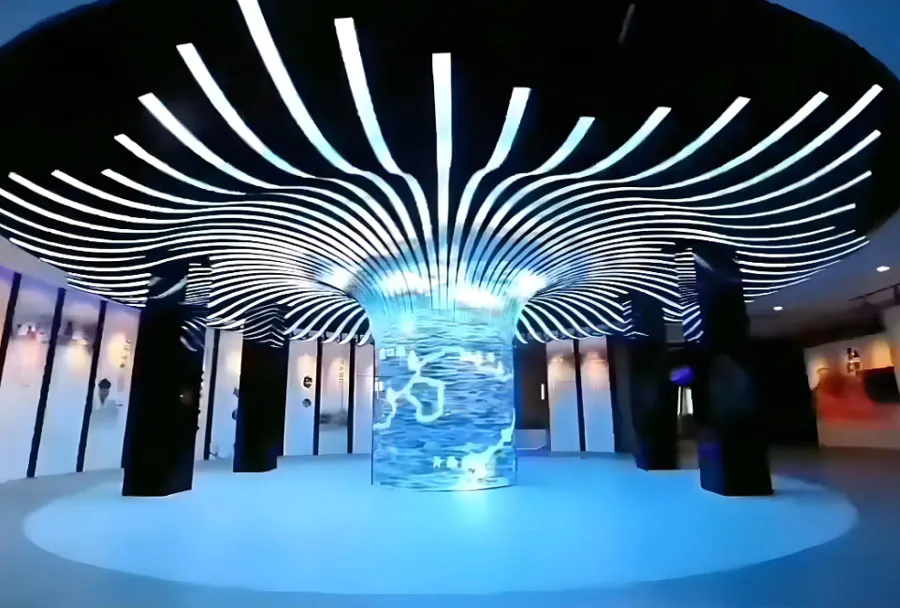
Industrial sites add a different constraint. When a screen is installed in a training bay or a plant visitor center rather than a ballroom, dust and vibration matter more than portability. Our IP-CT P2.5 cabinet, 640 by 480 mm, uses a soft connection between modules that tolerates handling in a fixed installation, and it ships from Atlanta stock rather than waiting on a factory run.
For offshore and refinery-adjacent visitor centers, state the environment on the enquiry. Screen specification follows the air, not the brochure.
Trade Booths and Exhibit Halls
Trade show work compresses every decision into a build window. At George R. Brown Convention Center, the practical limit is usually labour and freight rather than the screen itself, so a wall that assembles with one locking action per cabinet saves more time than a lighter cabinet that needs tools.
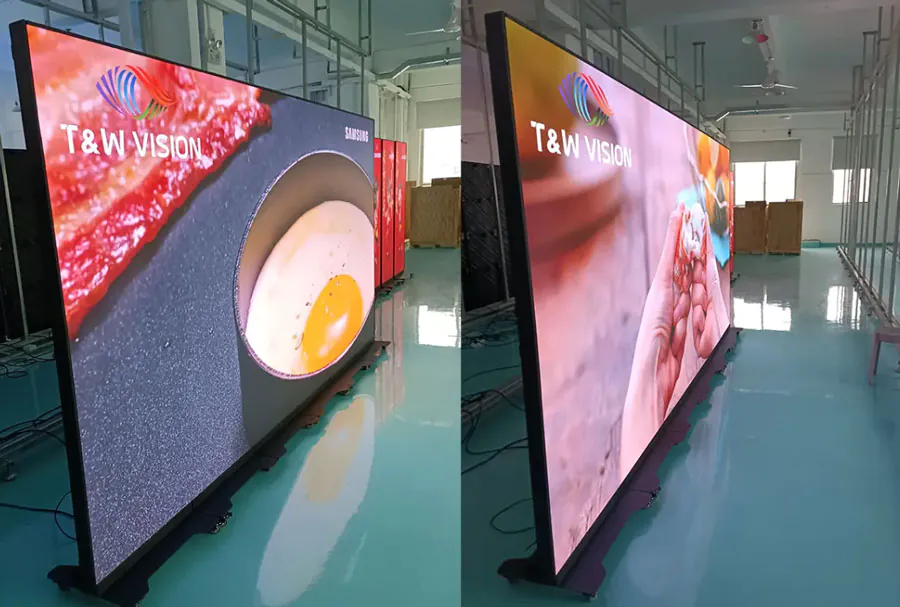
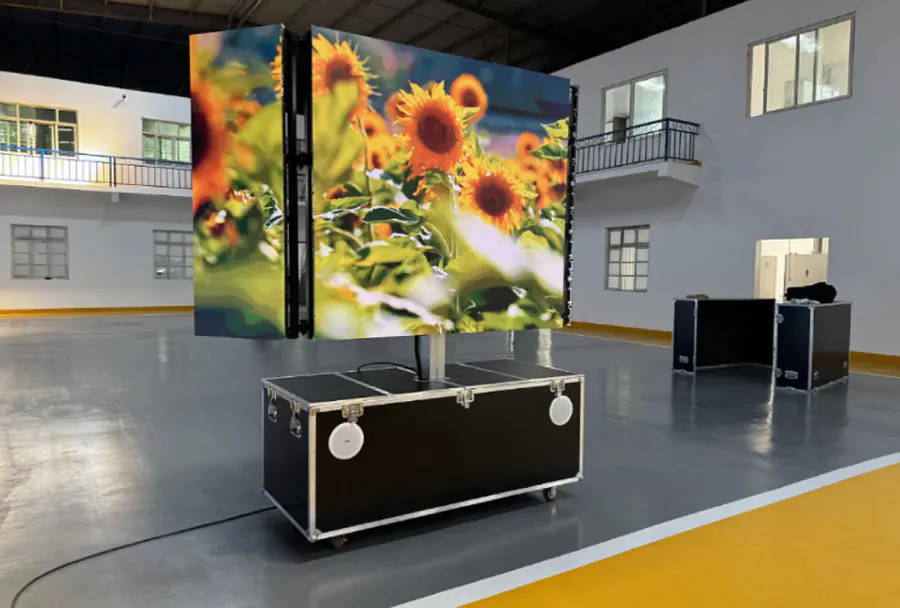
Two configurations cover most booths. A backwall of 3 m by 1.7 m in P2.5 fills a 20-foot booth and stays inside the hall’s height rule. A hanging banner or a folded poster on a flight-case base handles the corner booth where floor space is rented by the square metre.
Book the screen and the rigging together. A booth wall quoted without its truss, base or hanging hardware tends to arrive with a build plan that does not match the hall’s ceiling grid, and that gap is discovered at 2 a.m. on build day.
Exhibitor manuals from Houston First list the current rigging and electrical rules for the city’s major halls; read them before the order, not after.
Commercial LED Screen Rental for Camera and Streaming
Every commercial LED screen rental decision that touches a camera has to clear three thresholds: refresh rate, scan behaviour and colour consistency across cabinets.
A refresh rate of 3,840 Hz or higher removes the horizontal banding that appears when a phone or broadcast camera points at an LED wall. Genlock keeps multiple walls and the camera on one clock, which matters when a Houston launch is cut between a stage wall and a confidence monitor.
HDR is often sold as a checkbox, yet it needs a native pixel grid, adequate bit depth and content graded to a defined standard. If the client’s footage is Rec.709, a standard-gamut cabinet reproduces it faithfully; claiming HDR output over SDR footage only adds cost. The ITU-R BT.2100 recommendation defines the HDR signal, and the display has to meet it, not approximate it.
For streaming, test the actual encoder before the event. A wall that looks correct to the eye can still beat against a 50 Hz or 60 Hz capture frame rate.
Power, Rigging and Venue Rules
Power planning starts with the cabinet, not the wall. A P2.6 rental cabinet averages roughly 95 W and peaks near 190 W; multiply by cabinet count, add twenty percent headroom, then check the circuit the venue will actually give you.
Rigging follows the same logic. Screen weight plus truss plus ballast has to sit inside the hall’s certified point load, and AVIXA publishes the design and safety references most US venues cite in their exhibitor manuals.
Houston adds two local habits. First, downtown halls enforce loading-dock time slots, so a screen that clears the freight door in twenty minutes keeps the crew inside its window. Second, fire marshals require documentation for anything hung above an occupied floor, which means the truss drawing and the screen weight certificate should travel with the shipment.
If the venue asks for a licensed rigger, hire one. A commercial LED screen rental order that saves on rigging certification tends to lose the saving at the first inspection.
Humidity, Heat and Indoor-to-Outdoor Moves
Houston averages well above 70 percent relative humidity for much of the year, and the National Weather Service Houston/Galveston office tracks a hurricane season that runs from June through November. Both facts change how cabinets are prepared.
Cold cabinets moved into a humid room attract condensation on the module face. Let them reach room temperature before power-on, and keep them in the flight case until they do. For an outdoor element of an otherwise indoor programme, specify IP65 sealing and plan for rain covers on the processor and cabling, because water reaches the electronics long before it reaches the LEDs.
Heat is the quieter problem. A wall run at full white in an unconditioned tent reaches thermal limits faster than the same wall showing mixed content. Set brightness to the room, not to the maximum, and keep the rear service gap clear.
What Ships From Stock
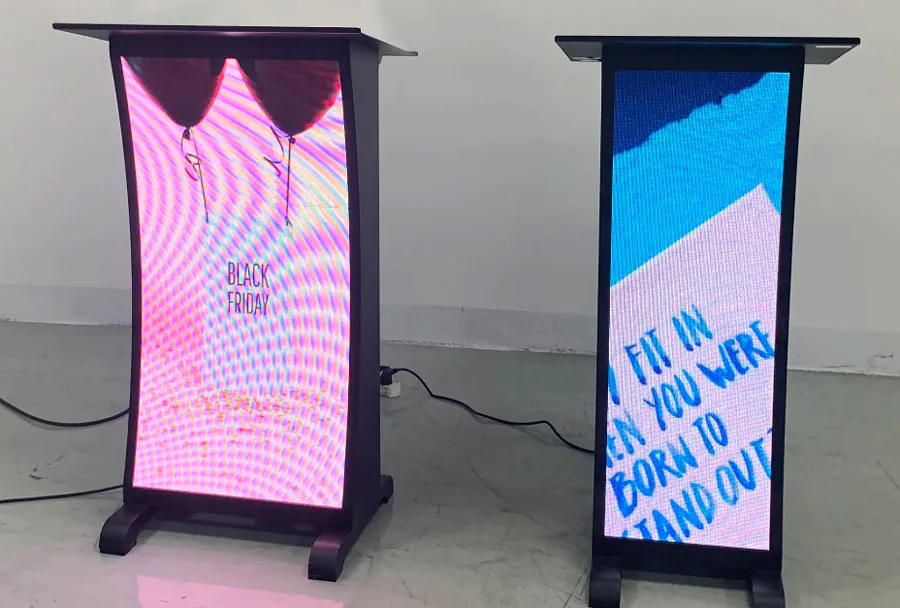
We hold rental-relevant product in our Atlanta warehouse, and we say plainly which lines are there. Indoor rental cabinets in the PQ series cover P2.6 at 500 by 500 mm and 500 by 1,000 mm. The IP-CT P2.5 cabinet, 640 by 480 mm, covers fixed indoor installations. The LP-H P1.86 folding poster, 640 by 1,920 mm, ships as a self-contained unit on a flight-case base. The LED Podium P1.8, 960 by 480 mm, is a finished all-in-one lectern display.
NovaStar VX400, VX600 and VX1000 Pro processors are also in stock. Anything outside these lines is a factory order with a 15 to 20 day production lead time.
We do not claim a Houston warehouse. Shipments leave Atlanta, roughly 790 miles and two days by road, and we say so before a client plans a build window around a delivery date.
Lead Times and Delivery to Houston
Plan backwards from the build day. Stock orders leave Atlanta within a few working days of confirmed payment and paperwork. Factory orders need 15 to 20 days of production before transit, so a custom pitch or a large quantity should be placed a month ahead of the event, not two weeks.
Freight arrives as palletised flight cases. Confirm whether the venue dock has a lift gate, because a 40-foot trailer without one cannot unload at a hotel service entrance. For downtown venues, book the dock slot before the truck is dispatched.
Texas buyers should also settle the tax question early: a resale certificate filed with the Texas Comptroller keeps a qualifying purchase exempt, and the form takes minutes compared with a refund later.
Every order ships with a spare module ratio and a batch record. When a cabinet is replaced eighteen months later, the colour still matches because the modules came from the same production run.
Budget Bands for Commercial Work
Commercial LED screen rental budgets move with four variables: total area, pitch, brightness class and cabinet count. Doubling the area roughly doubles the cabinet cost; halving the pitch roughly doubles the cost per square metre for the same area.
A 20-square-metre P2.6 indoor wall for a general session sits in a different band from a 20-square-metre P1.86 boardroom wall, even though both are “the same size”. Outdoor or high-brightness cabinets add a further step because the LED package and the sealing change.
Processors, flight cases and spares are usually quoted separately. Ask for the spare ratio in writing, since a three percent spare allowance and a ten percent allowance look identical on a headline price and very different on show day.
We quote per square metre plus cabinet quantity, so a client can compare two configurations without decoding a package. If a quote arrives as a single number with no cabinet count, ask for the breakdown before signing.
Specimen Configurations
| Scenario | Size | Pitch | Brightness | Notes |
|---|---|---|---|---|
| Boardroom | 3.2 × 1.8 m | P1.86 | 800 nits | 16:9, wall mount, low heat |
| Hotel general session | 9 × 5 m | P2.6 | 1,000 nits | Ground support, 500 mm cabinets |
| 20-foot booth backwall | 3 × 1.7 m | P2.5 | 1,200 nits | Flight case, one-person build |
| Arena concourse | 6 × 3.4 m | P3.9 | 5,000 nits | IP65, genlock, rain cover |
| Registration desk | 0.96 × 0.48 m | P1.8 | 800 nits | LED Podium, stock item |
These are starting points, not catalogue rules. Give us the room, the sightline to the back row and the content type, and the configuration follows.
FAQ
Do you rent LED screens in Houston?
We manufacture and supply the cabinets; we do not operate a rental fleet in Houston. Event companies, AV integrators and corporate teams buy or fleet-order from us, and many of them rent the equipment onward. Our role is the hardware, the batch consistency and the processor.
How fast can a commercial LED screen rental order reach Houston?
Stock lines leave Atlanta in a few working days and reach Houston in about two days by road. Factory orders need 15 to 20 days of production before transit.
Which pitch should a 500-seat ballroom use?
P2.6 for a wall around 9 by 5 m with a back-row sightline of 25 to 30 m. Move to P2.9 if the budget is tight and the content is mostly video, since the audience will not resolve the finer pitch from that distance.
Can you match an existing wall we already own?
Sometimes. Send the cabinet model, the batch label and a photograph of the rear connector. Matching depends on the module batch and the driver IC, and we would rather decline than ship a panel that reads half a shade off.