Trade Show LED Screen Rental Las Vegas — Booth Walls Built for Short Build Windows

A trade show LED display in Las Vegas is bought against a clock, not a season. The exhibitor manual sets the height, the marshalling yard sets the arrival, the hall sets the electrical order and the show sets the four-hour strike. The wall that works is the one designed around those four documents before anyone chooses a pitch.
TW VISION manufactures rental-grade LED cabinets and holds standard stock in our Atlanta warehouse, with delivery into southern Nevada in four to six business days once loaded. We do not rent screens in Las Vegas and we do not work the show floor. This page is written for the exhibitors, booth builders, AV suppliers and rental houses that do.
What a trade show changes. A ballroom wall has a night to go up. A booth wall has a window measured in hours, inside a hall with hundreds of other exhibitors, under a manual that governs height, rigging, floor loading and electrical supply. Everything that shortens assembly — cabinet format, pre-addressed receiving cards, a saved configuration file — is worth more here than a finer pitch.
Table of Contents
- 1. Why Booth Walls Are Specified Differently
- 2. Booth Geometry, Height and Sightlines
- 3. The Exhibitor Manual Comes First
- 4. What trade show LED display Buyers Order
- 5. LED Against Projection in a Lit Hall
- 6. Build Windows and Crew Sizing
- 7. Rigging, Hanging and Floor Loading
- 8. Power and Signal on the Show Floor
- 9. Content, Playback and Reliability
- 10. Freight, Advance Warehouse and Drayage
- 11. Insurance, Appointed Contractors and Labour
- 12. What a Booth trade show LED display Costs
- 13. Five Mistakes That Cost a Build Window
- FAQ
- Conclusion
1. Why Booth Walls Are Specified Differently
Three constraints separate a booth wall from any other rental job.
The window is fixed. Exhibitor installs are scheduled against a hall-wide timetable. Overrun is not absorbed by a longer night; it is absorbed by overtime, by the next exhibitor, or not at all.
The footprint is fixed. A booth is an island or an inline space with a defined boundary. The wall must sit inside it, clear the aisle, respect the height limit and leave room for storage and a counter.
The structure is borrowed. Most exhibitors rent the booth frame and own or rent the screen. The screen has to hang from, or stand on, someone else’s structure — which means load figures and attachment points are agreed between two suppliers who may never meet.
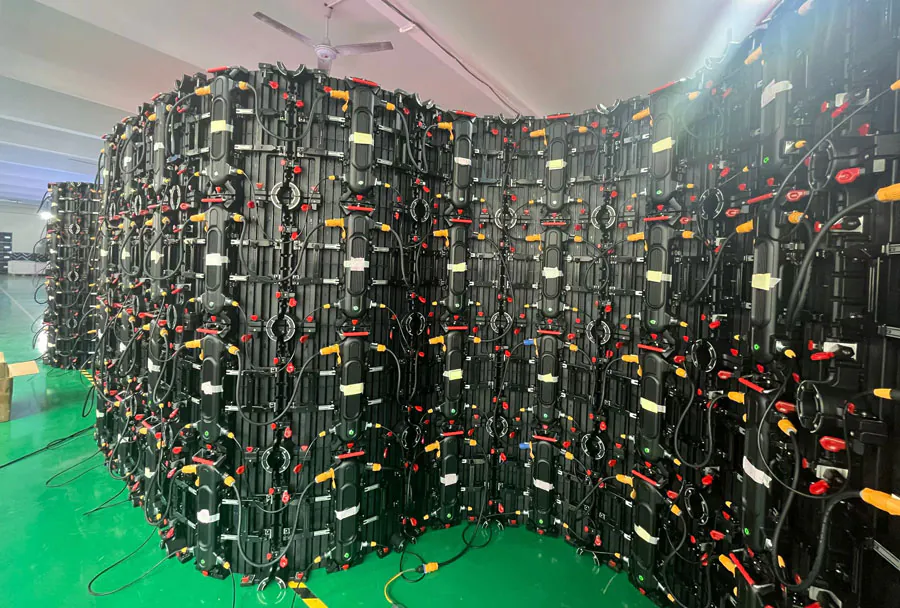
That is why a trade show LED display is usually ordered in 500×500 mm cabinets with quick locks, front service and a documented assembly sequence. The specification is chosen for the crew and the clock first, and for the audience second.
It also explains why exhibitors who rent a wall once and repeat the show year after year end up buying cabinets: the same build, repeated, is where ownership becomes cheaper and predictable.
2. Booth Geometry, Height and Sightlines
Start with the booth drawing, not the catalogue.
Width determines cabinet count. A 10-foot booth wall is six 500 mm cabinets across; a 20-foot back wall is twelve. Confirm the module count, because content is designed to the native pixel grid, not to a rounded size.
Height is capped by the manual. Many halls limit hardwall to 8 feet and require approval above that; hanging signs and headers have their own tier. A wall that exceeds the limit is either rebuilt or refused on the floor.
Sightlines are short. Aisle width means the nearest viewer may be 1.5–2 metres away, which pushes pitch finer than the same screen in a ballroom. P1.9–P2.6 is the working range for a back wall read at that distance; P2.9–P3.9 suits a wall viewed from the aisle across a 20-foot booth.
Density scales as the square of pitch: (1,000 ÷ pitch)², so P2.6 carries roughly 147,900 pixels per square metre and P3.9 about 65,700. One step finer raises panel count, processing load and price together.
Aspect ratio is a decision, not a leftover. A 16:9 deck on a 2.5:1 wall letterboxes; designing for the ratio before content is produced costs nothing, and fixing it during build costs the window.
Working rule for a trade show LED display: size the wall to the aisle view, choose pitch to the closest reader, and keep the cabinet format identical across every show in the calendar so the crew builds the same wall every time.
3. The Exhibitor Manual Comes First
Every major hall publishes an exhibitor manual, and it decides more of the screen specification than the buyer expects.
For the Las Vegas Convention Center, the manual covers booth height limits, hanging sign approval, rigging rules, floor loading, electrical ordering, freight routes and the marshalling yard sequence. The Venetian Expo and Caesars Forum publish their own versions with different deadlines and different approval chains. Read the one for your hall before the design is signed off.
Six items in the manual translate directly into screen decisions:
- Height limit — sets maximum wall height and whether a header can hang.
- Hanging approval — determines whether the wall flies or stands on ground support.
- Floor loading — caps ballast weight for a ground-supported build.
- Electrical order — fixes the circuit size, the tie-in point and who installs it.
- Target freight date — decides whether the wall ships direct or to the advance warehouse.
- Labor jurisdiction — states which work must be done by hall labour.
The International Association of Exhibitions and Events publishes guidance on exhibitor appointed contractors and show-floor rules that explains how these documents interact. If a supplier cannot point to the clause behind their plan, the plan is a guess.
4. What trade show LED display Buyers Order
Orders for this market cluster around four configurations, and each maps to a booth type.
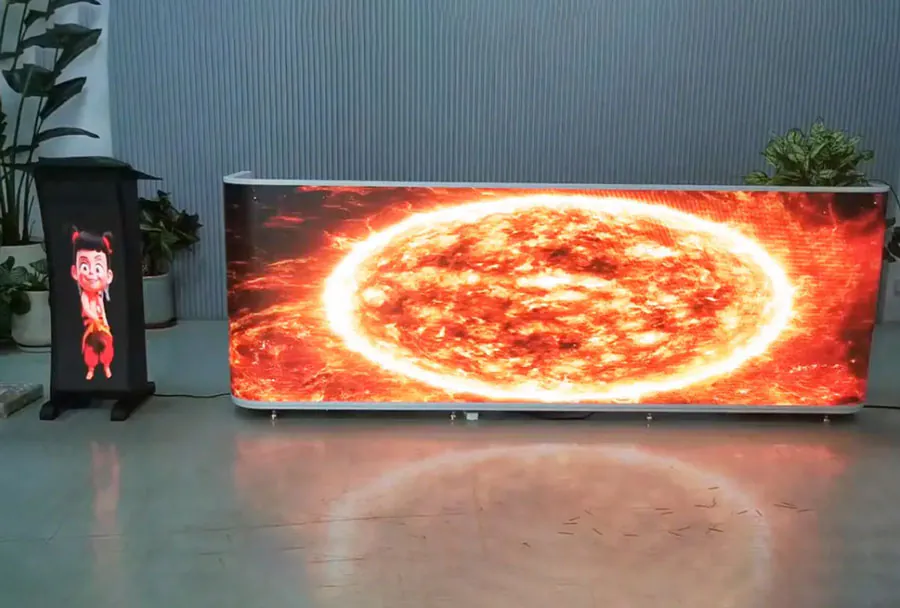
Back wall, P2.6
The standard exhibitor wall: 500×500 mm cabinets, front service, quick locks, six to twelve cabinets across. Sharp at two metres, which is where the aisle puts people.
Corner or two-sided wall
Straight and 90-degree cabinets combined, so the screen reads from two aisles. The corner detail is where cheap builds show a seam.
Hanging header or logo display
A smaller array, often P2.9–P3.9, flown from the booth structure or the hall grid with approval. It carries the brand at distance while the back wall carries the detail.
Podium or counter display
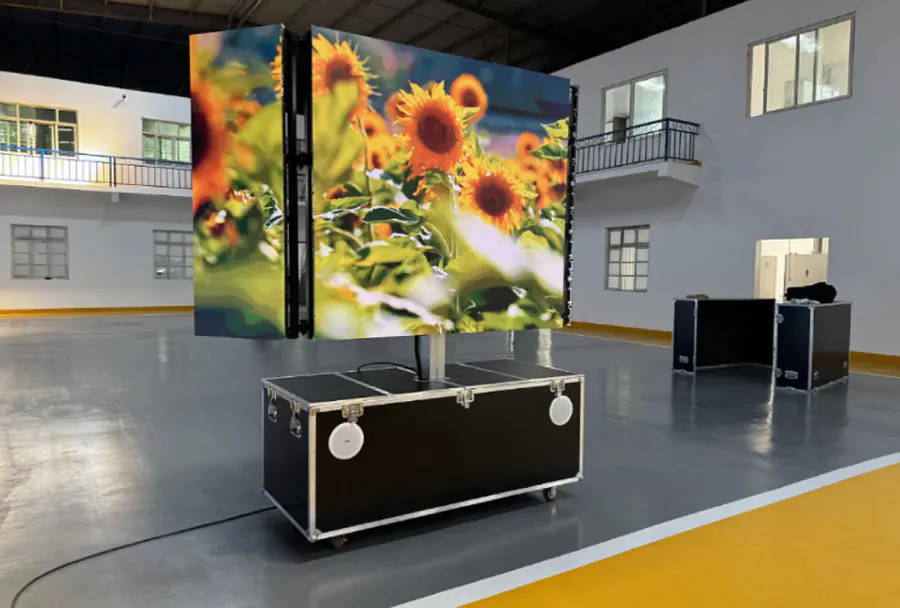
A 960 × 480 mm all-in-one unit at P1.86 for the presenter’s position or a product counter. It replaces a printed banner, runs from one power and one signal connection, and is stocked in Atlanta.
| Series | Stock | Pitch | Cabinet | Typical booth use |
|---|---|---|---|---|
| PQ P2.6 | Atlanta stock | P2.6 | 500×500 / 500×1000 mm | Back walls, corner builds, headers |
| LP-H | Atlanta stock | P1.86 | 640×1920 mm folding poster | Side panel, product plinth, entrance |
| Podium display | Atlanta stock | P1.86 | 960×480 mm all-in-one | Presenter position, counter |
| Other pitches | Factory order | P1.953 – P6.67 | 500×500 / 500×1000 mm | 15–20 days production plus freight |
Cabinets, cases, spares and the processor should ship as one batch. A module from a different run shows as a patch under hall lighting, and on a booth wall the client is standing two metres away.
5. LED Against Projection in a Lit Hall
Halls are bright, and that single fact decides most screen choices.
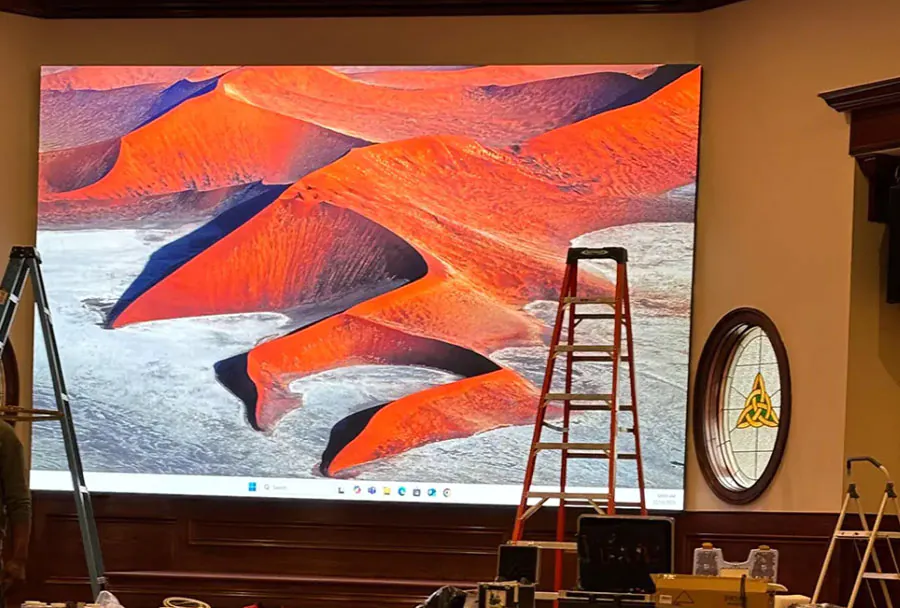
A projector needs darkness to hold contrast; a convention hall has high ambient light, white walls and daylight through glazing. An LED wall holds contrast at 1,200–2,500 nits without dimming the room, needs no throw distance, and casts no shadow when a presenter walks across it.
The trade-offs are weight, cost and packing. LED cabinets need structure and cases; projection needs a screen surface and a lens. For a 10-foot booth wall read at two metres, LED usually wins on legibility. For a 20-foot wall viewed from across a hall, a coarser pitch LED still wins on contrast, at a lower cost per square metre than fine pitch.
Two practical checks. Confirm the wall’s calibrated brightness in the actual hall, not from a datasheet, and confirm the refresh rate against the camera that will film the booth. Exhibitors increasingly stream or record, and banding is visible before pixel pitch is.
6. Build Windows and Crew Sizing
Booth builds are quoted in hours because the hall gives hours.
- 10 × 8 ft back wall: 2–3 hours with two technicians.
- 20 × 8 ft back wall with corner: 4–6 hours with three or four.
- Booth plus hanging header: 6–8 hours, with rigging approval already in hand.
- Island booth with two walls and a counter display: 8–10 hours.
Crew size follows cabinet count and height, not budget. Two people can build a 20-cabinet wall in a booked window; four people cannot build it in half the time if the structure is not ready when they arrive. The critical path is usually the booth frame and the electrical tie-in, not the screen.
Sequence that works: structure signed off, power confirmed, first row levelled, wall built bottom-up, processor connected, calibration checked, content run through, then photographs before the aisles open.
For a repeat exhibitor, keep the same cabinet count and the same layout file. A build that has been done four times takes half the hours of a first attempt, and that saving repeats at every show on the calendar.
7. Rigging, Hanging and Floor Loading
Whether the wall flies is a hall decision, not a supplier preference.
Hanging. Halls that permit hanging require approval, often with a stamped drawing, and rigging performed by approved labour. The booth structure must be rated for the wall’s weight plus rigging hardware, and the load path back to the grid has to be documented.
Ground support. Where hanging is refused or the structure is not rated, the wall stands on bases and truss with ballast. Ballast raises two questions: does the floor allow the point load, and does the ballast fit inside the booth footprint without blocking storage.
Safety. Secondary safety cables on every flown cabinet, rated hardware, and a documented inspection before the show opens. Fire and life-safety review covers egress and materials, and the relevant code guidance is published by NFPA.
Weight discipline. A lighter cabinet reduces ballast and crew time. This is the practical reason 500×500 mm aluminium cabinets dominate booth work, and why a heavier outdoor cabinet is a poor choice for an indoor build even when the pitch matches.
8. Power and Signal on the Show Floor
Electrical supply in a hall is ordered, metered and installed by the venue’s contractor. That changes what the screen supplier has to provide.
Circuit sizing. Plan on maximum draw, not average consumption. A 20 m² P3.9 booth wall plus processing can pull more than a single 20-amp circuit comfortably supplies, and the hall will not add capacity on the day.
Distribution. Bring a distribution plan that matches the ordered service — phase, connector type, cable length to the tie-in. Adapters are the usual cause of a stalled build.
Signal. Confirm the source: a laptop, a media player or the booth’s own playback device. Check HDMI and SDI availability, HDCP handling, and cable length limits. A locked-down corporate laptop behaves differently from a playback machine, and the difference surfaces during rehearsal.
Backup. A second playback device and a spare processor input are cheap compared with a dark wall on opening morning.
Every one of these items belongs in the pre-show checklist, signed before freight leaves. On the floor there is no time to discover that the ordered service is three-phase and the distro is single-phase.
9. Content, Playback and Reliability
Booth content has a different job from ballroom content: it runs for eight hours, loops without a presenter, and is read by people standing still.
Design for the loop. Short cycles, large type, high contrast, and a clear call to action. Text that needs ten seconds to read is text nobody reads in an aisle.
Design for the pixel grid. Deliver at native resolution with safe margins that account for cabinet edges. Scaling a 16:9 deck to a 2.5:1 wall blurs small type first.
Design for the light. Hall lighting is flat and bright. A day grade with more contrast and less subtle gradient will read better than a design built on a monitor.
Test the loop. Run the full cycle at show brightness for ten minutes before the aisles open, and check for dead pixels, seams and audio sync if the booth plays sound.
Carry spares. Two modules, a receiving card and a power supply on site. A spare in a hotel room is not a spare; a spare in a case under the counter is.
For a trade show LED display that runs unattended, the single highest-value accessory is a configured backup playback device. It turns a failed laptop into a five-minute swap instead of a service call.
10. Freight, Advance Warehouse and Drayage
Freight timing on a show floor is a schedule, not a shipping preference.
Direct to show site. Faster and cheaper when the target date is met. Arrive inside the assigned window or the truck waits in the marshalling yard at hourly cost.
Advance warehouse. Ship earlier to the show’s warehouse, and the official contractor delivers to the booth on schedule. Costs more per shipment and removes the risk of a missed target date.
Drayage. Moving freight from the dock to the booth is billed by weight and handled by the official contractor. A wall in heavy cases costs more to dray than the same wall in slim cases, which is a specification decision, not a shipping one.
Cases. Flight cases protect cabinets and speed the build, but they add drayage weight. For a repeat exhibitor, a case set that doubles as the booth’s storage is usually the right compromise.
Return freight. Book it before the show. Strike ends, the hall empties, and a wall with no outbound booking sits in the aisle.
From Atlanta, stock orders reach southern Nevada in four to six business days by LTL once loaded. For a show with a hard target date, ship to the advance warehouse and let the official contractor carry the last mile.
11. Insurance, Appointed Contractors and Labour
Three administrative items stop builds more often than technical faults.
Certificate of insurance. The venue requires one naming the appropriate parties, with limits set by the show. Send it early; the marshalling yard will not release freight without it.
Exhibitor appointed contractor. If a third-party AV supplier builds the booth, the show usually requires an EAC form, proof of insurance and a fee. Missing paperwork means the crew is refused access on the morning of the build.
Labour jurisdiction. Rigging, electrical and sometimes material handling fall to hall labour under collective agreements. Plan the crew around those rules rather than discovering them at the dock.
Because the booth is usually a trade show LED display hanging on someone else’s structure, responsibility should be written down: who supplies the structure, who certifies the load, who connects power, who tests signal, and who is on site when the wall fails. One page, signed by both suppliers, prevents the argument that otherwise happens in front of the client.
12. What a Booth trade show LED display Costs
Indicative US market rates for a locally supplied booth rental, useful for benchmarking rather than as a factory price.
| Configuration | Size | Pitch | Indicative rental |
|---|---|---|---|
| Inline back wall | 10 × 8 ft | P2.6 – P3.9 | $700–$1,500 per day |
| Corner or two-sided wall | 20 × 8 ft | P2.6 – P3.9 | $1,500–$3,500 per day |
| Hanging header | 8 × 3 ft | P2.9 – P4.8 | $600–$1,500 per day |
| Island booth, multi-surface | 30 × 10 ft | P2.6 – P3.9 | $4,000–$10,000 per day |
| Podium display | 960 × 480 mm | P1.86 | $250–$600 per day |
Add drayage, labour, electrical service and EAC fees to every line — on a show floor those four often exceed the equipment charge for a small booth. A wall rented for a three-day show is usually priced as a show package rather than three daily rates.
For buyers repeating six or more shows a year, ownership changes the arithmetic: the equipment cost disappears after the first cycle, and the recurring spend becomes freight, drayage and labour.
13. Five Mistakes That Cost a Build Window
- Ordering electrical late. Service is allocated before the show, not during it.
- Assuming the booth frame is rated. A structure built for graphics may not carry an LED wall.
- Shipping to show site without a target-date plan. A truck in the marshalling yard is a build that has not started.
- Designing content for the monitor. Hall light and native mapping change what reads.
- Bringing no spares. One module failure without a replacement is a dark panel for three days.
FAQ
Do you rent trade show LED screens in Las Vegas?
No. We manufacture and sell rental-grade cabinets and supply the exhibitors, booth builders and AV companies that do. This page covers buying a wall for repeat shows or extending a rental fleet.
What pitch suits a 10-foot booth wall?
P1.9–P2.6 for a wall read at one and a half to two metres. P2.9–P3.9 works when the wall is viewed from across a 20-foot booth.
Can the wall hang from the booth structure?
Only if the structure is rated and the hall approves. Otherwise ground support with ballast is the route, and the ballast has to fit inside the footprint and floor-load limits.
How fast can a trade show LED display reach Las Vegas?
Stock lines ship from Atlanta and usually arrive in four to six business days by LTL. Factory-order pitches take 15–20 days, so confirm against the show’s target freight date.
Do cabinets ship with spares?
Yes. Matched modules, receiving cards and power supplies are quoted with the order, from the same production batch, which keeps colour consistent after a swap.
Can one wall be reused across several shows?
Yes, and that is the usual pattern. Keep the cabinet count and layout file identical so the crew builds the same wall each time.
Conclusion
A trade show LED display is judged by whether it was standing, calibrated and running when the aisles opened. That comes from the manual, the booth drawing, the freight booking and the crew sequence — and from ordering the same cabinets every time so the build is repeatable.
For the wider Las Vegas picture — resort ballrooms, ground support, heat and fleet decisions — see LED screen rental in Las Vegas. For fleet sizing and batch matching, see LED display solutions for rental companies.