Outdoor LED Screen Rental for Outdoor Advertising & Marketing

Outdoor LED screens have transformed the way brands communicate in public spaces. For advertisers and marketers, renting an outdoor LED screen offers a flexible, high-impact way to reach large, targeted audiences at events, retail locations, transit hubs, and city centers. Rather than committing to a single long-term investment, many businesses prefer rental solutions that provide access to the latest display technologies without capital expenditure, simplify logistics for temporary campaigns, and allow rapid creative iteration based on performance data.
This article examines the practical, technical, and strategic considerations for using outdoor LED screen rental in advertising and marketing. It covers benefits, selection criteria, cost drivers, case examples, ROI measurement, logistics, permitting, and best practices for maximizing impact. An analysis table is included to compare common rental options and use cases.
Market Trends and Opportunities
– Growth of out-of-home (OOH) digital advertising: Digital OOH, powered largely by led displays, continues to outpace traditional static billboards. Digital screens enable dynamic content, dayparting, and programmatic buying, increasing engagement and CPM competitiveness.
– Event-driven demand: Concerts, festivals, sports events, and urban activations create recurring short-term demand for large-format outdoor LED rentals.
– Retail and experiential marketing: Brands use LED screens to create immersive storefront displays, window activations, and live event tie-ins to drive foot traffic and conversions.
– Data-driven creativity: Integration with sensors, mobile targeting, and social media provides dynamic content capability and real-time campaign optimization.
Key Benefits of Renting Outdoor LED Screens
– Flexibility: Rent by day, week, or month to match campaigns or events.
– Access to upgrades: Rental companies maintain current models with higher brightness, better pixel pitch, and advanced control systems.
– Lower upfront cost: No heavy capital investment or depreciation concerns.
– Reduced maintenance responsibility: Rentals usually include setup, monitoring, and technical support.
– Scalability: Easy to scale screen size and quantity to match audience size and venue.
– Faster time to market: Short lead times compared to purchasing and installing permanent screens.
Important Technical Considerations
When choosing a rental led screen, marketers must match technical specs to campaign goals and venue conditions:
– Brightness (nits): For outdoor daylight visibility, look for screens rated 5,000 to 8,000 nits or higher depending on local sunlight. Lower-brightness screens suffice for night events.
– Pixel pitch (mm): Pixel pitch determines viewing distance and image clarity. For long-distance highway advertising, P16–P20 may be acceptable; for close pedestrian interactions or street-level retail, P4–P6 provides crisp visuals.
– Resolution and size: Determine required physical dimensions and resolution to show legible text, video, and brand assets at the intended viewing range.
– Refresh rate: High refresh rates (≥ 3840 Hz) are important for camera compatibility (e.g., live broadcasts) and flicker-free capture.
– IP rating and weatherproofing: Choose screens with IP65 or better for fully exposed outdoor use to resist rain, dust, and humidity.
– Power and cooling: Confirm local power availability and ensure that rental includes proper cabling, distribution, and cooling solutions.
– Mounting and structure: Consider truss, ground-frame, truck-mount, or building-mounted options. Structural engineer sign-off may be required for large installations.
– Control systems and connectivity: Verify content playback options (media players, networked control, remote content updates) and backup redundancy.
– Viewing angle: Wide viewing angles optimize visibility for viewers approaching from multiple directions.
Use Cases and Creative Applications
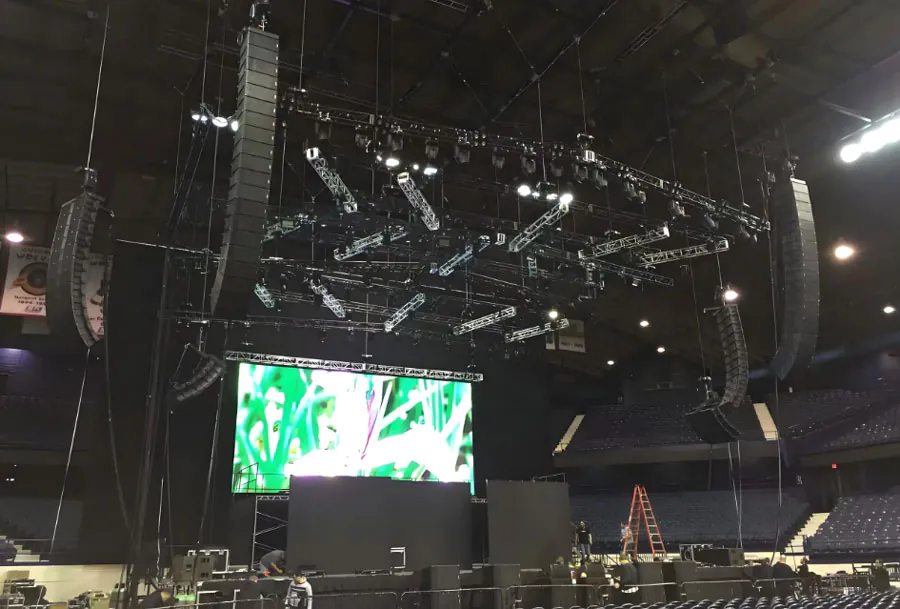
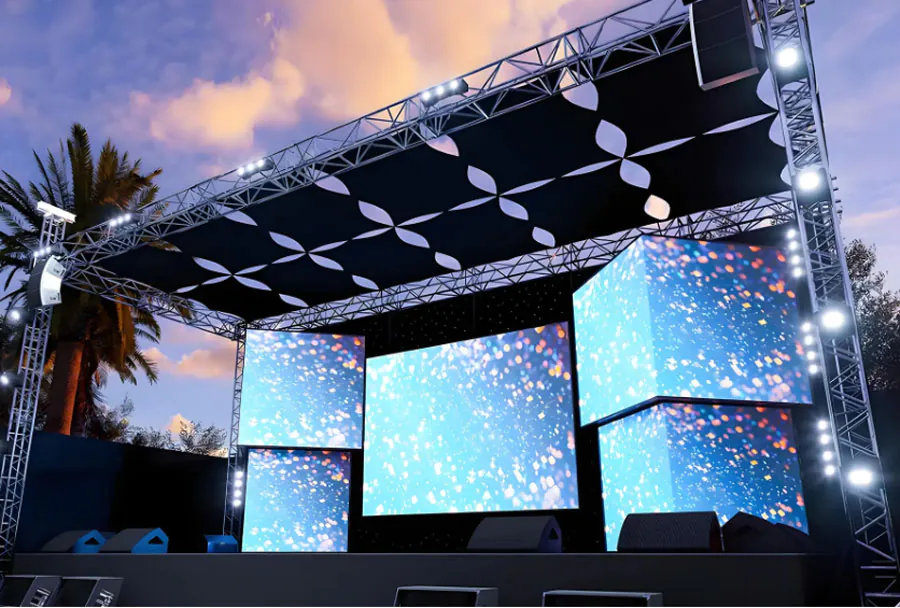
– Event Staging: Live video, dynamic sponsor rotations, and real-time social displays at concerts and festivals.
– Retail Promotions: Window displays, pop-up events, or parking-lot activations that drive store traffic and instant purchases.
– Transit and Street Advertising: High-visibility placements at bus hubs, train stations, and high-footfall intersections.
– Sports and Live Broadcasting: Scoreboards, instant replays, and fan-facing content within stadiums and fan zones.

– Product Launches and Experiential Marketing: Immersive brand experiences combining LED visuals, AR/VR enhancements, and interactive touchpoints.
– Wayfinding and Public Safety Messaging: Temporary, highly-visible public information during marathons, parades, or construction detours.
Comparison Analysis Table
| Use Case | Recommended Pixel Pitch | Typical Size Range | Brightness (Nits) | Primary Consideration |
|---|---|---|---|---|
| Large Outdoor Concerts | P6–P10 | 200–1,000+ sq ft | 6,000–8,000+ | Visibility from long distances, live video |
| Street-Level Retail/Window | P3–P6 | 20–200 sq ft | 3,000–6,000 | Close-range clarity, color fidelity |
| Transit Hubs & Street Billboards | P8–P16 | 100–600 sq ft | 5,000–8,000 | Legibility at speed, durability |
| Sports Fan Zones / Replays | P6–P10 | 300–1,200 sq ft | 6,000–10,000 | Refresh rate, broadcast compatibility |
| Pop-up Activations / Small Events | P3–P8 | 10–100 sq ft | 3,000–6,000 | Mobility, fast setup |
Cost Drivers and Pricing Models
Rental pricing varies widely based on screen size, pixel pitch, brightness, duration, location, and included services. Typical pricing models include:
– Daily/Weekly/Monthly Rates: Screen size and spec determine base daily rate. Weekly and monthly discounts often apply.
– Package Pricing: Bundles include installation, technical crew, transport, and power; attractive for events.
– Add-ons: Content creation, live-feed integration, structural engineering, permit handling, and insurance are add-ons.
– Delivery and logistics: Remote or urban locations can significantly change transportation and labor costs.
– Seasonal demand: Peak seasons (summer festivals, holidays) can increase rates and deposit requirements.
Example cost factors:
– Small 10–20 sq ft rental (P6) for a weekend: lower-cost option suitable for pop-ups and small activations.
– Medium 100–300 sq ft wall (P8) for a week: mid-range price; includes crew and basic transport.
– Large stage screens 500+ sq ft (P6) for multi-day festivals: premium pricing due to engineering, power, and rigging complexity.
Measuring ROI and Effectiveness
To justify rental spend, marketers should define KPIs before the campaign:
– Impressions and Reach: Estimate viewers using footfall or traffic data. Combine sensor analytics or third-party audience measurement where available.
– Engagement Metrics: Scan QR codes, short URLs, or unique promo codes displayed on the LED screen to measure conversions.
– Dwell Time and Social Uplift: Use sensors or event data to measure time spent near the screen, and monitor social mentions and user-generated content.
– Sales Attribution: Track uplift in sales in the timeframe and geography of the activation—use A/B tests if possible.
– Brand Lift Studies: Use quick surveys or mobile intercepts to measure recall and favorability pre- and post-activation.
Plan for baseline measurement: capture historical footfall or sales data to compare after activation.
Logistics, Permitting, and Safety
Outdoor LED rentals often require complex logistics:
– Site Survey: Conduct a site survey to confirm power access, load-bearing surfaces, anchor points, and clear sightlines.
– Permits and Approvals: Local municipalities may require permits for temporary structures, sound, illumination levels, and advertising content. Begin the permitting process early—some approvals can take weeks.
– Structural Safety: For rooftop or side-of-building installs, structural engineering and ballast calculations may be required. Crowd safety is critical for ground-level displays.
– Electrical and Power: Determine whether the site has adequate power or requires generators. Ensure cabling meets local codes and is protected from pedestrian traffic.
– Insurance: Liability and equipment insurance are often required by venue or local authorities.
– Cable Management & Weather Plans: Waterproof connectors, cable ramps, and contingency plans for high winds or storms are essential.
– Crew and Timing: Plan installation windows to minimize disruption; nighttime installs reduce traffic interference but may require lighting for crew safety.

Content Strategy for Outdoor LED Campaigns
Outdoor LED content must be optimized for distance, brevity, and legibility:
– Short and Bold Messaging: Keep text minimal and readable from the intended distance. Use strong contrasts and large typefaces.
– High-Impact Visuals: Use high-contrast, well-graded video and images that remain legible in bright sunlight.
– Dayparting: Schedule content variations for morning, daytime, evening, and night to optimize brightness and relevance.
– Motion & Pacing: Motion attracts attention but avoid rapid cuts that reduce message comprehension. Consider 8–12 second loops for key messages.
– Calls to Action: Include immediate CTAs (QR codes, promo codes) that are easy to act on from the screen’s viewing distance.
– Accessibility: Use color-blind-friendly palettes and sufficient contrast for legibility.
– Live Content: Live feeds, user-generated social walls, or event cameras increase immediacy but require real-time moderation and bandwidth.
Vendor Selection and Questions to Ask
Choosing the right rental vendor is crucial. Ask potential providers:
– What is the screen’s pixel pitch, brightness, refresh rate, and IP rating?
– Can you provide recent case studies and references for similar campaigns?
– What’s included in the rental rate (setup, crew, transport, permits)?
– What are lead times for booking and delivery?
– Do you provide a site survey and structural engineering if needed?
– How are power and generator needs handled?
– What redundancy and technical support are available on-site?
– Is there content playback hardware/software? Can you update content remotely?
– What insurance coverage do you carry and what is required from us?
– What is your cancellation and weather policy?
Maintenance, Support, and Troubleshooting
Rentals should include support terms. Key support items:
– On-site technical crew during events for immediate troubleshooting.
– Remote monitoring to detect brightness, color balance, or module failures.
– Spare panels and power modules for quick replacement.
– Clear escalation process and SLAs for response times.
– Post-installation health checks to confirm image alignment and color calibration.
Common issues:
– Flicker or refresh artifacts: often due to low refresh rates or camera incompatibility.
– Color balance shifts: may require recalibration or PID tuning.
– Weather-related failures: ensure IP-rated components and protective housings.
– Power spikes and grounding issues: use surge protection and proper grounding.
Case Studies and Real-World Examples
– Music Festival Activation: A national beverage brand rented multiple P6 LED walls for a multi-stage festival. The screens displayed synchronized brand visuals, product shots, and social media walls. Measured results showed a 35% uplift in onsite sampling and a 20% increase in social mentions during the weekend.
– Retail Launch Pop-Up: A fashion brand rented a P4 storefront wall to stream runway footage and product spotlights. Immediate footfall increased by 28% during the launch week, and a unique discount code shown only on the screen drove trackable online conversions.
– Transit Hub Campaign: A fintech company used P10 LED panels at a busy transit hub. Dynamic dayparting aligned messages with commuter moods—informational content in the morning, promotional in the evening—resulting in measurable app downloads correlating with the campaign period.
Checklist for a Successful Rental Campaign
– Define objectives and KPIs up front (reach, engagement, sales).
– Choose pixel pitch and brightness to match viewing distance and daylight conditions.
– Book the vendor early and request a site survey.
– Confirm what’s included in the quote: rigging, crew, transport, permits.
– Prepare content specifically designed for outdoor LED (legible, high-contrast, short loops).
– Obtain necessary permits and insurance.
– Plan power provisioning and backup.
– Schedule test runs and on-site checks before live dates.
– Ensure on-site technical support and contingency spares are in place.
– Capture baseline metrics for post-campaign analysis.
Future Outlook
The future of outdoor LED rental for advertising and marketing looks strong. Advances in pixel density, energy efficiency, and modular, quick-deploy systems will make rented LED displays more attractive and easier to deploy. Integration with programmatic OOH buying platforms, AI-driven content optimization, and enhanced measurement tools will enable smarter, more accountable campaigns. Sustainability considerations, including lower-power LEDs and recyclable panels, will become more prominent in vendor selection.

Outdoor LED screen rental offers marketers a powerful, flexible tool for high-impact advertising and experiential campaigns. When planned correctly—with attention to technical specifications, site logistics, content strategy, and measurement—rentals deliver significant reach and measurable business outcomes without the long-term financial commitment of purchase. By partnering with experienced rental providers, securing the necessary permits, and tailoring content to the viewing environment, brands can maximize ROI and create memorable public experiences.