Full Service Led Screen Rental Columbus With Installation And Support

The demand for high-quality LED screen rental services in Columbus has never been higher. Whether you are producing a corporate conference, a music festival, a community event, or a drive-in movie night, a full service LED screen rental with professional installation and ongoing support can make the difference between an event that dazzles and one that disappoints. This guide explains what “full service” means in practice, breaks down technical and logistical considerations, analyzes cost and value, and provides a practical checklist to help event planners, AV managers, and venues in Columbus select the right partner.
What “Full Service” Really Means
Full service LED screen rental encompasses more than simply dropping off a display. The hallmark of a full-service provider is end-to-end responsibility: consulting and design, equipment provisioning, on-site installation, content management, real-time technical support during the event, teardown, and post-event follow-up. In Columbus, a mature full-service provider will also assist with local permitting, venue coordination, and power or rigging assessments specific to Ohio building codes and weather patterns.
Key elements:
– Pre-event consultation and site survey
– Design of LED layout and content mapping
– Delivery, installation, and certified rigging
– On-site technician(s) and remote monitoring
– Redundancy planning and backup systems
– Teardown, transport, and equipment inspection
Why Hire a Full Service Provider in Columbus?
Hiring a full service provider reduces your operational risk and simplifies logistics. Local companies know Columbus venues, common load-in routes, parking constraints, and vendor requirements. They also offer expertise in:
– Weatherproofing and wind-load considerations for outdoor screens
– Power distribution for large LED arrays
– Compliance with venue insurance and safety policies
– Emergency contingency plans (backup processors, spare modules)
Beyond technicalities, full service providers bring production experience: they help size the screen correctly for viewing distance, ensure content looks crisp by matching pixel pitch to venue scale, and provide a crew experienced with live-event troubleshooting.
Technical Considerations: Choosing the Right LED Screen
Selecting the right LED screen depends on venue type (indoor vs. outdoor), viewing distance, ambient light, resolution needs, and budget. Important technical specs include:
– Pixel pitch: Defines image clarity at specific viewing distances. Smaller pixel pitch (e.g., 1.9–2.9mm) is ideal for indoor corporate events or close audiences. Larger pitch (4–10mm+) suits outdoor stages and long-distance viewing.
– Brightness (nits): Outdoor screens need high brightness (5,000–7,000 nits) to compete with daylight. Indoor screens typically range 800–2,500 nits.
– Refresh rate: Higher refresh rates (≥3,840 Hz) reduce flicker on camera, which is critical if your event will be live-streamed or recorded.
– Weatherproofing: IP65+ ratings are standard for outdoor use to survive rain and dust.
– Modular design: Ease of repair during events comes from modular panels that can be swapped quickly.
– Control system and processors: Ensure compatibility with content types (4K sources, multiple inputs) and redundancy for mission-critical events.
Typical Use Cases in Columbus
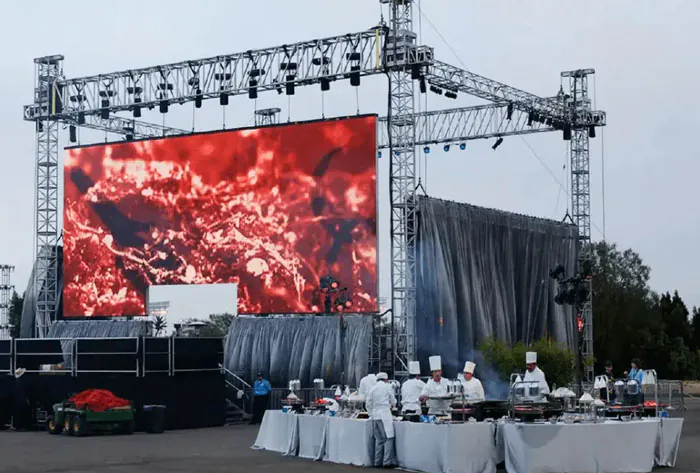
– Concerts and festivals: Large outdoor LED walls for stage backdrops and video playback.
– Corporate events and trade shows: High-resolution indoor screens for presentations, video, and branding.
– Sporting events and arenas: Scoreboards and perimeter displays requiring high refresh rates.
– Weddings and private events: Intimate LED walls for photo/video playback and live feeds.
– Drive-in cinemas and community screenings: Large-format outdoor screens optimized for night-time viewing.
– Political events and rallies: Durable outdoor setups that handle long hours and variable weather.
Installation Process: What to Expect
A professional installation follows a structured workflow:
1. Site survey: The provider assesses sight lines, rigging points, power availability, and any structural limitations.
2. System design: Engineers design the screen layout, power distribution, and signal routing.
3. Permitting and approvals: The provider coordinates permits, traffic control, and venue insurance requirements when needed.

4. Delivery and rigging: Skilled technicians deliver and rig the LED modules using certified hardware.
5. Calibration and content mapping: The system is color-calibrated and content mapped to ensure seamless visuals.
6. Sound and integration: Integration with audio and lighting systems is tested for synchronization.
7. Rehearsal and support: Technicians remain on-site (or on-call) during rehearsals and the live event for real-time support.
8. De-rig and return: After the event, equipment is dismantled, inspected, and transported back.
Support and Maintenance: Real-Time Reliability
Support is the defining feature of full service. Expect:
– On-site technicians during load-in, rehearsals, and showtime
– Remote monitoring of screen health and performance
– Spare panels, power supplies, and processors staged for rapid replacement
– Preventive maintenance prior to an event: firmware updates, module testing
– Post-event diagnostics and a damage report
Providers often offer service-level agreements (SLAs) that stipulate response times and uptime guarantees. For critical events, consider a provider that offers redundant processors, dual power feeds, and networked monitoring systems.
Cost Structure and Pricing Models
LED screen rental pricing varies based on screen size, pixel pitch, event duration, installation complexity, and support level. Typical pricing models:
– Per day/per square foot rental: Common for short events. Price increases for premium pixel pitches and outdoor-rated panels.
– Project-based flat fee: Includes consultation, installation, tech labor, and teardown — useful for predictable total pricing.
– Long-term rental discounts: For multi-day or multi-week installations.
– Add-ons: Transportation, rigging labor, permits, and content services may be billed separately.
While sticker price matters, total value is determined by a provider’s ability to minimize downtime and deliver a seamless audience experience.
Analysis Table: Service Components and Recommendations
| Service Component | Description | Typical Cost Range (Columbus) | Typical Timeline | Recommended For |
|---|---|---|---|---|
| Consultation & Site Survey | On-site assessment, sightline analysis, power and rigging check | $150–$800 | 1–3 days before booking; 1–2 hrs on-site | Large venues, outdoor events, complex installs |
| Screen Rental (Indoor, fine pitch) | High-resolution modules for close viewing distances | $1,200–$3,500/day (per 100 sq ft) | Delivery same day; setup 4–12 hrs | Conferences, trade shows, corporate events |
| Screen Rental (Outdoor) | Weatherproof panels with high brightness and larger pitch | $1,500–$6,000/day (per 100 sq ft) | Setup 8–24 hrs; requires rigging crew | Concerts, festivals, sports, drive-ins |
| Installation & Rigging | Certified rigging, structural supports, safety equipment | $500–$5,000+ (project dependent) | 4–24 hrs depending on scale | Any elevated or large-screen setups |
| On-site Technical Support | Technicians for load-in, rehearsals, and showtime | $40–$120/hr per tech; flat day rates available | On-call during event days | Live events, broadcasts, high-stakes productions |
| Content Management & Playback | Formatting, mapping, playback servers, video switching | $300–$1,500+ depending on complexity | 1–3 days prep; onsite testing | Corporate content, branded experiences, multi-source events |
| Logistics & Permits | Transport, insurance coordination, local permits | $200–$2,000+ depending on requirements | 1–4 weeks for permit processing | Outdoor public events, street-facing installs |
Case Study Snapshot: Columbus Festival Setup
Scenario: A weekend music festival in Columbus needs a 25 ft x 14 ft outdoor LED screen for stage backdrops plus two side screens. The organizer wants guaranteed uptime, live camera feed integration, and content playback for artists.

Provider approach:
– Pre-event site survey to identify rigging points and wind-load mitigation.
– Design of three-screen array with modular panels at 6mm pixel pitch and 6,500 nits brightness.
– Dual power feeds and redundant video processors for failover.
– On-site crew: 6 riggers plus 3 technicians for the event days and rehearsals.
– Real-time monitoring with spare modules staged on-site.
Outcome: Smooth load-in, uninterrupted live broadcast feeds, and seamless showtime operation. The redundancy plan eliminated downtime even when a single video processor experienced a fault mid-performance.
Checklist: Choosing a Full Service LED Rental Partner
– Local experience: Has the vendor worked at your venue or similar Columbus sites?
– Technical capacity: Do they stock the pixel pitch and brightness you need?
– Safety and certifications: Are riggers and electricians certified? Do they carry proper insurance?
– Redundancy and spares: Do they bring spare modules, processors, and power supplies?
– SLAs and support: What response times and guarantees are in writing?
– Reviews and references: Ask for recent Columbus references or case studies.
– Permitting assistance: Will they handle permits and coordinate with local authorities?
– Clear invoicing: Ensure quotes separate labor, equipment, transport, and permits.
Common Pitfalls and How Full Service Solves Them
– Wrong screen size or pixel pitch: Full service vendors perform sightline analysis to avoid screens that are too small or too detailed for the viewing distance.
– Power shortfalls: Providers run load calculations and bring distribution gear.
– Weather surprises: Outdoor vendors plan for wind loads, tarps, and quick de-rig options.
– Content mismatch: Providers handle mapping and format conversion so your graphics look correct on the LED canvas.
– Staffing gaps: On-site techs ensure swift fixes rather than shipping parts mid-event.
Environmental and Regulatory Considerations in Columbus
Columbus has specific municipal rules and venue policies that affect outdoor events: noise ordinances, temporary structure permits, and traffic control requirements. A full service rental provider will have familiarity with local permitting authorities and can manage inspection schedules. Additionally, consider environmental controls: temperature extremes and precipitation can affect LED performance, so discuss protective enclosures and heating/cooling provisions for longer installations.
Making the Decision: Value Over Price
When selecting a full service LED screen rental in Columbus, prioritize reliability and support. A lower upfront price may lead to higher operational risk and unexpected costs if problems occur during your event. Evaluate vendors on:
– Proven track record with similar events in Columbus
– Technical competence and inventory depth
– Transparency in quoting (what’s included vs. excluded)
– Responsiveness in planning and emergencies
Ask vendors for a written run-of-show plan that outlines roles, equipment lists, contingency measures, and contact numbers for on-site leads.
Final Recommendations
– Book early: High-demand seasons (summer concert series, sports playoffs) fill weeks in advance.
– Confirm power and rigging availability with the venue before finalizing plans.
– Opt for redundancy on mission-critical events: dual signal paths, spare modules, and on-site backup gear.
– Request a site-specific quote rather than a generic per-square-foot price.
– Ask for a rehearsal window to test camera feeds, switching, and content playback.
A true full service LED provider in Columbus combines deep technical expertise with local knowledge and a commitment to proactive support. Investing in that level of service will protect the visual integrity of your event, reduce stress, and let you focus on delivering a memorable experience for your audience.